Could Iran shut down global oil supplies? Understanding the Strait of Hormuz threat


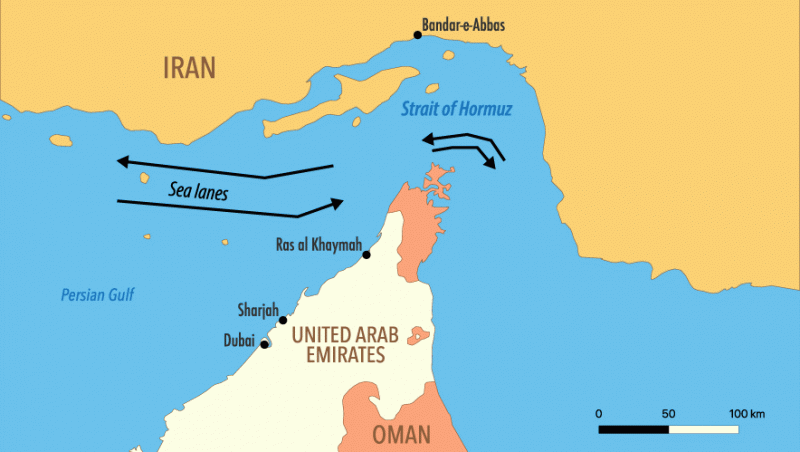
Strait of Hormuz has suddenly become one of the most closely watched waterways on the planet.
Following the sharp escalation in tensions between Iran, Israel and the United States in June 2026, global markets have been gripped by a single question: what happens if Iran tries to disrupt shipping through the Strait of Hormuz, News.az reports.
The concern is not theoretical. Iranian lawmakers have repeatedly discussed possible restrictions on maritime traffic, military commanders have warned that all options remain on the table, and international shipping companies have increased their security measures as the conflict in the region intensifies.
For the world economy, few places matter more than this narrow stretch of water.
What is the Strait of Hormuz?
The Strait of Hormuz is a narrow waterway connecting the Persian Gulf with the Gulf of Oman and the Arabian Sea.
Although only a few dozen kilometers wide at its narrowest point, it serves as the main export route for oil and gas produced by several of the world's largest energy exporters.
Countries that rely heavily on the strait include:
-
Saudi Arabia
-
Iraq
-
Kuwait
-
Qatar
-
United Arab Emirates
-
Iran
Every day, thousands of vessels pass through the waterway, including some of the world's largest oil tankers and LNG carriers.
Why is the Strait of Hormuz so important?
The strait is often described as the world's most important energy chokepoint.
Roughly one out of every five barrels of oil traded globally moves through Hormuz.
Large volumes of liquefied natural gas, particularly from Qatar, also transit the route.
If traffic is disrupted, the consequences extend far beyond the Middle East.
Fuel prices, airline tickets, electricity costs, manufacturing expenses and food prices can all be affected.
That is why even rumors of disruptions often trigger immediate reactions in global financial markets.
Why are concerns growing now?
The latest concerns stem from the rapidly escalating confrontation involving Iran, Israel and the United States.
Recent military exchanges have heightened fears that Iran could respond by targeting shipping lanes or threatening to close the strait.
Insurance premiums for vessels operating in the Gulf have already risen, while shipping companies are closely monitoring security developments.
Oil markets have also become increasingly volatile as traders attempt to assess the risk of supply disruptions.
Could Iran really close the Strait of Hormuz?
Iran has the ability to seriously disrupt shipping, but a complete and long lasting closure would be extremely difficult.
Iran possesses a range of military capabilities that could threaten maritime traffic.
These include:
-
Anti ship missiles
-
Naval mines
-
Drones
-
Fast attack boats
-
Coastal missile batteries
-
Naval special forces
Even limited attacks or mine deployments could force shipping companies to temporarily halt operations while security assessments are conducted.
However, completely sealing the strait for months would likely trigger a major international military response.
Has Iran threatened closure before?
Yes.
The threat of closing Hormuz has appeared repeatedly during periods of heightened tension.
Iranian officials have raised the possibility during disputes over sanctions, military confrontations and regional conflicts.
Yet despite decades of threats, the strait has never been completely closed.
Even during periods of intense conflict, oil exports generally continued, although often under increased risk.
What happened during the Tanker War?
One of the closest historical comparisons comes from the Iran-Iraq War in the 1980s.
Both sides attacked oil tankers in what became known as the Tanker War.
Hundreds of vessels were damaged or attacked.
Despite the violence, shipping through the Gulf never stopped entirely.
Instead, insurance costs surged, naval escorts became necessary and global markets experienced heightened uncertainty.
The episode demonstrated both the vulnerability and resilience of global energy trade.
Could oil prices soar?
Yes.
Oil prices react quickly to threats involving Hormuz because traders understand how critical the route is.
Even a temporary disruption lasting days could cause prices to spike sharply.
A prolonged crisis could potentially push oil prices well above current levels.
Higher oil prices would affect:
-
Petrol and diesel
-
Airline fuel
-
Shipping costs
-
Manufacturing
-
Agriculture
-
Consumer goods
The impact would eventually reach households around the world.
Could petrol prices rise immediately?
In many countries, yes.
Fuel markets often respond to expectations rather than actual shortages.
If traders believe supplies may be disrupted, oil prices can rise before any physical interruption occurs.
Consumers may therefore notice higher fuel prices within days of a major escalation.
Which countries would be hit hardest?
China
China is one of the largest importers of Gulf oil.
A significant share of its energy imports passes through Hormuz.
Any disruption could increase costs for Chinese industry and consumers.
India
India relies heavily on Middle Eastern energy supplies and would be particularly vulnerable to shipping disruptions.
Japan and South Korea
Both countries import large quantities of oil and LNG from Gulf producers.
European countries
Europe could face challenges particularly related to LNG supplies from Qatar, which has become increasingly important since the continent sought alternatives to Russian energy.
Would the United States suffer?
The United States is less dependent on Gulf oil than it was decades ago thanks to domestic production.
However, America would still be affected.
Oil is traded on a global market.
If prices rise internationally, American consumers and businesses also feel the consequences.
Higher fuel costs could contribute to inflation and economic uncertainty.
What would happen to global inflation?
A major Hormuz disruption could quickly become an inflationary shock.
Energy influences nearly every sector of the economy.
Higher fuel prices increase transportation costs.
Higher transportation costs increase the price of goods.
Food prices often rise because farming, processing and distribution depend heavily on fuel.
This chain reaction could complicate economic policy for governments and central banks around the world.
Are there alternative routes?
Some alternatives exist, but they are limited.
Saudi Arabia operates pipelines that can transport some oil to ports outside the Gulf.
The United Arab Emirates also has infrastructure that bypasses part of the Hormuz route.
However, these alternatives cannot fully replace the enormous volumes normally shipped through the strait.
Most Gulf exports still depend on Hormuz.
Could the world simply replace Gulf oil?
Not quickly.
Other major producers such as the United States, Canada, Brazil and Norway could increase output over time.
However, replacing millions of barrels per day of disrupted Gulf exports would be challenging in the short term.
Strategic petroleum reserves could help cushion the impact, but they are designed to provide temporary relief rather than a permanent solution.
Would natural gas markets also be affected?
Absolutely.
Qatar is one of the world's largest LNG exporters.
A large share of global LNG trade passes through the Strait of Hormuz.
Countries in Asia and Europe that rely on LNG imports could face supply concerns and rising prices.
This would affect electricity generation, industrial production and household energy costs.
Could shipping companies stop using the route?
If risks become too high, some companies may temporarily suspend operations.
This has happened during previous periods of heightened tension.
However, because there is no practical maritime alternative for many Gulf producers, prolonged avoidance of the route would be difficult.
Eventually, governments and shipping firms would likely seek ways to maintain traffic under enhanced security arrangements.
Would Iran also suffer from a closure?
Yes.
This is one of the strongest arguments against a long term shutdown.
Iran's own exports rely heavily on the Gulf.
Closing the strait would reduce Iranian oil revenues and place additional pressure on its economy.
The disruption would therefore hurt Iran as well as its rivals.
What is the worst case scenario?
The worst case scenario would involve:
-
Prolonged military confrontation
-
Attacks on major energy infrastructure
-
Widespread disruption of tanker traffic
-
Significant reductions in oil exports
-
Sharp increases in energy prices
Under such circumstances, the world could experience a major energy shock similar to previous oil crises that triggered economic slowdowns and inflation spikes.
What is the most likely scenario?
Most security and energy analysts believe a complete closure remains unlikely.
A more probable scenario would involve temporary disruptions, increased security risks, higher shipping costs and periods of market volatility.
Even without a total shutdown, these factors alone could significantly affect energy prices.
That is why markets pay close attention to every development involving the Strait of Hormuz.
What is the key takeaway?
Iran may not be able to permanently shut down global oil supplies, but it does not need to completely close the Strait of Hormuz to create serious economic consequences. Even limited disruptions, military threats or attacks on shipping can push oil and gas prices higher, unsettle financial markets and increase inflation around the world.
The recent escalation between Iran, Israel and the United States has reminded governments, businesses and consumers of a reality that has existed for decades: a narrow stretch of water in the Middle East remains one of the most important arteries of the global economy. If that artery is blocked, even briefly, the effects can be felt from petrol stations in Europe and Asia to factories, airlines and households across the globe.
By Faig Mahmudov


Similar news