Did Russia offer Iran record volumes of gas with a 75% discount?


By Asif Aydinli
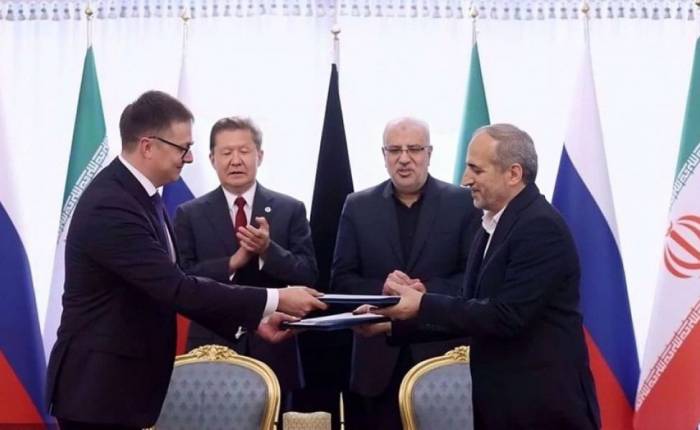
Russia is considering the possibility of signing a long-term contract with Iran for the supply of pipeline gas, announced Javad Owji, the Minister of Energy of the Islamic Republic.
For comparison, the price of gas for Europe and Turkey—Gazprom's main export markets—averages $400 per thousand cubic meters, which, according to BCS estimates, represents a 75% discount. In China, which buys gas via the Power of Siberia pipeline at $260 per thousand cubic meters, the price for Iran will be 62% lower.
Thus, the price for Iran is actually comparable to the price paid by CIS countries—around $100 per thousand cubic meters. If the supply volumes match the stated amounts, Tehran would become Russia's largest gas client.
In an interview with News.Az, Igor Yushkov, a leading analyst at the National Energy Security Fund and an expert at the Financial University under the Government of the Russian Federation , stated: "The Iranian side's announcement about Russia's plans to supply up to 100 billion cubic meters of gas per year seems fantastic. Iran, having the second-largest gas reserves in the world after Russia, practically fully provides itself with this resource. In the past, Iran bought gas from Turkmenistan due to an underdeveloped gas transportation system, but later built its own pipelines and stopped importing. In this regard, it is unclear why Iran needs another 100 billion cubic meters of gas from Russia.
Domestic gas consumption in Iran will not increase to such an extent as to justify such large supplies. Even if we consider swap deliveries, for example, when Russia supplies gas to northern Iran and Iranian gas goes to Gazprom for supplies to Pakistan or India, it also does not make sense. The 'Peace Pipeline' project for supplies to Pakistan and India is not yet ready. And again, Afghanistan is self-sufficient in gas, and it is unclear why it would need swap supplies".
Yushkov also doubts the economic feasibility of constructing the Trans-Caspian gas pipeline, which would require significant investments estimated at over $10 billion: "At current gas prices of $100 per 1,000 cubic meters, the project will not pay off. Building a pipeline through the Caspian Sea would require laying several strands of pipe, which also complicates the task.
The project will face environmental and political obstacles. Previously, Russia and Iran blocked the construction of a pipeline through the Caspian Sea from Turkmenistan to Europe, citing the need to preserve the Caspian Sea's ecological balance. To implement the new project, approval from all Caspian countries would be required, posing a significant hurdle".
Yushkov believes that the current information is most likely part of an informational campaign aimed at demonstrating to potential buyers, such as China, the availability of numerous markets for Russian gas:
"In reality, the construction of a pipeline from Russia to Iran in such volumes is unlikely. Therefore, plans to supply huge volumes of gas to Iran seem unrealistic and are most likely pursuing political rather than economic goals".
Oil and gas expert Mikhail Krutikhin believes that seriously discussing a deal with Iran, which involves the construction of a multi-strand pipeline along the bottom of the Caspian Sea, makes no sense, calling it "fairy tales." In his opinion, Iranian gas is unnecessary for Russia in such volumes, as the country itself has significant gas reserves, estimated at 34 trillion cubic meters, or 17% of the world's reserves. Moreover, the re-export of Russian gas is unlikely: Iran is under sanctions and cannot launch liquefied natural gas (LNG) projects, and its legislation prohibits the transit of hydrocarbons through its territory.


Similar news