Germany loses UN Security Council bid, diplomatic setback for Merz


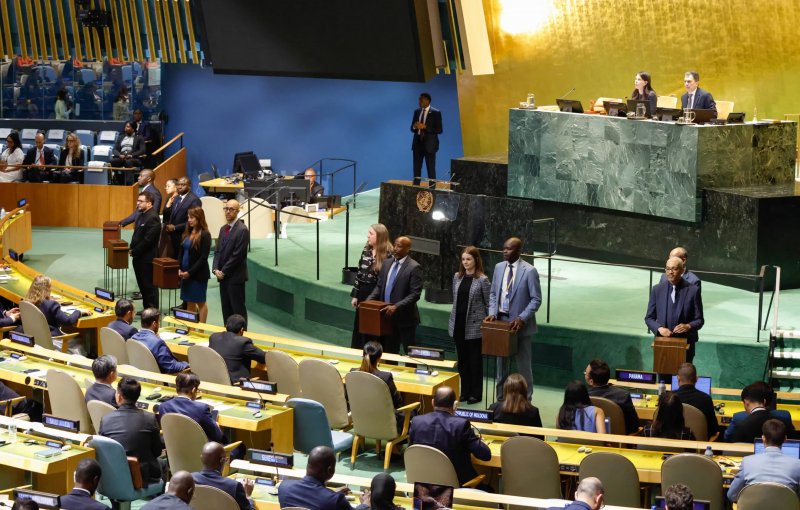
Chancellor Friedrich Merz faced a major setback Wednesday when the United Nations General Assembly bypassed Germany, granting non-permanent Security Council seats to Portugal and Austria instead.
German Foreign Minister Johann Wadephul attributed the “bitter defeat” in part to Berlin’s support for Israel, which he suggested cost his country key U.N. votes. He added that the outcome would not prevent Germany from continuing “to stand by our historical responsibility” to Israel, News.Az reports, citing Politico.
RECOMMENDED STORIES
Wadephul also accused the Kremlin of agitating against Berlin for its “unwavering support” of Ukraine by maneuvering to block it from the U.N.’s most powerful body. “It’s no secret that Russia doesn’t want such a voice at the Security Council table and has also stirred up sentiment against us,” he said.
Germany’s defeat not only represents a diplomatic setback, but it is also likely to fuel domestic criticism of an already-unpopular and politically weakened Merz, particularly because the chancellor ran for the office on a promise to restore his country’s leadership role within Europe.
Germany has, for decades, managed to win one of the non-permanent Security Council seats allocated to Western Europe every eight years. Ahead of the vote, Wadephul led an aggressive lobbying campaign, personally pressing his case to some 80 ministers or ambassadors around the world. But U.N. delegates ultimately favored Portugal and Austria, nations that the foreign minister appeared to dismiss as “smaller” European countries earlier this week.
The vote also marks the latest in a string of diplomatic victories for Lisbon, which has capitalized on its status as a neutral interlocutor between Europe and its former colonies in Africa, Asia and South America to consolidate itself as a major player on the global stage. Former prime ministers António Guterres and António Costa now respectively lead the U.N. and the European Council.
Austria’s successful quest for a seat on the Security Council similarly involved embracing its neutrality, which is constitutionally mandated. The country touted its lack of NATO membership in a bid to win over African, Asian and Latin American countries unhappy with Washington’s moves on the global stage.
In a video message posted on X after the results were announced, Austrian Chancellor Christian Stocker said the world’s problems could not be solved through “dominance” and that his country would fight to defend multilateralism.
“It is not the right of the strongest that must prevail, but the strength of the law,” added Stocker. “A country’s value is not determined by its size, military power or economic strength: What matters is the equality of all states.”
Merz’s domestic political opponents were quick to attack the chancellor for Germany’s loss.
Alice Weidel, co-leader of the far-right Alternative for Germany (AfD) party, said the defeat was an “embarrassment” that underscored the chancellor’s failure to restore the country’s international standing.
“While Merz wanted to bring our country ‘back onto the international stage’ at the beginning of his chancellorship, Germany now remains without a seat on the UN Security Council,” she wrote on X.
Even members of the center-left Social Democratic Party (SPD), which governs in coalition with Merz’s conservatives, characterized the defeat as a debacle.
Adis Ahmetovic, foreign policy spokesman for the SPD’s parliamentary group, depicted the vote as “a gauge of how [Germany] is perceived internationally.”
The results, he added, were “not a mere mishap, but a warning sign.”
By Ulviyya Salmanli


Similar news