How the "Great Return" program is changing the lives of thousands


By Tural Heybatov
The "Great Return" program is one of Azerbaijan's largest infrastructure projects aimed at restoring and developing the territories that came back under Azerbaijan's control after the Second Karabakh War. The main goal of the program is to ensure the safe and sustainable return of internally displaced persons to their native lands, create favorable conditions for living and working, and develop social and economic infrastructure.The "Great Return" program involves extensive work to restore the infrastructure destroyed during the prolonged conflict. Azerbaijan is investing significant resources in the restoration and construction of new roads, bridges, and transport interchanges to ensure the regions are accessible. In this context, over 700 km of roads have already been restored, and several strategically important bridges have been built, connecting key areas of Karabakh and East Zangazur with the rest of the country. These transport arteries not only facilitate the movement of people and goods but also contribute to the region's economic integration.
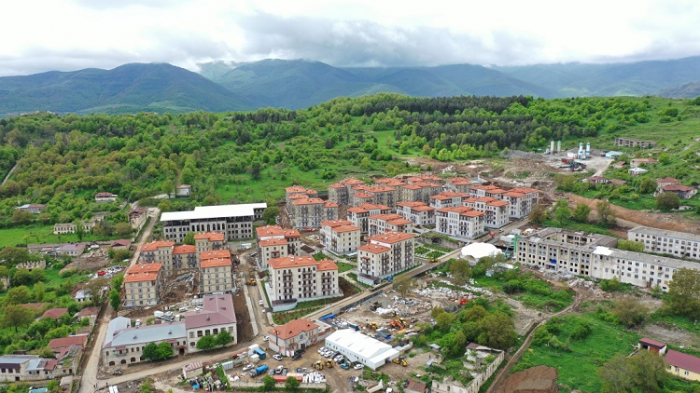
Housing construction is also a priority of the program. The project plans to build modern housing complexes that can provide returning families with comfortable and safe living conditions. To date, several thousand new houses and apartments have already been built, equipped with everything necessary for comfortable living. These new residential areas include children's playgrounds, recreation areas, parks, and public spaces, aimed at creating sustainable and thriving communities.
Social infrastructure includes the construction of schools, kindergartens, medical facilities, and cultural centers. This is essential for creating a full-fledged social environment that will support the integration of returning citizens. Several new schools and hospitals have already been opened in Karabakh and East Zangazur, providing high-quality educational and medical services. These facilities are equipped with modern equipment and staffed by qualified professionals, ensuring high service standards.
Utility services play a crucial role in creating comfortable living conditions. Ensuring regions have electricity, water supply, gasification, and sewage systems is a priority task. The restoration of utility infrastructure not only improves the population's quality of life but also stimulates economic activity. As a result, more than 90% of the settlements are now supplied with electricity and water. Additionally, new treatment facilities and drainage systems are being constructed to ensure the region's environmental safety.
The economic development of the regions is also an important part of the program. Supporting the agro-industrial complex, creating agro-parks, and developing farms contribute to the revival of agriculture and food security. In this context, more than 30 agro-parks have been created, providing jobs and promoting local economic development. The creation of industrial zones and the construction of industrial parks attract investments in production and processing, contributing to job creation and local economic growth. The development of tourist infrastructure attracts tourists to the region's historical and natural attractions, further boosting economic growth. New hotels, restaurants, and tourist centers are opening in the region, creating additional jobs and attracting investments.
Social support and integration of returning citizens include organizing educational programs, professional training, and retraining courses, helping people adapt to new conditions and find work. Social programs aimed at ensuring social protection, employment assistance, and integration into local communities play an important role in creating a sustainable society. The preservation and popularization of cultural heritage, support for local traditions and customs contribute to cultural revival and the strengthening of national identity. An essential part of the program is also holding cultural events and festivals that strengthen bonds between people and revive national culture.
The "Great Return" program includes active international cooperation. Azerbaijan collaborates with international organizations and partner countries to attract investments, share experiences, and implement joint projects. This international cooperation plays a significant role in the program's successful implementation and achievement of its goals. Support from international organizations and participation in global initiatives help attract additional resources and technologies for the region's development.
To date, about a thousand people in Azerbaijan have been resettled in Karabakh and East Zangazur as part of the "Great Return" program. This information was announced during a meeting of the Board of the State Committee for Refugees and Internally Displaced Persons of Azerbaijan, dedicated to the results of the first six months of this year and the upcoming tasks. "To date, 217 families, 934 people, have been resettled to their native lands within the framework of the 'Great Return'," the committee's press release stated. As previously reported, the President of Azerbaijan, Ilham Aliyev, approved the "First State Program of the Great Return to the liberated territories of Azerbaijan." The first program is designed for 2022-2026. It is planned that by 2026, 10,270 families will be resettled in Karabakh and East Zangazur, and by 2027 - 34,500 families. In these regions, 34,500 apartments and individual houses will be built. By this time, the military infrastructure in Karabakh and East Zangazur will be strengthened, and energy, transport, sports, social, and other infrastructure will be built there. By 2026, 197 preschool and general educational institutions will be built and restored, and by 2027, a university branch and seven branches of DOST centers will start functioning in the region.
The "Great Return" program in Karabakh and East Zangazur is a symbol of restoration and new life for thousands of people affected by the conflict. It is not only about rebuilding what was destroyed but also about creating a new, thriving region that will become a model of sustainable development and integration. Azerbaijan demonstrates that with the right approach and support, it is possible to achieve significant results in restoring territories and improving people's lives.
The "Great Return" program holds immense significance not only for Azerbaijan but for the entire region. It symbolizes hope for peace and prosperity, showing that even after prolonged conflicts, revival and development are possible. The return of internally displaced persons to their native lands is not just a matter of infrastructure and economy. It is the restoration of justice, the rekindling of lost connections, and the revival of cultural traditions. The program serves as an example of how a government can successfully integrate international standards and best practices into national policy, creating a foundation for sustainable development and stability. The successful implementation of the "Great Return" program can become a model for other countries facing the consequences of conflicts, demonstrating that with proper management and international support, any challenges can be overcome.
The article themed "the Great Return to the liberated Azerbaijani territories" was published with the support of the Media Development Agency of the Republic of Azerbaijan (MEDIA).


Similar news