India and South Korea target $50 billion trade goal with major focus on shipbuilding


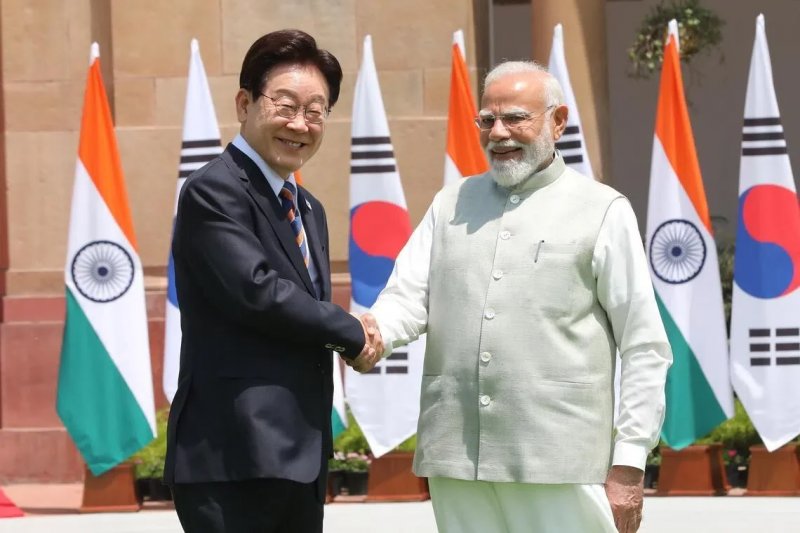
India and South Korea have embarked on a transformative new chapter in their bilateral relations, with Prime Minister Narendra Modi and President Lee Jae-myung pledging to nearly double bilateral trade to $50 billion by 2030.
During high-level talks held in New Delhi on April 20, 2026, the two leaders emphasized a "futuristic partnership" designed to insulate both economies from global volatility, News.Az reports, citing Straits Times.
A central pillar of this engagement is a massive deepening of ties in the shipbuilding sector, where South Korea’s world-leading precision engineering and LNG tanker technology will be integrated into India’s "Make in India" maritime initiatives.
RECOMMENDED STORIES
The shipbuilding collaboration is expected to involve significant technology transfers, with South Korean industrial giants assisting Indian shipyards in the construction of large-scale commercial vessels and specialized LNG carriers. This partnership aligns with India’s Maritime India Vision 2030, which seeks to transform the country into a top-ten global shipbuilding power. By leveraging South Korea's efficient production systems and India's vast labor pool and manufacturing capacity, both nations aim to create a resilient maritime supply chain that can withstand the geopolitical disruptions currently affecting trade routes in the Middle East and the Indo-Pacific.
Beyond the maritime domain, the two countries have agreed to fast-track negotiations to upgrade their Comprehensive Economic Partnership Agreement (CEPA) within the next year. This upgrade will focus on critical technologies, including semiconductors, artificial intelligence, and clean energy. The leaders also announced the launch of an India-Korea Financial Forum to facilitate smoother investment flows and an Economic Security Dialogue to coordinate on supply chain resilience.
As India-Korea looks to diversify its trade away from traditional partners and India seeks to cement its position as a global manufacturing hub, this "chips to ships" strategy represents a significant strategic realignment for the two Asian powers.
The summit also addressed immediate economic needs, with South Korea requesting an increase in naphtha supplies from India to cushion against potential energy shortages linked to ongoing regional tensions.
Prime Minister Modi highlighted that the "DNA" of both nations—rooted in market economies and democratic values—provides a stable foundation for this expanded cooperation. As President Lee continues his diplomatic tour toward Vietnam, the agreements signed in New Delhi serve as a roadmap for a more integrated Asian economy, proving that in a world of increasing uncertainty, strategic and technological synergy remains the most reliable path to mutual growth.
By Leyla Şirinova


Similar news