Why violence, disease and displacement are worsening in Sudan's Darfur and Kordofan regions


Sudan's humanitarian crisis has entered a dangerous new phase as intercommunal violence, renewed warfare and a suspected cholera outbreak converge across the western regions of Darfur and Kordofan.
The worsening situation is creating additional challenges for millions of civilians already affected by more than three years of conflict, mass displacement and economic collapse, News.az reports.
Humanitarian agencies warn that escalating insecurity is disrupting aid operations, increasing civilian casualties and raising fears that disease outbreaks could spread rapidly during the upcoming rainy season.
What is happening in Darfur and Kordofan?
Several areas of western Sudan have witnessed a sharp escalation in violence involving armed groups, local communities and forces linked to the broader conflict that has engulfed the country since 2023.
Recent clashes in Central Darfur and South Darfur have reportedly caused civilian casualties and forced families to flee their homes. Some displaced residents have crossed into neighboring Chad in search of safety, adding to the growing regional refugee crisis.
At the same time, fighting has intensified across parts of North Kordofan and West Kordofan, where attacks, drone strikes and armed confrontations have further destabilized already vulnerable communities.
The violence is occurring alongside Sudan's broader civil war, making it increasingly difficult to distinguish between local disputes and wider military confrontations.
Why are Darfur and Kordofan particularly vulnerable?
Darfur and Kordofan have experienced decades of instability, ethnic tensions, armed conflict and underdevelopment.
Darfur became internationally known in the early 2000s due to a devastating conflict that led to hundreds of thousands of deaths and the displacement of millions of people. Although international peace efforts reduced some of the violence, many underlying grievances remained unresolved.
Kordofan has similarly struggled with insecurity, political marginalization and competition over land and resources.
The current conflict has reignited many old tensions while creating new pressures on communities already suffering from poverty, food insecurity and weak public services.
How serious is the cholera outbreak?
Health authorities and humanitarian organizations are increasingly concerned about a suspected cholera outbreak in West Kordofan.
More than 300 suspected cases and dozens of deaths have reportedly been recorded in recent weeks. Aid agencies warn that the real number could be significantly higher because insecurity limits access to affected communities and hampers disease surveillance efforts.
The outbreak comes only months after authorities announced the end of a nationwide cholera emergency that had infected more than 124,000 people and caused thousands of deaths.
The reappearance of suspected cholera cases highlights the fragility of Sudan's public health system and the continuing risk of large-scale disease outbreaks.
Why does the rainy season increase the danger?
The rainy season traditionally creates favorable conditions for the spread of cholera and other waterborne diseases.
Flooding can contaminate water sources, damage sanitation facilities and increase human exposure to polluted water. In conflict zones, damaged infrastructure often makes the situation even worse.
Many communities in Darfur and Kordofan already struggle to access safe drinking water. Attacks on water systems, electricity networks and transportation routes further reduce the ability of local authorities and aid organizations to provide essential services.
As a result, humanitarian officials fear that disease transmission could accelerate significantly over the coming months.
How is the violence affecting humanitarian operations?
The deteriorating security environment is severely restricting humanitarian access.
Aid agencies have been forced to suspend some operations in areas affected by active fighting. Thousands of civilians who depend on humanitarian assistance for food, healthcare and clean water are facing growing uncertainty.
Humanitarian workers often encounter roadblocks, security threats and logistical difficulties when attempting to reach vulnerable populations.
In some areas, warehouses, medical facilities and aid distribution centers have become inaccessible because of ongoing clashes.
The suspension of humanitarian activities increases the risk of hunger, disease and further displacement.
How many people have been displaced?
The latest fighting has triggered new waves of displacement across multiple regions.
In North Kordofan, clashes reportedly forced numerous families to leave their homes. International migration agencies estimate that thousands of people have been newly displaced in recent days alone.
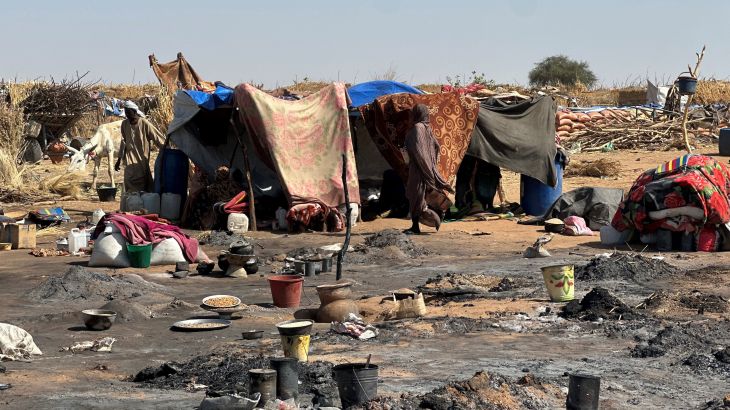
Many displaced families seek shelter in overcrowded camps or informal settlements where access to food, water and healthcare is limited.
Others attempt to reach neighboring countries, particularly Chad and South Sudan, placing additional pressure on already strained refugee support systems.
The displacement crisis is occurring within a broader national emergency that has already uprooted millions of Sudanese since the conflict began.
What role are drone attacks playing in the conflict?
Reports from Darfur and Kordofan indicate that drone strikes are becoming an increasingly visible feature of the conflict.
Recent attacks reportedly killed and injured civilians in several locations, including populated towns and villages.
The growing use of drones reflects the changing nature of Sudan's conflict, where modern military technologies are increasingly being deployed alongside conventional ground operations.
Humanitarian organizations warn that attacks in civilian areas can cause significant casualties and further undermine efforts to deliver aid and maintain essential services.
Why is the international community concerned?
International organizations fear that Sudan is facing one of the world's most severe humanitarian emergencies.
The combination of armed conflict, disease outbreaks, displacement, food insecurity and economic collapse presents an extraordinarily complex challenge.
Humanitarian agencies have repeatedly warned that the crisis risks being overshadowed by other global conflicts despite its enormous human toll.
The situation is particularly alarming because multiple crises are occurring simultaneously and reinforcing one another.
Violence disrupts healthcare systems. Disease outbreaks weaken vulnerable communities. Displacement increases humanitarian needs. Limited funding restricts relief efforts.
Together, these factors create a cycle that becomes increasingly difficult to break.
How severe is Sudan's overall humanitarian crisis?
Sudan is currently experiencing one of the largest humanitarian crises in the world.
Millions of people require emergency assistance, while large portions of the population face food insecurity and limited access to healthcare.
Entire communities have been displaced multiple times, and critical infrastructure has suffered extensive damage.
The conflict has also devastated economic activity, making it harder for families to afford basic necessities.
Humanitarian agencies continue to warn that conditions could deteriorate further if fighting intensifies or disease outbreaks spread more widely.
What are humanitarian organizations calling for?
Aid agencies are urging all parties involved in the conflict to protect civilians and civilian infrastructure, including hospitals, water facilities and humanitarian assets.
They are also calling for unrestricted humanitarian access to affected populations and greater international financial support.
Relief organizations stress that additional funding is urgently needed to sustain emergency operations, support displaced communities and strengthen disease response efforts.
Without increased assistance and improved security conditions, humanitarian officials warn that both Darfur and Kordofan could face an even deeper crisis in the months ahead.
What happens next?
The coming weeks will be critical for Sudan's western regions.
The progression of the rainy season, the trajectory of the cholera outbreak and the intensity of ongoing fighting will largely determine whether conditions stabilize or worsen.
If violence continues to escalate and humanitarian access remains restricted, aid agencies fear that civilian suffering could increase dramatically.
For now, Darfur and Kordofan remain at the center of a rapidly evolving crisis where conflict, disease and displacement are converging to create one of the most serious humanitarian emergencies in Africa.
By Faig Mahmudov


Similar news