New comet C/2024 E1 detected by ground-based telescopes on Earth approach


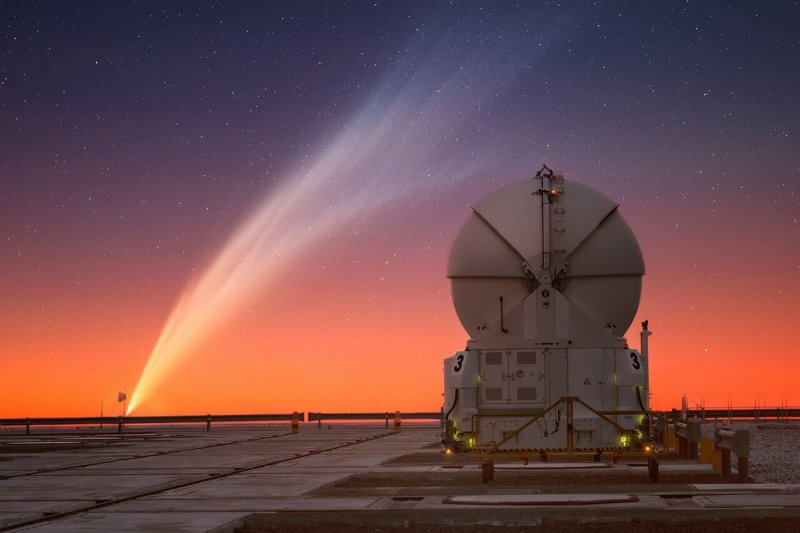
Astronomers have recently observed Comet C/2024 E1 during its approach toward the inner solar system using powerful ground-based telescopes.
This discovery has drawn interest from both professional researchers and skywatchers because comets are ancient remnants from the early formation of our solar system and can reveal information about conditions that existed billions of years ago, News.Az reports.
RECOMMENDED STORIES
- Nvidia CEO's foundation buys $108 million of AI computing from CoreWeave, donates it to researchers
- Scientists in France conduct zero-gravity experiments during parabolic flights - VIDEO
- Astronomers discover "Loki": The scattered remains of a lost ancient galaxy
- Giant hidden structure mapped behind the milky way's "dead zone"
Comet C/2024 E1 was first detected earlier this year by survey telescopes designed to spot new or faint objects moving through space. These telescopes continuously scan the sky to find asteroids, comets, and other transient phenomena. When an object moves against the background of stars from night to night, astronomers can calculate its orbit and determine whether it is approaching Earth or on a different path.
Based on these initial observations, Comet C/2024 E1 has a long, elongated orbit typical of many comets. Such orbits originate in distant regions of the solar system, often the Oort Cloud – a spherical shell of icy bodies located far beyond the orbit of Neptune. Gravitational interactions with passing stars or other objects can nudge these icy bodies inward, sending them on a long journey toward the Sun and occasionally close to Earth.
The naming convention for comets includes the year of discovery, a letter representing the half-month when it was found, and a number indicating the order of discovery in that period. In this case, 2024 E1 means it was the first comet discovered in the fifth half-month of the year. Once an object is confirmed as a comet, additional observations refine its orbit and physical characteristics.
What Makes Comet C/2024 E1 Noteworthy
Comet C/2024 E1 stands out for several reasons. First, the fact that it has been detected well before its closest approach allows astronomers to track its motion over time and improve predictions of its trajectory. Accurate orbital data is essential for estimating when and how close the comet will come to Earth, as well as for planning scientific observations.
Second, early observations show that the comet is active. When a comet approaches the Sun, heat causes volatile ices such as water, carbon dioxide, and methane to sublimate – turning directly from solid to gas. This process releases dust and gas that form a glowing coma around the nucleus and sometimes a visible tail pushed outward by solar radiation and the solar wind. The brightness and structure of the coma and tail can vary widely among comets depending on their size, composition, and distance from the Sun when first observed.
Third, because C/2024 E1 is on a long, elongated orbit, it may originate from a region of the solar system that has experienced little change over billions of years. That makes it a valuable target for researchers seeking to understand the early chemistry of our solar system. Comets contain pristine materials that have been preserved in the cold depths of space, and their composition can offer clues about the mix of elements and organic compounds present when planets were forming.
How Astronomers Observe Approaching Comets
Ground-based telescopes with sensitive cameras and spectrographs are the primary tools for observing comets like C/2024 E1. Optical telescopes capture visible light from the comet’s coma and tail, allowing astronomers to measure brightness, size, and motion. Spectroscopy – the analysis of light at different wavelengths – reveals the chemical composition of the gas and dust released from the nucleus.
Observatories in both hemispheres participate in comet tracking because an object’s visibility changes as the Earth rotates and as the comet moves along its path. Astronomers coordinate observations and share data through professional networks so that all available information can be combined to refine orbital calculations.
In addition to professional surveys, advanced amateur astronomers also contribute to comet observations. With high-quality telescopes and cameras, amateur observers can record images of bright comets, measure positions, and report changes that assist professionals in monitoring the object over time.
Space-based observatories also play a role in comet studies. Telescopes above Earth’s atmosphere can observe wavelengths that are absorbed by the atmosphere, such as ultraviolet and infrared, providing complementary data about the comet’s composition and activity.
What We Know About C/2024 E1 So Far
Initial observations indicate that Comet C/2024 E1 has a diffuse coma – the cloud of gas and dust surrounding its nucleus – and may develop a tail as it nears the Sun. Tail formation depends on how much volatile material is released as the comet warms and on the strength of solar radiation pushing the dust outward.
Astronomers have tracked the object’s motion and determined preliminary orbital elements, which describe the shape and orientation of the comet’s path around the Sun. Based on these data, the comet’s trajectory takes it inward from the outer solar system toward a point relatively close to Earth’s orbit. The exact distance of closest approach will be refined as more observations are collected.
Because comets are often unpredictable in how they brighten or fade, scientists are cautious about forecasting how visible C/2024 E1 will be to the unaided eye or small telescopes. Some comets remain faint and visible only through long-exposure photography, while rare comets become prominent in the night sky and can be seen without optical aid.
In Summary
Comet C/2024 E1 is a newly observed comet making its way toward the inner solar system, attracting attention from scientists and skywatchers alike. Observations with telescopes on Earth are tracking its approach, refining its orbit, and measuring its activity. As the comet gets closer, both the scientific community and the public will follow its progress, seeking to learn more about this intriguing visitor from the depths of space.
By Faig Mahmudov


Similar news