Pashinyan favoured, but Armenia’s real test comes after the vote


.jpg)

Editor's note: Nataly Aleksanyan is a prominent Armenian journalist. The article expresses the author’s personal opinion and may not coincide with the view of News.Az.
Armenia’s parliamentary elections, scheduled for June 7, 2026, carry particular significance not only for the country’s domestic political development, but also for the future configuration of the South Caucasus. Their outcome may determine Yerevan’s foreign policy and economic course for years to come, while also influencing Armenia’s role in the emerging system of regional communications.
These elections are especially important because the South Caucasus is becoming one of Eurasia’s key transit and connectivity hubs. Major transport and logistics routes linking Europe and Asia already pass through the region, while new ones are being developed. Against the backdrop of the growing importance of the Middle Corridor, new railway and road projects, and continuing discussions on the reopening of regional communications, Armenia’s political choice is acquiring much broader significance.
The election results may therefore affect not only the country’s internal political order, but also the strategic architecture of Eurasian transport links. Much will depend on whether the next Armenian government chooses to participate in new integration and connectivity projects or whether the country remains on the sidelines of major regional developments.
At the same time, it would be an oversimplification to describe the upcoming elections solely as a geopolitical referendum in which Armenian voters are being asked to choose between Russia and the West. The main logic of the current government’s policy lies not so much in moving from one geopolitical bloc to another, but in attempting to strengthen Armenia’s sovereignty by expanding its foreign policy and economic options.

Source: trendsresearch
This is essentially a pragmatic model under which the state engages with different centres of power on the basis of its own interests. Europe may be regarded in this context as an important economic and political partner. However, the question of Armenia’s full integration into the European Union remains complex and multilayered. It concerns not only trade, investment and reforms, but also the extent to which Yerevan would be able to preserve its foreign policy independence while deepening relations with European institutions.
The central issue is therefore not the traditional confrontation between East and West, but whether Armenia will be able to preserve and expand its sovereignty. A sovereign state should build relations with external partners on the basis of national interests and pragmatic calculation, rather than under the influence of ideological slogans or pressure from a particular geopolitical centre.
I assess the chances of the ruling Civil Contract party and Prime Minister Nikol Pashinyan securing victory as relatively high. Although the media environment often presents a contradictory picture and creates the impression that the current government’s position has weakened considerably, a significant level of public support for the authorities remains.
At the same time, Armenian society continues to display a strong negative attitude towards the former political elites who were removed from power following the events of 2018. Many citizens still do not see representatives of the old system as a credible alternative to the current government.
The opposition has so far failed to produce a convincing and coherent programme capable of uniting a majority of voters. Its criticism of Pashinyan is often centred on the past, the Karabakh issue and accusations that the government has abandoned Armenia’s traditional foreign policy course. Yet criticism alone is not enough to win public confidence. Voters need to be offered a clear model for the future, a viable economic programme and a realistic vision of Armenia’s place in a rapidly changing region.
Under these circumstances, the most likely scenario remains that Civil Contract will retain its dominant position in parliament. However, even a victory for the ruling party would not mean that Armenia will avoid serious challenges after the elections.
The main risks are likely to be economic. Should the current government remain in power, a further deterioration in relations with Russia cannot be ruled out. In Moscow, Yerevan’s policies may be interpreted as a shift towards closer cooperation with Europe and the broader West. In theory, this could lead to stronger political and economic pressure on Armenia.
Such a scenario would pose a serious threat to the country because a significant part of the Armenian economy remains closely connected to Russia. This includes trade, energy, logistics, financial flows and several strategic infrastructure sectors. Russian influence also remains substantial in sensitive areas such as energy and telecommunications.
A sharp decline in relations with Moscow could create major economic difficulties for Yerevan, particularly if Armenia’s new partners prove unable to compensate quickly for potential losses. This is where the central question surrounding the government’s foreign policy diversification emerges.
In recent years, Armenia has signed a number of strategic partnership agreements with various countries. Yet the true significance of these documents will be determined not by statements or diplomatic language, but by their practical content.
Will these new partners be able to become genuine guarantors of Armenia’s economic, energy and political stability in the event of a serious crisis? Are they prepared to support the country not only through public declarations, but also by providing investment, access to new markets, energy resources, infrastructure projects and security mechanisms?
The answers to these questions will become the main test of the effectiveness of Armenia’s new foreign policy model. Strategic agreements are judged not by ceremonial declarations, but by the ability of partners to provide meaningful support in times of crisis.
Source: atlanticcouncil
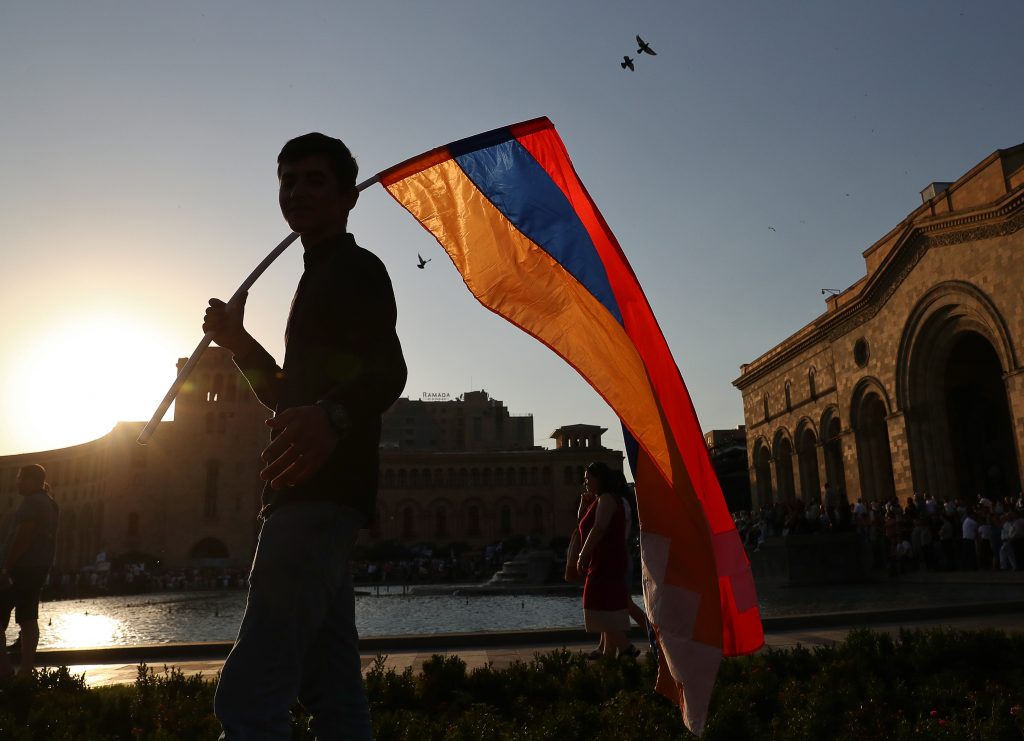
The Karabakh issue remains one of the central themes of the election campaign. Opposition forces accuse Pashinyan’s government of losing Karabakh and abandoning Armenia’s traditional foreign policy course. The issue continues to be widely used in the political struggle and retains a strong emotional influence over Armenian society.
It is important, however, to understand that for decades the Karabakh issue was not only historical and humanitarian in nature, but also geopolitical. Under the previous regional configuration, it effectively served as one of the factors through which external influence was exercised and a particular balance of power was maintained in the South Caucasus.
The disappearance of the Karabakh factor objectively changes the entire architecture of regional influence. If the line of conflict and territorial claims disappear, the logic behind the presence of external actors in the region also changes. The need for former mediation formats, military deployments and conflict-management mechanisms diminishes.
This is why the Karabakh issue is viewed not only as a matter of Armenia’s domestic politics, but also as an instrument of geopolitical influence and competition. Various political forces are attempting to use it to mobilise society, strengthen their own positions and preserve the previous model of regional relations.
At the same time, a new approach to the country’s future is gradually emerging within Armenian society, based on a comparison between the past and present-day realities. A significant part of the population understands that a return to confrontational policies could lead to new wars, further loss of life, economic isolation and the weakening of Armenian statehood.
Therefore, despite the opposition’s active use of the Karabakh issue, the public response remains mixed. Many voters support Prime Minister Pashinyan’s peace agenda, under which a return to the former Karabakh policy is no longer seen as a realistic prospect.
The revival of territorial claims against Azerbaijan would inevitably create conditions for reciprocal claims against Armenia itself. This is an obvious risk that must be taken into account when assessing the consequences of political statements and election rhetoric.
The June 7 elections will therefore be more than another vote for political parties and individual candidates. They will represent a choice between continuing the difficult process of adapting to a new regional reality and attempting to return to the policies of the past, which have already demonstrated their failure.
A likely victory for Pashinyan and Civil Contract would allow the government to continue its peace agenda, diversify Armenia’s external relations and seek a new place for the country within the regional system. At the same time, however, the authorities would have to prove that their chosen course can deliver not only political declarations about sovereignty, but also genuine economic resilience, security and participation in major transport and connectivity projects.
The government’s ability to transform foreign policy diversification into tangible economic results will become the main criterion by which Armenia’s leadership is judged after June 7.
(If you possess specialized knowledge and wish to contribute, please reach out to us at opinions@news.az).


Similar news