The Big Four: Why the Foreign Ministers of Azerbaijan, Georgia, Iran and Turkey first met in Baku


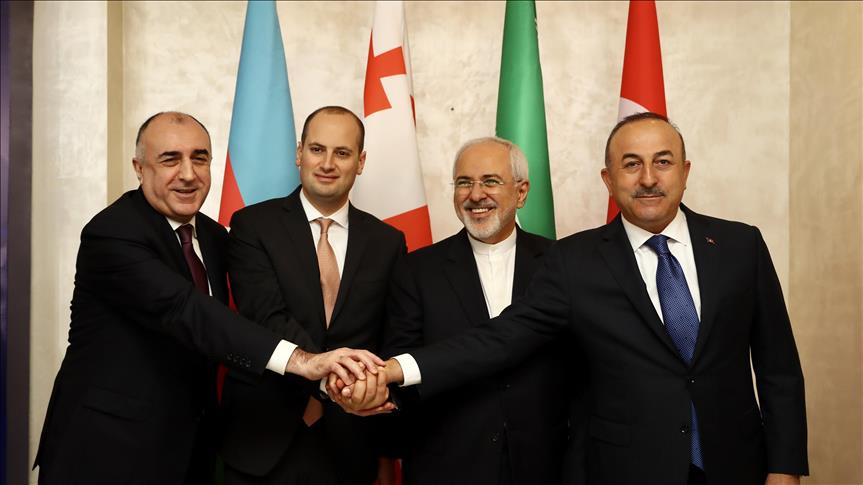
News.Az reprints from Bakinsky Rabochiy an article titled "The Big Four: Why the Foreign Ministers of Azerbaijan, Georgia, Iran and Turkey first met in Baku" by Firuza Bagirova.
Located at the crossroads of the main energy and transport routes, Azerbaijan today is the axis of modern and promising communication corridors in the Eurasian space. The effectiveness and safety of these routes attracting all new states to it, Azerbaijan delineates the wide formats of transregional and transnational cooperation and increasingly takes responsibility for the formation of new parameters of the multilateral relations system.
New format
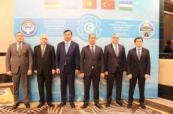
Having held an unprecedented quadripartite meeting of the Foreign Ministers of Azerbaijan, Georgia, Iran and Turkey in Baku on March 15, the country has become even stronger in the status of the chief architect of strategic regional cooperation. The first meeting in this format outlined the main components of the solidarity and cooperation of these countries, based on partnership, good-neighborliness, mutual respect and trust, as reflected in the Baku Declaration, which was signed by the Foreign Ministers of Azerbaijan Elmar Mammadyarov, Georgia - Michael Janelidze, Iran - Mohammad Javad Zarif and Turkey - Mevlut Cavusoglu.
Declaring their commitment to the norms and principles of the UN Charter, the ministers emphasized common interests in strengthening regional peace and stability and in this context declared their commitment to respect for the sovereignty, territorial integrity and inviolability of internationally recognized borders, as well as to the principle of international law as the solution of all conflicts in the region in peaceful way. The ministers agreed to study and expand quadrilateral cooperation in all possible areas with a view to ensuring the well-being of the peoples of the four countries. The parties agreed to use the existing potential to encourage investment and trade, implementing projects and programs in the fields of energy, transport, banking, telecommunications, industry, agriculture, tourism and the environment. They stressed the importance of measures to increase the transit potential of the four countries occupying a geographically advantageous position in international transit corridors, with the aim of integrating the national transport infrastructure into the international transport infrastructure.
The Foreign Ministers noted the importance of developing the transport infrastructure and strengthening cooperation to increase the transit potential of the four countries located on the route "South West", starting from the Iranian ports Chabahar and Bandar Abbas in the Persian Gulf, via the railway of Rasht-Astara with accession to the railway Baku - Tbilisi - Kars.
The parties stressed the importance of strengthening cooperation to achieve high potential in the field of civil aviation and to receive large dividends from geographical advantages. The ministers expressed their desire to strengthen commercial cooperation in the oil and gas and petrochemical sectors, agreed on the exchange of information and experience between the banking networks of the four countries in the fight against money laundering and the financing of terrorism.
The Foreign Ministers stressed the importance of cooperation within global and regional economic organizations, noted the importance of strengthening cooperation to reduce cases and prevent pollution of the environment in order to achieve the Sustainable Development Goals 2015-2030 adopted by the UN in 2015. The participants of the meeting supported the candidacy of Baku for the World Exhibition EXPO 2025, taking into account the fact that the Azerbaijani capital is a candidate for hosting annual meetings of the World Bank Group and the Board of the International Monetary Fund. The ministers expressed their strong support for the fight against all manifestations of terrorism, extremism and separatism, transnational organized crime, illicit trafficking in narcotic drugs and their precursors, trafficking in arms, people, crimes against cultural and historical heritage, cybercrime and smuggling of migrants.
With the aim of expanding contacts between the peoples of the four countries, the foreign ministers stressed the importance of cooperation in the spheres of culture, education, health, youth exchange, tourism and sports, noted that their countries are ready to initiate projects and events in these areas. It was also stressed the importance of preparing an action plan for quadrilateral sectoral cooperation in areas of common interest. The holding of the first ministerial meeting in Baku once again demonstrated the exceptional attractiveness of the Azerbaijani capital as an authoritative platform for the organization of important international forums, which is due to the steadily growing authority of Azerbaijan in the world political arena. This is all the more evident given the authorship of Azerbaijan for the creation of various formats of cooperation, favorable prerequisites to which one of the main foreign policy priorities of our country - strengthening peace, stability, development, security not only in the South Caucasus region, but also on wider geography.
The strategic axis
In all these formats, it is extremely important for Azerbaijan to be a major player, without which it is impossible to implement large-scale projects and initiatives in the region, and this fully meets the interests - both of Azerbaijan and of neighboring countries with which our country has good-neighborly partnerships. In this regard, it will be appropriate to quote from the speech of President Ilham Aliyev at the recently held 6th Global Baku Forum titled "Elimination of Differences for the Creation of Inclusive Societies." Touching upon the first meeting of the foreign ministers of Azerbaijan, Iran, Georgia and Turkey in Baku, the Azerbaijani leader said: "Before that, we established tripartite cooperation formats - Azerbaijan - Turkey - Georgia, Azerbaijan - Iran - Turkey and Azerbaijan - Iran - Russia. All these formats serve stability and peace, as well as economic development. As I have already noted, our energy and transport projects serve the interests of our peoples. We can only succeed in this way. No matter how much money you invest, without good relations with neighbors, you can never become a transit country. Good-neighborly relations are important for any country."
Indeed, Baku has already implemented and continues to implement successful projects with Ankara and Tbilisi in the East-West direction, and with Iran - through the North-South route. In particular, we are talking about such important energy projects as the Baku-Tbilisi-Ceyhan and Baku-Tbilisi-Erzurum oil and gas pipelines, through which hydrocarbon resources of Azerbaijan are transported to international markets. In the energy sector, Azerbaijan is now working with partners to develop a mega-project "Southern Gas Corridor", unifying the seven states with prospects for further expansion of geography. And this is a very important contribution to the energy security of a huge geography - from our region to Europe. Another global project linking the East and the West is transport. The Baku-Tbilisi-Kars railway, which has not yet earned its full power, already attracts with its indisputable advantages new partners from Asia, Central Asia and Europe.
The same can be said about the North-South transit corridor, embodied in a huge railway network, which functioning will fully ensure the flow of cargo from European countries, Russia, the regions of Central Asia and the Caucasus towards the Persian Gulf and India, and will lead to intensification of trade relations between the Caspian states and the Black Sea ports.
This corridor will increase rail transport and, consequently, rail revenue, both from local and transit traffic between Europe, South Asia and the Middle East. Thus, Azerbaijan, expanding energy and transport networks from the East to the West and from the North to the South, takes on to a completely new and equally important geostrategic direction...
South-West
By combining the Persian Gulf, Iran, Azerbaijan, Georgia and Ukraine in transit , the South-West transport corridor significantly reduces the time of delivery of goods by rail from India to Europe. According to experts, this transport corridor delivers goods within 7 days against 35-37 days spent on alternative routes. Thus, the delivery of cargo through the Suez Canal takes up to 40 days, and the way that cargo currently passes from India to Europe through the territory of Russia is more than 1000 km longer. The territories through which the South-West route crosses have large human and economic resources. Thus, the annual flow of goods from India to the countries of Europe is 72 million tons of cargo, and from Europe in the opposite direction - 25 million tons per year. The main transhipment points on the route are Indian Mumbai (one of the world's top five ports), Iran's Bender Abbas (70 million tons of cargo per year), Astara (Azerbaijan and Iran), Georgian Poti and Batumi, Ukrainian Chernomorsk and Izov, and the final destination is Polish town of Slavkov. The total length of the corridor is 7654 kilometers. According to calculations, the term of delivery of goods on it (one way) will be 15 days.
As good neighbors
There are plenty of reasons for creating a new format for cooperation between Azerbaijan, Georgia, Iran and Turkey, and the main ones are the future of the region, stability, development and security, which is clearly reflected in the Declaration signed at the end of the first ministerial meeting in Baku. The development of ties within the framework of this format makes it possible to provide a painless exit of Iran from under international sanctions, and Azerbaijan, which supported the neighboring country, allocated a 500 million loan for the construction of the railroad of Resht-Astara, plays an important role in this case. Iran is also extremely interested in using the Baku-Tbilisi-Kars railway, which can provide it with an additional outlet to the Black Sea ports of Georgia and Turkey. In this regard, it would be useful to recall the endless and unsuccessful efforts of Armenia to offer its territory for leading of Iranian cargoes to the West, requesting investments for the construction of an appropriate infrastructure that Iran is not able to provide, weakened by sanctions, not to mention Armenia itself. If Armenia, being cut off from practically all communications that can provide it with access to the rest of the world, and surviving on pitiful handouts, can not even build an automobile road for which the big name of the real North-South corridor "borrowed".
But no matter how much you repeat the word "halva", it will not become sweet in your mouth.
"The Land of Death"
No wonder they say: "If you want to see the future - look back to the past." Armenia should have made an excursion into its past, recall the events of the new history, when, as usual, in December 1918, it provoked - on the basis of territorial claims, of course, the Armenian-Georgian war. Then, in response to Armenian claims, Georgia blocked any delivery of food to Armenia from the north and stated that Armenia is inviable. The railway, passing through Batumi, controlled by independent Georgia, was vital for Armenia as the only transport corridor linking it to Russia. Armenia received two-thirds of all food from Russia right from there. The deprivation of access to the vital transport artery led to massive famine in Armenia. According to eyewitnesses, the winter of 1918-1919 in Armenia was not just hungry - it was a nightmare. As soon as the first grass appeared on the slopes of the mountains and hills, weakened after a hungry winter, the people, crouching, slowly walked along the mountains, collecting grass, from which they then prepared a salad and ate. This prolonged their lives for several more hours. There were practically no cats and dogs left in Yerevan. They were eaten. " In addition, the epidemic of typhus was raging in the country during the whole winter.
According to the government, in January 1919, there were almost no families in Yerevan who escaped typhus. The corpses of the deceased were collected by hundreds from the streets of the city and buried in mass graves, often without even having the simplest funeral rites performed on them. The last Prime Minister of the Republic of Armenia Simon Vracyan (from November 25 to December 2, 1920) wrote that about 180,000 died by the summer. This was slightly less than 20% of the country's population. That is, almost every fifth. Historian Richard Hovhannisyan cites statistics: every 1,000 people in 1919 constituted to 8.7 births and 204.2 deaths. According to him, in 1918-1919 Armenia "became a country of death".
Unjustified territorial claims determined the sad past and hopeless present of Armenia. Its future depends on whether it will be able to draw the moral from its recent history and, abandoning its baseless ambitions and mythological illusions, to turn from a pariah into a full-fledged member of a regional family.
Instead of an afterword
Considering the success of the tried-and-tested trilateral formats Azerbaijan-Turkey-Georgia, Azerbaijan-Turkey-Russia, Azerbaijan-Turkey-Iran, Azerbaijan-Russia-Iran, Azerbaijan-Turkey-Turkmenistan, it is safe to say that this unique initiative proved itself and occupies a strategic place in regional and international politics in general, which also determines the broad prospects for quadrilateral cooperation between Azerbaijan, Georgia, Iran and Turkey. In the structure of these prospects, in addition to economic, there is a serious political component. It is, in particular, about security and the fight against terrorism. And the more effective this struggle, the more clearly it highlights the main threats to regional and international security. First of all, this is the Nagorno-Karabakh conflict. Azerbaijan, being committed to peaceful politics, is making serious efforts towards a peaceful resolution of the conflict, and welcomes the efforts of any states that would contribute to this and put an end to the status quo, which the world's leading states and international organizations declare unacceptable. The change in the status quo is based on the complete and immediate withdrawal by Armenia of its occupying forces from the occupied territories and in the return of Azerbaijani refugees and internally displaced persons to their native lands.
"This conflict is not only the greatest injustice in modern history, but also a source of constant threat and instability in our already not very stable region. Therefore, it is necessary to ensure the settlement of the conflict as soon as possible on the basis of the norms of international law, the resolutions of the UN Security Council, the Helsinki Final Act. After that, peace can be established in our region," Azerbaijani President Ilham Aliyev said.
News.Az


Similar news