USA: Aztec dancers brave rain at San Francisco’s Cesar Chavez festival - VIDEO


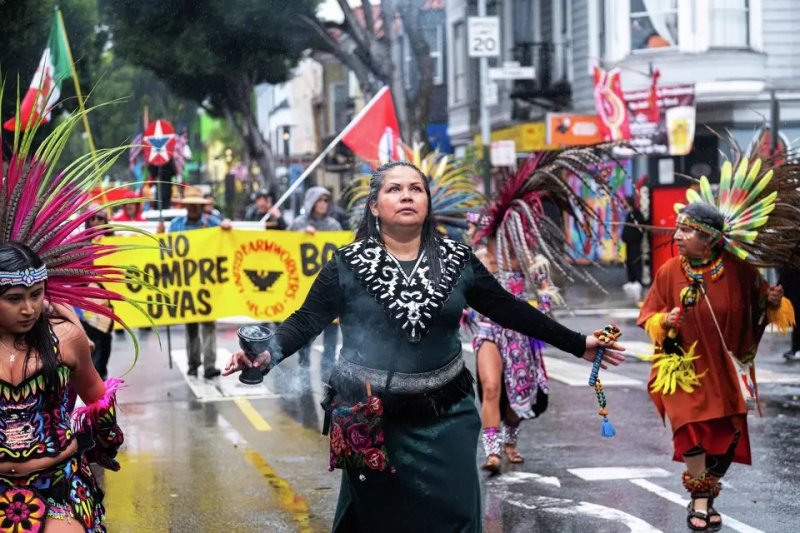
A downpour kept the crowds and bands away from San Francisco’s first Cesar Chavez-free Farmworkers Day celebration Saturday, but neither rain nor sexual assault allegations against the late labor leader could dampen the joy of the Aztec dancers who twirled through the streets of the Mission District as amazed onlookers held up their phones.
“It’s wonderful to see the dancing, even in the rain!” said Pia Bacascu, 23, raising her voice to be heard over the steady beat of the huehuetl, the drums that are the heartbeat of Aztec dancing, News.Az reports, citing Sfchronicle.
Labor unions and farmworker supporters have been celebrating in San Francisco with a parade and festival each spring since 2001, the year after California declared March 31 as Cesar Chavez Day, a paid state holiday.
RECOMMENDED STORIES
But last month, a New York Times investigation revealed shattering allegations that the late hero of the migrant labor movement molested and raped young women, including longtime colleague Dolores Huerta, co-founder of the United Farm Workers union, who turned 96 on Friday.
Gov. Gavin Newsom proclaimed April 10, 2026, Dolores Huerta Day. Last month, the governor also renamed March 31 Farmworkers Day, while similar efforts to scrub Chavez’s name from buildings and parks have advanced across California and the rest of the country.This year’s parade from Dolores Park to 24th and Bryant streets was to be the 25th annual Cesar Chavez & Dolores Huerta Day Festival. The name has been changed to Farmworkers Day Festivities, said its director, Eva Royale, who was stunned when the four bands scheduled for the main stage pulled out just days before the event due to the threat of rain.
Their costumes, evocative of ancient Mexico, left bare most arms and legs and the occasional chest. Yet no one stopped dancing when the skies opened up around 11:45 a.m. with a cold rain that continued for nearly an hour.
“It’s refreshing!” dancers Gigi Munoz and Sofia Aviles said in unison when asked what it was like to have to perform in the squall.
Aviles, a recent graduate of San Francisco’s High School of the Arts, called it “a gift.”
Although the dancers and drummers were the stars of Saturday’s show, the parade also featured trucks representing labor unions from throughout the Bay Area, some decorated with colorful paper flags called papeles picados.
Only about 50 or 60 people showed up to march, but the dedicated few included unions for electrical, glass, iron and farmworkers, many with their families.
One group of United Farm Workers carried a yellow banner from the earliest days of the movement: “No compre uvas!” it read. “Boycott grapes!”
This was the 1970s admonition that kept grapes off tables across the country for many years among supporters of better labor conditions for migrant farmworkers.
Armando Barbosa, 52, with the International Brotherhood of Electrical Workers Local 260, came up from San Jose with his family to ride a truck in the parade. Wearing blue shorts and a clear plastic poncho, he said he didn’t know what the truth was concerning the Chavez allegations.
“But it’s more important to continue moving forward to protect the labor movement and frontline workers” than to focus on any individuals, he said.
Larry Nelson, 74, an LGBTQ and senior rights activist in San Francisco, stood on the corner of 19th and Guerrero streets watching the dancers before the skies let loose. He carried a sign reading, “Thank you, Dolores!”
“I’m thanking her for speaking up,” he said of Huerta, who accused Chavez of raping her twice and spoke out for the first time about it to the Times. “Sometimes it takes a lifetime and it still doesn’t happen. I think this will ease her soul.”
Raymond Martinez, 63, was a 16-year-old mechanic for the United Farm Workers in 1976 when he marched beside Cesar Chavez from Richmond down to Salinas to support the labor movement.
On Saturday, he reached into his brown 1965 Chevy and pulled out an old United Farm Workers flag that Chavez had signed for him.
“He was a good organizer,” Martinez said, staring at the tattered cloth. “He was an ordinary man.”
By Leyla Şirinova


Similar news