What Google AI Plus is and what it offers


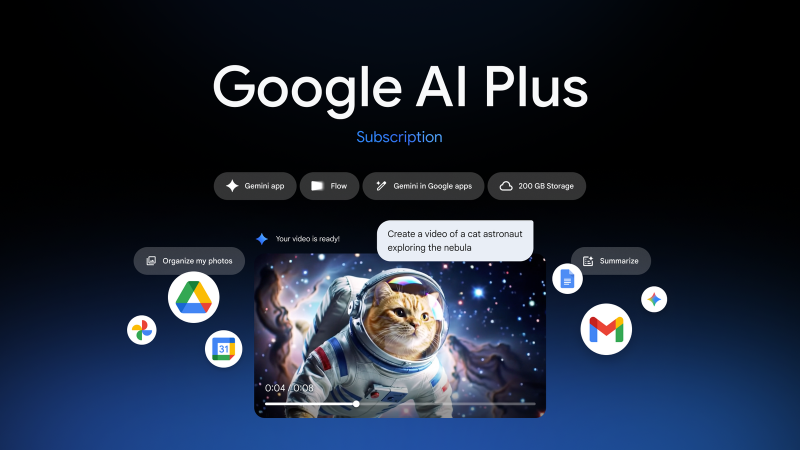
Google has launched AI Plus as a new paid tier designed to bring advanced artificial intelligence capabilities directly to everyday users, News.Az reports.
The move reflects a broader shift in how major technology companies package, price, and distribute AI tools, moving from experimental features toward structured subscription products. With AI Plus, Google is signaling that artificial intelligence is no longer a background enhancement, but a core consumer service with clear value, defined benefits, and a long term monetization strategy.
The launch comes at a moment when generative AI is becoming mainstream. Millions of users already rely on AI for writing, research, productivity, creativity, and daily problem solving. By introducing AI Plus, Google is positioning itself to capture this demand while shaping how users interact with its growing AI ecosystem.
What Google AI Plus is and what it offers
AI Plus is positioned as a premium subscription that provides access to more powerful AI features than those available in free tiers. While Google has steadily integrated AI across search, productivity tools, and mobile services, AI Plus creates a dedicated layer where users can unlock enhanced performance, priority access, and advanced functionality.
At its core, AI Plus is about capability and convenience. Users gain access to stronger AI models, faster responses, and expanded usage limits. This matters because as AI tools become more sophisticated, they also become more resource intensive. Subscriptions help manage demand while ensuring consistent quality for users who rely on AI frequently.
AI Plus also reflects a shift in expectations. Instead of AI being an occasional helper, Google is framing it as a daily assistant that supports work, learning, creativity, and organization. The subscription model formalizes that relationship.
Why Google is introducing a paid AI tier now
Timing is critical. The AI market has moved rapidly from novelty to necessity. Competing platforms have already introduced subscription models that gate advanced features behind monthly fees. Users are becoming accustomed to paying for AI tools that save time or enhance output.
For Google, launching AI Plus now serves several strategic purposes.
First, it creates a clear revenue path for AI investment. Developing and operating advanced AI models requires massive infrastructure spending. A paid tier helps fund continued innovation without relying solely on advertising.
Second, it allows Google to segment users. Casual users can remain on free tiers, while professionals, students, creators, and power users can opt into AI Plus for deeper capabilities.
Third, it gives Google flexibility. With a subscription layer, the company can roll out experimental or resource heavy features to a defined audience before broader deployment.
How AI Plus fits into Google’s broader AI strategy
Google’s AI efforts span search, cloud computing, mobile devices, productivity software, and developer tools. AI Plus acts as a connective layer across these domains, reinforcing AI as a unified experience rather than a collection of separate features.
Rather than launching a single standalone product, Google is building an ecosystem where AI capabilities are shared and reinforced across services. AI Plus helps formalize that ecosystem by defining a premium tier that can evolve over time.
This approach also aligns with Google’s long term goal of making AI assistance ambient. Instead of users seeking out AI tools, AI becomes embedded in workflows, anticipating needs and offering support proactively. A subscription model encourages deeper engagement, which in turn provides more data to refine performance, within privacy and safety constraints.
How AI Plus changes the user experience
For users, the most immediate difference is access. AI Plus subscribers typically receive higher limits, faster processing, and priority access to new features. This can significantly improve usability for people who rely on AI throughout the day.
In practical terms, this means smoother long form writing, more complex reasoning tasks, better contextual understanding, and improved creative output. For professionals, it can reduce friction in research, drafting, and analysis. For students, it can support learning and exploration. For creators, it can accelerate ideation and production.
The psychological shift is also important. Paying for AI changes how users perceive its value. It becomes a tool worth learning deeply, customizing, and integrating into routines, rather than a novelty used occasionally.
Why AI Plus focuses on everyday users, not only enterprises
While enterprise AI remains a major revenue driver, Google’s decision to focus AI Plus on consumers highlights an important trend. Individual users are increasingly willing to pay for digital tools that improve productivity and creativity.
This mirrors earlier shifts seen in cloud storage, music streaming, and productivity software. What starts as a business tool often becomes a consumer staple once interfaces improve and value becomes clear.
AI Plus recognizes that students, freelancers, journalists, developers, and small business owners often need advanced AI just as much as large organizations. A consumer subscription lowers the barrier to entry while expanding the overall market.
The competitive landscape shaping AI Plus
Google is not operating in isolation. The AI subscription market is becoming crowded, with multiple platforms offering paid tiers that promise better models, higher limits, and exclusive features.
In this environment, differentiation matters. Google’s advantage lies in integration. AI Plus is not just a chatbot upgrade, but part of a broader digital environment that includes search, documents, email, mobile operating systems, and cloud services.
This integration allows AI Plus to feel less like a separate product and more like an enhancement to tools users already depend on. Over time, this could become a decisive factor in retention.
What AI Plus means for search and information access
One of the most closely watched aspects of Google’s AI strategy is its impact on search. AI Plus signals that search is evolving from a list of links into a more conversational, synthesized experience.
For AI Plus users, this could mean deeper explanations, more contextual answers, and faster access to complex information. The challenge for Google is to balance this with the broader web ecosystem, ensuring that content creators and publishers remain visible and valued.
The subscription model may also allow Google to experiment with new search formats for AI Plus users before rolling them out more widely.
Trust, safety, and responsibility in AI Plus
As AI becomes more powerful, questions of trust and responsibility grow more important. Google has emphasized safety, accuracy, and responsible deployment as core principles of its AI development.
AI Plus does not remove these constraints. Instead, it places greater responsibility on Google to ensure that premium features meet high standards of reliability and transparency. Users paying for AI expect not only better performance, but also clear boundaries and safeguards.
This includes reducing hallucinations, improving citation behavior, respecting privacy, and providing users with control over how AI interacts with their data.
How AI Plus could evolve over time
AI Plus is unlikely to remain static. Subscription models work best when they evolve continuously, adding new features that reinforce value.
Future developments could include deeper personalization, advanced multimodal capabilities, stronger integration with productivity tools, and expanded creative functions. Over time, AI Plus could also become more modular, allowing users to tailor their subscription to specific needs.
What matters is that AI Plus provides a framework. It gives Google a structured way to deliver innovation without overwhelming users or destabilizing free services.
Why AI Plus matters beyond Google
The launch of AI Plus is part of a broader industry signal. AI is becoming a paid utility, not just a free experiment supported by ads or hype. This shift will influence how startups, competitors, and regulators think about AI access and value.
For users, it raises questions about digital equity and access. For developers, it shapes expectations about monetization. For policymakers, it underscores the need to understand how AI services are priced and distributed.
Google’s approach will likely be studied closely, not only for its technical execution, but for how it balances openness, sustainability, and profitability.
A milestone in the normalization of AI subscriptions
AI Plus represents a milestone in the normalization of artificial intelligence as a consumer subscription. It reflects a world where AI is no longer optional, but increasingly central to how people work, learn, and create.
For Google, the launch is both a business move and a statement of intent. It shows confidence that users see enough value in AI to pay for it, and that the company can deliver experiences worth that trust.
As AI Plus rolls out and evolves, its real impact will be measured not by headlines, but by habits. If users integrate it into daily life, the subscription will have achieved its goal.
By Faig Mahmudov


Similar news