What is behind Philippine President Ferdinand Marcos Jr.’s visit to Japan?


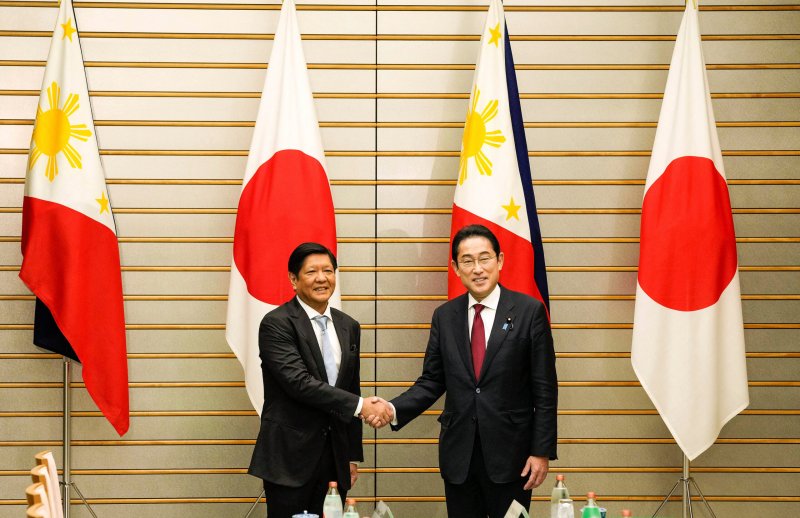
Philippine President Ferdinand Marcos Jr.’s visit to Japan is being closely watched because it reflects the rapidly evolving strategic environment in Asia, particularly amid growing concerns over China’s expanding military and geopolitical influence.
The trip is widely viewed as part of a broader effort by regional powers to strengthen cooperation in security, defense, trade, and maritime affairs. Japan and the Philippines have increasingly aligned their strategic interests in recent years, especially regarding tensions in the South China Sea and the wider Indo Pacific region.
RECOMMENDED STORIES
Analysts believe the visit highlights how countries across Asia are building deeper partnerships to counterbalance Beijing’s assertive posture without directly provoking open confrontation.
Marcos’ trip to Tokyo therefore carries significance far beyond routine diplomacy. It reflects changing security calculations in Asia and the emergence of tighter regional coordination among U.S. allies and partners.
Why are Japan and the Philippines becoming closer strategically?
Japan and the Philippines share several overlapping concerns linked to regional security and maritime stability.
The most important factor is China’s growing military and coast guard activity in disputed waters, particularly in the South China Sea and East China Sea.
The Philippines has repeatedly accused Chinese vessels of harassment, dangerous maneuvers, water cannon attacks, and interference with Philippine resupply missions near contested maritime features.
Japan, meanwhile, faces its own tensions with China around the Senkaku Islands in the East China Sea.
As a result, both Tokyo and Manila increasingly view security cooperation as necessary for protecting sea lanes, territorial claims, and regional balance.
Their growing alignment also reflects a broader trend in Asia where middle powers are seeking stronger partnerships amid uncertainty about future geopolitical competition.
What is meant by “anti China contour” in Asia?
The phrase “anti China contour” refers to the gradual formation of strategic partnerships, defense arrangements, and diplomatic alignments designed to limit or balance China’s growing influence.
This does not necessarily mean countries are forming a formal anti China alliance similar to NATO.
Instead, many governments are strengthening military cooperation, intelligence sharing, joint exercises, and defense procurement arrangements to create a network of deterrence.
Countries involved often emphasize that their policies are aimed at preserving regional stability, international law, and freedom of navigation rather than containing China outright.
However, Beijing frequently views these developments as attempts to encircle or constrain its rise.
Japan’s expanding ties with the Philippines fit within this wider regional pattern.
Why is the South China Sea central to these tensions?
The South China Sea is one of the world’s most strategically important waterways.
A significant portion of global trade passes through the region, including major energy shipments and commercial shipping routes.
Several countries have overlapping territorial claims there, including:
-
China
-
The Philippines
-
Vietnam
-
Malaysia
-
Brunei
-
Taiwan
China claims most of the South China Sea through its controversial “nine dash line,” a position rejected by an international arbitration ruling in 2016.
The Philippines has increasingly clashed with Chinese coast guard and maritime militia vessels near disputed reefs and shoals.
Because of the strategic importance of these waters, tensions there have become a focal point of broader U.S. China competition and regional security concerns.
Why is Japan interested in the South China Sea if it is not a claimant?
Although Japan is not a claimant in the South China Sea disputes, it has major economic and strategic interests in the region.
Japan depends heavily on maritime trade routes that pass through the South China Sea.
Any disruption to these shipping lanes could affect Japanese energy imports, exports, and economic stability.
Tokyo also worries that unchecked Chinese expansion in one maritime region could encourage greater pressure elsewhere, including around the East China Sea.
For Japan, supporting regional maritime security and international law is therefore seen as directly connected to its national interests.
This explains why Tokyo has steadily increased defense cooperation with Southeast Asian countries.
How has Marcos changed Philippine foreign policy?
Since taking office, President Ferdinand Marcos Jr. has significantly deepened the Philippines’ security cooperation with the United States and its allies.
This marks a notable shift from the more China friendly approach pursued at times under former President Rodrigo Duterte.
Under Marcos, Manila has:
-
Expanded U.S. military access to Philippine bases
-
Increased joint military exercises
-
Strengthened ties with Japan and Australia
-
Taken a firmer stance on maritime disputes with China
Marcos has argued that protecting Philippine sovereignty and territorial rights requires stronger alliances and defense partnerships.
His administration has therefore moved closer to the broader U.S. led regional security architecture.
What role does the United States play in this growing alignment?
The United States remains the central security actor in the Indo Pacific region.
Washington has treaty alliances with both Japan and the Philippines, making trilateral cooperation increasingly important.
The U.S. sees closer coordination among allies as essential for maintaining regional deterrence and stability.
In recent years, Washington has encouraged:
-
Joint military exercises
-
Intelligence cooperation
-
Maritime patrol coordination
-
Defense technology sharing
-
Expanded regional security frameworks
The U.S., Japan, and the Philippines have already held high level trilateral meetings aimed at strengthening cooperation.
Marcos’ Tokyo visit is therefore also connected to wider strategic coordination involving Washington.
What defense agreements exist between Japan and the Philippines?
Japan and the Philippines have steadily expanded their defense relationship over the past decade.
Key areas of cooperation include:
-
Maritime security assistance
-
Coast guard training
-
Defense equipment transfers
-
Joint military exercises
-
Intelligence sharing
Japan has provided patrol vessels and surveillance systems to the Philippines to improve maritime monitoring capabilities.
The two countries have also moved toward agreements that would facilitate easier military cooperation and troop visits.
These steps are especially significant because Japan traditionally maintained a more restrained defense posture after World War II.
Why is Japan increasing its military role in Asia?
Japan’s defense policy has undergone major changes in response to shifting regional security dynamics.
For decades after World War II, Japan maintained a relatively limited military posture under its pacifist constitution.
However, rising concerns about:
-
China’s military expansion
-
North Korean missile tests
-
Regional instability
-
Maritime security threats
have pushed Tokyo toward a more proactive security role.
Japan has increased defense spending, revised strategic doctrines, and expanded partnerships across the Indo Pacific.
Tokyo now emphasizes “proactive contribution to peace” and stronger deterrence capabilities.
The Philippines has become one of Japan’s key regional security partners within this evolving strategy.
How does China view Japan Philippines cooperation?
China generally criticizes expanding military partnerships involving the United States and its allies in Asia.
Beijing often argues that such arrangements:
-
Increase regional tensions
-
Promote bloc politics
-
Undermine stability
-
Reflect Cold War thinking
Chinese officials have repeatedly warned against what they describe as attempts to contain China’s rise.
Beijing also remains highly sensitive about Japan’s expanding military profile because of historical memories linked to Japanese wartime actions in Asia.
As Japan strengthens defense ties across the region, China watches these developments very closely.
Could this cooperation lead to military confrontation?
Most regional governments emphasize that their goal is deterrence rather than confrontation.
Japan and the Philippines publicly frame their cooperation as defensive and focused on preserving peace, stability, and international law.
However, analysts warn that rising military activity in contested waters increases the risk of accidents, miscalculations, or unintended escalation.
Close encounters between coast guard vessels, military aircraft, and naval ships have already become more frequent in the region.
While no major power appears to seek direct conflict, tensions remain elevated.
Why is the Indo Pacific becoming more strategically important?
The Indo Pacific has emerged as the world’s most important geopolitical theater for several reasons.
The region contains:
-
Major global shipping routes
-
Key manufacturing centers
-
Fast growing economies
-
Strategic maritime chokepoints
-
Important military positions
It is also the primary arena of competition between the United States and China.
Countries across Asia increasingly find themselves balancing economic ties with China against security relationships with the U.S. and its allies.
This complex environment is driving new partnerships and strategic realignments.
Japan Philippines cooperation is one example of this broader regional transformation.
What economic factors influence Japan Philippines relations?
Security issues dominate headlines, but economic ties are also crucial.
Japan is one of the Philippines’ largest investors, development partners, and trading partners.
Japanese involvement in the Philippines includes:
-
Infrastructure projects
-
Transportation development
-
Energy cooperation
-
Manufacturing investment
-
Technology assistance
Stable relations therefore benefit both economies.
For Tokyo, stronger economic engagement also supports broader strategic influence in Southeast Asia.
Why is Southeast Asia important in U.S. China rivalry?
Southeast Asia occupies a central geographic position between the Pacific and Indian Oceans.
The region sits along vital maritime trade routes and contains several strategically important waterways.
Because of this, both Washington and Beijing seek influence there.
Southeast Asian countries often try to avoid choosing sides outright, preferring balanced diplomacy.
However, rising maritime tensions and security concerns have made neutrality increasingly difficult for some governments.
The Philippines has become one of the clearest examples of a country moving closer to the U.S. aligned camp.
How does this affect ASEAN unity?
The Association of Southeast Asian Nations, commonly known as ASEAN, traditionally emphasizes neutrality, consensus, and balanced diplomacy.
However, member states differ significantly in their approaches toward China.
Some countries prioritize economic ties with Beijing, while others are more concerned about maritime disputes and security risks.
These differing perspectives sometimes complicate ASEAN’s ability to present a unified position.
The Philippines’ closer alignment with Japan and the United States reflects these growing internal differences within Southeast Asia.
Could Japan become a larger security actor in Southeast Asia?
Many analysts believe Japan’s role in Southeast Asian security will continue expanding.
Tokyo is increasingly viewed as a reliable partner because it combines:
-
Economic investment
-
Infrastructure financing
-
Maritime assistance
-
Defense cooperation
Unlike some major powers, Japan is often seen as less politically coercive while still possessing advanced technological and defense capabilities.
Countries concerned about regional instability may therefore seek deeper cooperation with Tokyo.
What role does Taiwan play in regional calculations?
Taiwan is another major factor shaping regional security dynamics.
Many Asian governments worry that a conflict involving Taiwan could destabilize the entire Indo Pacific region.
The Philippines’ geographic proximity to Taiwan makes it strategically important in any potential crisis.
Japan also views Taiwan’s security as closely linked to Japanese national interests because nearby sea lanes are critical to Japan’s economy.
As a result, broader regional partnerships increasingly factor Taiwan related contingencies into strategic planning.
How important are maritime alliances becoming in Asia?
Maritime security partnerships are becoming increasingly central to Asian geopolitics.
This is because many regional disputes involve:
-
Territorial waters
-
Shipping lanes
-
Fisheries
-
Naval access
-
Resource exploration
Countries are therefore investing heavily in:
-
Coast guard modernization
-
Naval expansion
-
Maritime surveillance
-
Joint patrols
-
Intelligence sharing
Japan and the Philippines are both prioritizing maritime cooperation because they view sea based security challenges as growing threats.
Is Asia entering a new Cold War?
Some analysts describe current developments as resembling a new Cold War, while others argue the situation is more complex.
Unlike the original Cold War, today’s major powers remain deeply economically interconnected.
China is a major trading partner for nearly every country in the region, including U.S. allies.
At the same time, security tensions continue rising.
Rather than a strict bipolar division, Asia currently faces a fluid environment involving competition, economic interdependence, and strategic hedging.
The growing Japan Philippines partnership reflects this evolving landscape.
What message does Marcos’ Tokyo visit send internationally?
The visit sends several important signals.
First, it demonstrates that the Philippines intends to deepen cooperation with like minded regional powers.
Second, it highlights Japan’s expanding diplomatic and strategic influence in Southeast Asia.
Third, it reinforces the growing network of partnerships surrounding the U.S. Indo Pacific strategy.
Finally, it signals to China that regional governments are increasingly coordinating in response to security concerns.
Even though officials avoid openly framing these ties as anti China, the strategic implications are widely understood internationally.
Could this reshape Asia’s balance of power?
Potentially yes.
The strengthening of partnerships among Japan, the Philippines, Australia, South Korea, India, and the United States contributes to a more interconnected regional security architecture.
This does not necessarily create a formal military bloc, but it increases coordination and collective deterrence capacity.
China’s rise has already transformed Asia’s strategic landscape.
In response, neighboring countries are adapting their policies, military planning, and diplomatic alignments.
Marcos’ Tokyo visit therefore represents part of a much larger geopolitical shift taking place across the Indo Pacific.
What is the broader significance of this visit?
At its core, Marcos’ trip to Tokyo symbolizes the accelerating strategic transformation of Asia.
Regional governments increasingly believe that security challenges can no longer be addressed individually.
As tensions rise over maritime disputes, military modernization, and geopolitical rivalry, countries are building denser networks of cooperation.
Japan’s growing partnership with the Philippines reflects:
-
Shared maritime concerns
-
Anxiety about China’s regional behavior
-
Expanding Indo Pacific alliances
-
The increasing importance of deterrence
The visit underscores how Asia’s political and security landscape is entering a new phase defined by stronger strategic coordination, shifting alliances, and intensifying competition among major powers.
By Faig Mahmudov


Similar news