Azerbaijan to emerge as key transport hub from India-Iran port deal – Indian experts


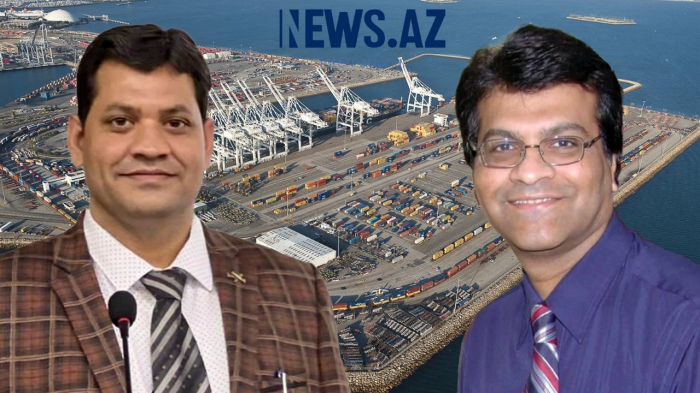

India and Iran have signed a decade-long agreement for the development and operation of Iran's Chabahar port.
Delhi views this port as a critical part of a strategic trade route to the landlocked Central Asian republics, allowing it to bypass its rival, Pakistan. India has announced that the agreement will create new opportunities for trade. Meanwhile, the US State Department has issued a reminder about the risk of sanctions for those conducting business with Iran. Through this agreement, India plans to connect the Chabahar port to the International North-South Transport Corridor, with Azerbaijan serving as a significant hub along this route. What role will Azerbaijan play in this agreement, and what opportunities will it gain?Below we present the views of two Indian pundits - Prof. Aslam Khan, Department of Gandhi and Peace Studies, Mahatma Gandhi Central University, Motihari, Bihar, India, and Dr. Shoaib Khan of the Centre for Central Eurasian Studies, University of Mumbai, on the subject of İndia-İran port deal and Azerbaijan's role as a key transport hub.
Professor Aslam Khan told News.Az in a video interview that India and Iran share a historic bond of friendship and cordial relations, and despite US sanctions on Iran, both countries move forward with the development of the Chabahar port, which means that the port can be a game changer as a new strategic trade route to Central Asia.
"That was long blocked by the bitter relations with Pakistan. So India will have a strategic connection through the Chabahar port to the International North-South Transport Corridor, where Azerbaijan is a key country due to its strategic location," he said.
"Azerbaijan can easily import and export, and greatly benefit from goods at reduced prices from two major economies - India and China, as well as other nations such as Russia, Europe and some Gulf nations to the ambit of the International North-South Transport Corridor," the expert added.
He noted that by connecting to the Chabahar port, Azerbaijan will emerge as "a key transport hub" and will reduce shipping costs and the time of delivery. "After becoming part of the International North-South Transport Corridor in 2005, Azerbaijan has developed roads, railways, networks and especially, a sea port at a fast pace. Azerbaijan will be a key strategic partner," he pointed out.
"I can cite one example here - the Baku-Tbilisi-Batumi transnational rail connection that is being constructed under the Trans-Caspian International Transport Route, which makes up the Western corridor of the International North-South Transport Corridor, is the most crucial aspect of India's strategic interest," the expert said.
"The construction of vast railway connectivity with the help of Russia will also add more economic incentives in the near future. We all know that historically, Azerbaijan's relations with Iran and India were not so fruitful due to their formal support for Armenia, but the changing strategic dimensions of trade, commerce and connectivity will overshadow this kind of phenomena. And we have the example of Europe's economic integration in the form of the European Union, where the differences among the European countries were much higher and deeper," he said.
"So I believe that this port connectivity with different regions will be a game changer not only for Azerbaijan, but also for the nations and regions involved in it," the expert went on to say.
"And let me shed some light on the US sanctions on Iran. I think that diplomatically, India was in this kind of wet water earlier as India is having a different stand on its foreign policy. We see that previously, the US also gave approval and concessions to the Chabahar port. And I strongly believe that this port connectivity will not only be beneficial for the Western nations, but for the whole of Central Asia, the Gulf nations and other parts of the world," he noted.
"The US is also going to benefit from this kind of trade, because in some circles, it is seen as a counter to the Chinese Belt and Road Initiative. So Azerbaijan is a key country in all this connectivity project," the expert said in conclusion.
In a video interview with News.Az. Dr Shoaib Khan said that Azerbaijan has become Europe's key supply hub amid the Russia-Ukraine war.
"Goods can be transported by ships from ports in Bulgaria and Romania to Georgia and Turkey, where they are loaded onto trains and transported to the Baku port. From there, goods can be shipped to China via Kazakhstan's Aktau port, to Central Asia via Turkmenistan's Turkmenbashi port or to West Asia, India, and South Asia via the INSTC, which is the International North-South Transport Corridor. This route is from Iran's Anzali port, which then leads to the Bandar Abbas port on the Persian Gulf," he noted.
"Additionally, it provides Europe with an alternative transportation route for energy resources from Central Asia, especially since the traditional routes through Russia or West Asia are vulnerable to geopolitical tensions and disruptions, which we are already experiencing now," he said.
"As we see, trade between Azerbaijan and India has increased substantially in recent years - from $50 million in 2005 to $1.88 billion in 2022. India is among Azerbaijan's top five trading partners. India's main exports to Azerbaijan are rice, electronics, electrical equipment, cereals, pharmaceuticals, machinery, boilers, nuclear reactors, ceramic products, agricultural and forestry tractors, vaccines, and black tea," the expert pointed out.
"At the same time, crude oil accounts for 98% of Azerbaijan's exports to India. India can help Azerbaijan diversify its hydrocarbon dependence by partnering in the food processing, pharmaceutical, and technological sectors," he said, adding that "there is significant potential for further growth between India-Azerbaijan trade through the INSTC's western route, which provides a faster, more cost-effective transportation option for goods".
"Trade between the two countries can increase through this route. For instance, the completion of the Rasht-Astara railway line will reduce the transit time along the INSTC's western route to 10 days from the current 25-30 days, which means almost a month, and even support the inclusion of Iran's Chabahar port in the INSTC. Both countries are also exploring new areas for engagement, such as tourism. The commencement of direct flights between New Delhi and Baku by Indigo Airlines has seen an increase in the number of tourists travelling between the two countries. Notably, the people of Azerbaijan perceive India as a constructive partner in the region," the expert added.
"India has stressed the development of reliable, resilient, and diversified supply chains that will require full connectivity and complete right to transit across Eurasia. Ensuring robust linkages between India and other regions, including Europe, is essential to promote sustained economic growth and prosperity for India and Eurasia," Dr Shoaib Khan pointed out.
"However, when we talk about any transportation route, it is not without hurdles or difficulties. If course, in the initial stages, any transportation route will face difficulties and hurdles. There are many restrictions, whether there are political, legal regulations, or many others like terrorism or security reasons. As we see, whether it's the Belt and Road Initiative of China, or the CPEC (China-Pakistan Economic Corridor), or the newly initiated India-Middle East-Europe Economic Corridor, they are not without hurdles. We have seen the recent ongoing fight between Israel and Palestine, which has already created a hurdle for the India-Middle East-Europe Economic Corridor. Even the historical Silk Road in its initial stages was not without difficulties, but when it succeeded, it brought the world together. Historically, it played an important part in bringing the world together," he noted.
"Any other route today, if it works properly, will benefit not only the countries involved, but also the people living in that area, in those cities, villages, urban, and rural areas that are part of these transportation corridors. If it works well, whether for financial, political, or security reasons, people in those areas and the countries along these routes can take full advantage of their geopolitical locations," the expert said in conclusion.


Similar news