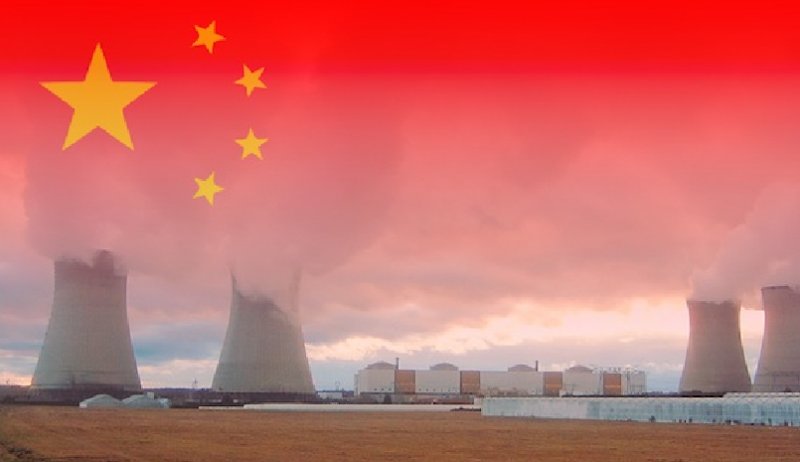
Battle for China's nuclear market: Rosatom vs. EDF


By Tural Heybatov
This year, China plans to develop its first Nuclear Energy Law. The announcement was made in a report on the work of the Standing Committee of the National People's Congress (NPC), presented at the 3rd session of the 14th NPC.
As a nuclear power, China recognizes the necessity of comprehensive legislation in the nuclear energy sector. It is worth noting that in 2003, China adopted the Law on the Prevention and Control of Radioactive Pollution, followed by the Nuclear Safety Law in 2018. Additionally, since the 1980s, various regulations and decisions have been implemented in this field.
The draft of the Nuclear Energy Law was first discussed on April 24, 2024. According to media reports, the law is expected to become a fundamental piece of legislation for the sector. It will primarily focus on research, development, cooperation, and the use of nuclear energy, as well as relevant aspects of regulatory oversight. China is currently examining international best practices and cooperating with the International Atomic Energy Agency (IAEA).

Source: Reuters
Work on the new law began last year. In October, a Chinese delegation held discussions at the IAEA headquarters in Vienna. The IAEA Office of Legal Affairs received the Chinese government delegation, and the meeting was organized at the request of the Chinese government to discuss nuclear legislation and its specific aspects. According to IAEA Director General Rafael Mariano Grossi, as China continues to expand its civilian nuclear energy program, he personally welcomes Beijing's efforts in the nuclear field, and the IAEA is ready to actively support this initiative.
China's first nuclear power plant was commissioned on February 8, 1970, marking the 55th anniversary of the country's nuclear energy sector this year. Fifty-five years ago, the "738" Institute was established, later renamed the Shanghai Nuclear Engineering Research and Design Institute. On December 15, 1991, the first nuclear reactor in China, with a capacity of 288 MW, began operations at the Qinshan Nuclear Power Plant. On February 17, 2013, the Hongyanhe Nuclear Power Plant in Liaoning Province was commissioned. It became the first Chinese nuclear power plant to use seawater desalination technology for cooling purposes.
In August of last year, China's State Council approved the construction of 11 new reactor units at five nuclear power plants.
The China National Nuclear Corporation (CNNC) has announced that the Xuwei Nuclear Power Plant in Jiangsu Province will be the first facility to feature both a high-temperature gas-cooled reactor and a pressurized water reactor on a single site. The plant's maximum annual electricity output is expected to exceed 11.5 billion kWh, which will help reduce coal usage by 7.26 million tons and cut CO2 emissions by 19.6 million tons annually.

Source: China Daily
China General Nuclear Power Group (CGN) has received approval to build four Hualong One reactors: Units 1 and 2 at the Zhaoyuan Nuclear Power Plant in Shandong Province and Units 3 and 4 at the Sanyao Nuclear Power Plant in Zhejiang Province. The CAP-1000 reactors will be installed at Units 1 and 2 of the Lufeng and Bailong Nuclear Power Plants.
According to the World Nuclear Association, China currently operates 56 nuclear reactors with a combined capacity of 54.36 GW, while an additional 30 reactors are under construction. The estimated cost of building the 11 new reactors is approximately 220 billion yuan (about $30.85 billion).
It is worth noting that in 2022 and 2023, China approved the construction of 10 new nuclear reactors. Today, China ranks third globally in the number of nuclear reactors and aims to become the world's leader by 2030. This goal includes adding 36 new reactors to its existing capacity, some of which are already under construction, while others are in the design phase.
China has been steadily increasing the share of nuclear energy in its total electricity production for several years. In 2009, the National Development and Reform Commission announced plans to raise the share of nuclear energy from 2% to 6% by 2020. For comparison, this figure stands at 19% in the United States. This plan aimed to increase the installed nuclear capacity from 17.9 GW to 80.6 GW, surpassing France's 63 GW of nuclear power. Indeed, by the end of 2020, China had outperformed France in nuclear power generation and, by 2023, matched it in the number of nuclear reactors.

Source: Xinhua
China's nuclear energy sector is managed by three major corporations: China National Nuclear Corporation (CNNC), China General Nuclear Power Group (CGN), and the State Power Investment Corporation (SPIC).
French technology is actively used in China's nuclear reactors. Moreover, French energy company EDF has announced its intention to strengthen its position in China's nuclear market, one of the most promising in the world, and to compete directly with Russia's Rosatom. EDF previously completed the Daya Bay Nuclear Power Plant project in China between 1984 and 1994 and is now prepared to build two additional units at the Taishan Nuclear Power Plant. Furthermore, EDF, in partnership with Chinese companies, is ready to compete for the construction of a new nuclear power plant in Kazakhstan—a project actively promoted by Rosatom.
Both Russian and French companies offer attractive prospects. Ultimately, it will be up to China to decide which partner is more beneficial.
On one hand, Russia's Rosatom has a long-standing partnership with China, having collaborated on several key nuclear projects, including the Tianwan Nuclear Power Plant and the Xudapu Nuclear Power Plant. Rosatom's expertise in fast neutron reactors and its willingness to transfer advanced technologies have been significant factors in strengthening this cooperation. The Russian company also offers competitive financing options and is known for its ability to deliver projects on schedule, which is crucial for China's ambitious nuclear expansion plans. Additionally, Rosatom's approach aligns well with China's broader energy strategy, which seeks to reduce reliance on fossil fuels and enhance energy security through diversification of supply sources. The ongoing cooperation between Russia and China in the nuclear sector can also be seen as part of a broader geopolitical alignment, where both countries are working closely to counterbalance Western influence.
Source: Xinhua
On the other hand, France's EDF brings a different set of strengths to the table. The company's European Pressurized Reactor (EPR) technology, which is already operational at the Taishan Nuclear Power Plant, has been praised for its safety standards and efficiency. EDF's strategy involves not only the sale of technology but also extensive knowledge transfer and localization of components, making its offer highly appealing to China, which is keen to enhance its domestic capabilities in the nuclear sector. Furthermore, EDF's extensive experience in managing large-scale nuclear projects worldwide and its ability to provide flexible financing solutions strengthen its competitive position. The French company's ambition to expand its footprint in China's nuclear market reflects its broader strategic goal of becoming a leading global player in nuclear energy, directly competing with Rosatom.
The competition between Rosatom and EDF is not merely a matter of technology and finance but also involves geopolitical considerations. For China, partnering with Russia offers the advantage of deepening strategic ties with a key ally in the context of growing tensions with the West. In contrast, expanding cooperation with France could help Beijing balance its relations with Europe, providing a counterweight to U.S. influence. China's decision will likely hinge on a combination of factors, including the technological advantages of each partner, the terms of financing, and the broader geopolitical implications of the partnership. As China accelerates its nuclear power expansion to achieve its goal of becoming the world's leading nuclear energy producer by 2030, the choice between Russian and French technologies will play a critical role in shaping the future of its nuclear sector.
Ultimately, China's decision will reflect its long-term vision for energy security and geopolitical strategy. Both Russian and French companies have positioned themselves as attractive partners, offering not only cutting-edge technology but also strategic benefits that align with Beijing's global ambitions. The outcome of this competition will likely set the stage for future alliances and influence the balance of power in the global nuclear energy market.


Similar news