Gold’s steady rise reflects lasting global uncertainty: What’s behind price surge


.png)

In recent days, the steady rise in gold prices has attracted significant attention in both local and international markets. Since early November, the price per gram has consistently increased — from around $126.2 on November 4 to $132.1 on November 10, marking a 4–5 percent gain in just one week. Analysts suggest that this upward trend could continue through the end of the year.
Key factors driving this growth include expectations regarding the U.S. Federal Reserve’s interest rate policy, renewed tensions in the Middle East, and investors’ growing preference for “safe-haven” assets amid a global economic slowdown. The relative weakening of the U.S. dollar and the recovery of demand from the Chinese market have also contributed to the rise in prices.
Physical gold purchases have surged in many countries, including Azerbaijan, pushing domestic prices even higher. Experts note that by the end of the year, prices could reach between $135 and $140 per gram. Analysts stress that this dynamic reflects both deepening global economic uncertainty and mounting inflation concerns.
News.Az spoke with market experts to examine the reasons behind the recent rise in gold prices and its potential implications for the market.
Toghrul Abbasguliyev, Chairman of the Azerbaijan Jewelers Association, told News.Az that although gold prices have stabilized at around $133 per gram after reaching $140 in October, growing demand and ongoing global economic instability suggest that the upward trend is likely to continue.

Photo: Toghrul Abbasquliyev, Chairman of the Azerbaijan Jewelers Association
“Gold prices are once again on the rise. In October, the metal reached one of its highest levels in recent years, climbing to $140 per gram of 999-carat gold. Prices later dipped to the $130–132 range but have since settled around $133,” Abbasguliyev said.
He added that according to leading global banks and central institutions, gold’s upward trajectory is expected to continue, potentially reaching $140 or even $150 in the coming months.
“This expectation is not coincidental — during times of conflict and economic crisis, gold has consistently proven to be a reliable and stable investment over the past five to six years. As a result, several international banks are increasing their gold holdings, which naturally boosts demand and drives prices higher. It’s a simple economic principle: as demand rises, so does the price,” he explained.
Abbasguliyev noted that more than 50 percent of the world’s mined gold is used in jewelry production. “If this share were smaller, the pace of price growth would probably be even higher. As gold becomes more expensive, the cost of jewelry also rises, reducing purchasing power and temporarily slowing the market. However, once consumers adjust to the new prices, we see renewed upward momentum,” he added.
He also highlighted that, according to the latest forecasts from major international financial institutions, gold prices could climb as high as $150 per gram. “From this perspective, investing in gold today — whether in the form of bullion, coins, or jewelry — can be considered a profitable long-term move. Regardless of purity (585, 750, or 999), the price increase offers substantial profit potential for investors,” he said.
In an interview with News.Az, economist Eldaniz Amirov noted that the growing demand for gold has become increasingly evident. He said this increase is driven primarily by geopolitical tensions and the monetary policies of central banks worldwide.
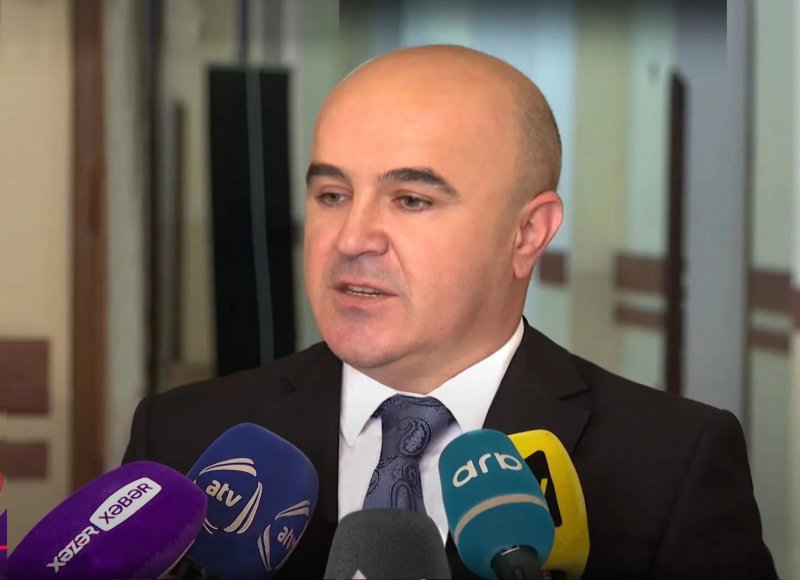
Photo: Eldaniz Amirov, Azerbaijani economist
“In the United States, the stabilization of interest rates, Donald Trump’s efforts to weaken the dollar, and growing gold purchases by central banks are all contributing to rising prices,” Amirov emphasized.
He explained that under such circumstances, investors traditionally turn to so-called “safe-haven” assets, namely gold. “The main reason Trump wants a weaker dollar is to strengthen the competitiveness of U.S. exporters in global markets. A cheaper dollar makes exports more affordable. For this reason, he is putting pressure on the Federal Reserve to keep the dollar’s value low,” Amirov added.
The economist also noted that a weaker dollar, combined with stable or lower interest rates, reduces demand for the dollar itself. “As a result, investors shift to more reliable assets such as gold, further accelerating price growth,” he said.
According to Amirov, statistical indicators also confirm this trend. Official data shows that approximately 216,000 tons of gold have been mined to date, referred to as ‘above-ground gold’ — reserves that have already been extracted.
“Meanwhile, around 60,000–65,000 tons of underground gold reserves remain. This is not a large volume. Current global annual production is about 3,000–3,200 tons. If this pace continues, existing reserves may eventually be depleted. This factor alone further increases demand,” he explained.
Amirov added that in recent years, leading central banks have preferred to increase their reserves in the form of physical gold. China, India, and Türkiye are actively pursuing this policy, and even the United States holds significant gold reserves. “This trend prevents a decline in gold demand and helps maintain high price levels,” he said.
Looking ahead, Amirov believes this dynamic will continue at least until the end of 2028. “Short-term declines are possible, but it is unrealistic to expect prices to return to 2023 levels. Forecasts indicate that the price of one ounce of gold could exceed $5,000 by 2028,” he said.
He added that in the post-Trump period, some stabilization may occur if the Federal Reserve strengthens the dollar. However, in the long term, gold will remain one of the most reliable investment assets.
“Yes, price fluctuations may occur in certain years, but the overall trend will remain upward and stable,” the economist concluded.


Similar news