Moldovan elections: Clash between East and West


Editor's note: Ruslan Shevchenko is a political analyst from Moldova, Doctor of Historical Sciences. The article expresses the personal opinion of the author and may not coincide with the view of News.Az.
The Moldovan presidential election , held after the disappointing local elections in autumn 2023 for the ruling Party of Action and Solidarity (PAS) and its de facto leader, President Maia Sandu, was seen as a new confrontation between East and West, or rather, between pro-Russian and pro-European directions. This heightened the stakes for both the left and the right, as they campaigned vigorously to convince voters of the validity of their ideologies. The left emphasized the concept of "friendship with both the West and the East" (with "East" implying Russia), pointing out various shortcomings of Western life, focusing primarily on socio-economic challenges. They advocated for rejecting a one-sided tilt towards the EU and called for considering Russia's interests while avoiding support for Ukraine in its war with Russia.Many pro-Russian supporters publicly demanded that the West halt its support for Ukraine, claiming that doing so would quickly bring an end to the war. Such calls, popular among left-leaning voters, clearly contain a cynical twist: if Western aid stops, Ukraine would likely cease to exist as an independent nation and be swiftly taken over by Russia. Under such circumstances, Moldova might face a similar fate, turning into a de facto Russian region. However, pro-Kremlin advocates in Moldova typically avoid discussing this to sidestep accusations of betrayal. Another blatant deception by pro-Russian political forces is their consistent refusal to address the colossal issues plaguing Russia, deflecting all criticism towards Europe instead of holding Putin accountable.
The pro-European camp had its own serious challenges. Led by the ruling PAS, it focused on the vision of Europe and Moldova's imminent accession to the European Union. However, there was a reluctance to talk about the failures of reforms initiated by Maia Sandu and her PAS-led administration. These failures lay at the heart of the results of both the presidential election and the referendum on constitutional amendments, which was held concurrently on October 20, 2024. Massive financial injections from the West (over 3 billion euros) were, for the most part, simply misappropriated by PAS leaders. Despite this corruption, no one was held accountable. The remaining funds were primarily used to cover increased pensions, wages, social benefits, and to offset the skyrocketing utility tariffs for water, heating, and gas over the past three years. Only a small portion was allocated to infrastructure repair.
Judicial reforms were another disaster, reduced merely to appointing loyalists to key positions in courts, the prosecutor's office, and the Anti-Corruption Center by Sandu and her close circle. These moves failed to improve the judiciary's efficiency; if anything, corruption levels increased. The competence of the government apparatus significantly declined compared to previous administrations because PAS and Sandu were more focused on promoting their allies rather than qualified experts. As a result, even ministerial positions were occupied by NGO representatives with no prior experience in state governance, who struggled to handle the complexities of running a country. A prime example is the Ministry of Economy, which was led by non-professionals and NGO activists throughout the three years. The result is clear: the economy stagnated, or saw microscopic growth of 1-2%. Even war-torn Ukraine managed to outpace Moldova's economic growth by several times.
Instead, there was a noticeable rise in arrogance, intolerance towards opposing views, and condescension. Sandu herself set the tone, refusing for a long time to travel around the country to meet voters. This behavior only began to change in the last year and a half, with carefully planned meetings where participants were preselected to avoid displeasing Sandu, who was unaccustomed to criticism and never admitted to her mistakes or shortcomings. She preferred to keep silent about failures, emphasizing the massive support from the West, which the current administration did indeed receive. But as the results of local elections, and now the presidential vote and referendum, showed, this support turned out to be rather futile. The authorities failed to harness it for the people's benefit. Therefore, it is no surprise that support for the EU dropped significantly under the “pro-European” PAS and Sandu's leadership. All these factors contributed to a sharp decline in the popularity of PAS and Maia Sandu herself, equalizing the chances for both camps.
In this environment, both the "pro-European" government and the pro-Russian opposition essentially isolated themselves from one another, living in their own imagined realities. After the announcement of the election and referendum dates, pro-Russian forces spent months painting a picture for their voters of Sandu's "inevitable defeat" and a return to "friendship with Russia." Meanwhile, the pro-European camp was equally zealous in assuring voters of Sandu’s decisive victory in the first round. To make this certainty more convincing, the European advisor to the Moldovan right-wing, German politician M. Sieg, proposed holding a referendum on constitutional amendments that would solidify Moldova’s pro-European course and eliminate Kremlin supporters from the political arena once and for all. Both sides regularly presented their supporters with commissioned polls, alternately showing wins for the left or the right, depending on the poll's sponsor.
In recent months, leftist forces bet on the Moldovans' weariness of the Ukraine conflict, their desire for a quick peace in the neighboring country, and an end to the armed conflict that was a source of concern for everyone. They made tremendous efforts to spread their views through hundreds of websites, portals, and TV channels directed at the Moldovan audience. They often portrayed Ukraine, and particularly the Moldovan government supporting it, as the main culprits of the situation. Playing on the concept of "neutrality," Russian-language media in Moldova accused the current administration of preparing to drag the country into a war against Russia.
Another topic actively exploited by pro-Russian propagandists was the government's stance on the Orthodox Church. This was approached cautiously, as since Soviet times, the Moldovan Orthodox Church has been a crucial center of Russian influence. Through the church, Russia successfully instilled pro-Russian and anti-Western sentiments in the Moldovan populace. Given its massive influence over the majority of residents, any government was reluctant to touch this stronghold of Kremlin influence, postponing the issue indefinitely. With the election approaching, this topic resurfaced, as some PAS members hinted that combating church influence might become a priority.
The Achilles' heel of the pro-Western forces in Moldova has always been their weak propaganda efforts. They were often primitive, using overly simplistic methods, or at times nonexistent, leading the authorities to resort to restrictions. Failing to counter pro-Kremlin propaganda effectively, without establishing alternative information channels, they were compelled to shut down about 15 TV channels and over 50 websites, as well as block international money transfer systems to prevent foreign funding of the opposition, allegedly from Russia. Yet, the authorities hesitated to act against key pro-Russian bloggers, analysts, and journalists who constantly spread narratives concocted within Putin's administration.
For months, almost all polls showed not only a twofold lead for Sandu over her opponents but also a lack of votes for a first-round win. The prospects for a referendum were even more uncertain: the balance of power was almost 50/50, and neither side could predict a clear victory.
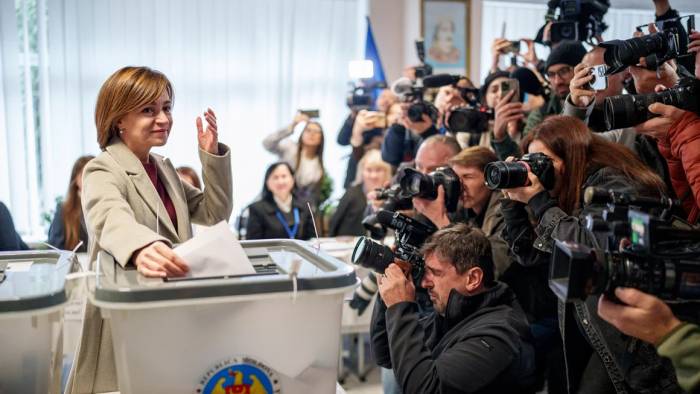
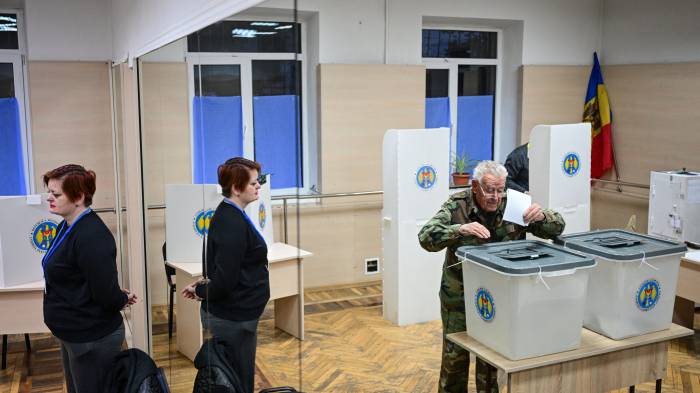
The October 20 election confirmed analysts' fears and stunned the PAS leadership and Sandu herself, who seemed disconnected from reality. They were preparing for a triumphant celebration, encouraged by a turnout exceeding 50% of the electorate. But the results shocked them: initially, Sandu led her main opponent, the socialist candidate A. Stoianoglo, by only 3% (33% to 30%).
The high number of left-wing rivals to Stoianoglo helped Sandu and the PAS. Candidates like former prosecutor V. Furtună, “Our Party” leader and Stoianoglo spoiler R. Usatîi, ex-prime ministers I. Chicu and V. Tarlev, former governor of Gagauzia I. Vlah, and pro-Russian journalist N. Morari, split the vote. If not for them (with Usatîi alone garnering 13.79%), Stoianoglo would have had a real chance to beat Sandu in the first round. Gradually, as voting progressed, things improved for Sandu due to the active core of her supporters and the contribution of the Moldovan diaspora, which supported Sandu and the referendum.
Despite these factors, she managed to secure only 42.45% of the votes, while A. Stoianoglo, the main pro-Russian candidate, received 25.98%. Other pro-Russian candidates also collected a significant portion of votes: I. Vlah — 5.38%, V. Furtună — 4.45%, V. Tarlev — 3.19%, I. Chicu — 2.06%. This means a second round of voting between M. Sandu, who avoided participating in televised debates, and A. Stoianoglo, who actively engaged in them.
The referendum's outcome was even more contentious. Initially, pro-European forces supporting constitutional amendments were in the minority, with only 42-43%. The situation balanced out the following morning thanks to diaspora votes, and pro-European supporters narrowly won with 50.39%. These results could significantly impact the West's view of Sandu and the PAS, as they failed to persuade the population of the benefits of a pro-European course, suggesting that their peak popularity with the EU and the US may have passed.
The results of the presidential election and the referendum have presented Sandu with a formidable challenge. Unable to counter the Kremlin's powerful information and propaganda influence, and accusing Russia (without yet presenting solid evidence, which is crucial in such a situation) of attempting to bribe over 300,000 voters, she declined to answer questions at a post-election briefing and left without disclosing her future plans.
Now she must either seek alliances with some of her former opponents or risk losing in
the second round. Sandu might benefit from the internal disarray within the leftist camp, which has yet to rally around a single candidate. However, if Moscow decides to fully back Stoianoglo, Sandu may be forced to resort to extraordinary measures, such as releasing compromising material on her opponent, taking repressive actions against key opposition figures, and intensifying attacks on opposition-controlled media. One of Sandu's crucial reserves remains the support from the West, which is likely to ramp up efforts to assist her before the runoff, as well as the mobilization of the diaspora and pro-European supporters within Moldova, who will be called upon to back her regardless of their personal views of her.
Stoianoglo's task appears somewhat more straightforward. Should Moscow intervene, it could easily mobilize all its loyal candidates (the majority of whom, 6 out of 11, support a pro-Russian stance) to rally behind Stoianoglo. The only one from this group controlled by the authorities and effectively serving as a spoiler for Stoianoglo is R. Usatîi. It will be extremely difficult for Usatîi to explain to his left-wing electorate why, in the current situation, they should support Sandu. Most likely, his voters will also lean towards Stoianoglo.
At present, the balance of power appears almost even, and if M. Sandu wishes to secure victory, she will need to make tremendous efforts to change the negative perception left by the October 20 elections and referendum among the Moldovan population and the key donors of the current administration — the US and the EU. How successful she will be in achieving this will become clear on November 3.
(If you possess specialized knowledge and wish to contribute, please reach out to us at opinions@news.az).


Similar news