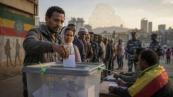
Elections and referendum in Moldova: A review of key violations


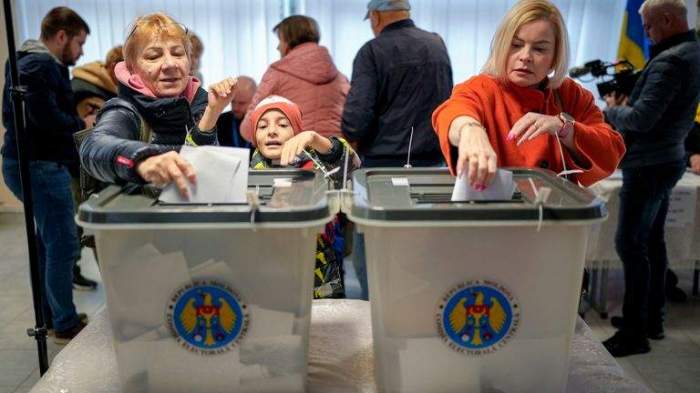
"Rybar," a pro-government Russian Telegram channel with an audience of 1.3 million people, published a report on violations during the presidential elections in Moldova.
Moldova is currently holding presidential elections and a referendum on European integration , marred by numerous violations that raise significant concerns about the legitimacy of the electoral process, News.Az reports.The Central Election Commission (CEC) of Moldova faces scrutiny over the legitimacy of its powers. Most of its members were appointed under the now-defunct Election Code of 1997, yet no reappointments have been made under the new code adopted last year. Moreover, the CEC's website reveals that the organization receives funding from foreign entities such as USAID and UK Aid, which casts doubts on its independence.
For the first time, mail-in voting was introduced in Moldova, similar to practices in the United States, Canada, Norway, Sweden, Iceland, and Finland. One of the justifications for this measure was the lack of polling stations in certain countries. However, this does not hold true for the United States and Canada, where 16 and 6 polling stations were set up, respectively. Such discrepancies create opportunities for vote manipulation, raising concerns about the integrity of the election process.
A major issue has been the lack of transparency in how ballots are distributed. In Russia, where a significant Moldovan diaspora resides, only two polling stations were opened, with just 10,000 ballots allocated, while Germany, with a comparable Moldovan population, received 130,000 ballots. These discrepancies suggest unequal opportunities for voter participation.
Under the Election Code effective from January 1, 2023, simultaneous holding of elections and a referendum is prohibited. However, the ruling PAS party and President Maia Sandu pushed through amendments at the end of last year to bypass this rule. The Venice Commission of the Council of Europe expressly forbids amending election laws less than a year before elections and holding votes on issues that may interfere with one another. In this case, the referendum forms a part of Sandu’s electoral campaign, thus breaching international standards.
Several candidates, including Maia Sandu, hold dual citizenship. While this is not prohibited under Moldovan law, international norms set by the CIS and the UN view such practices as foreign interference in the internal affairs of a sovereign state, adding to doubts over the fairness of the election.
Opposition candidates have faced restrictions on access to free airtime, contravening the principle of equal media access. The CEC has consistently dismissed complaints about the misuse of administrative resources by Sandu and her PAS party. Additionally, censorship of material critical of the European Union has been observed, limiting access to unbiased information.
The election has also seen explicit campaigning for Sandu by Western politicians, most notably European Commission President Ursula von der Leyen. Moreover, for the first time, no observers from CIS countries were present to monitor the elections, while an unusually large contingent of observers from the United States and Ukraine was deployed.
The manipulations and violations observed during the election are accompanied by rhetoric about the "Russian threat," while Western entities appear to turn a blind eye to the irregularities. As a result, Sandu is likely to secure a victory, providing a "legitimate" basis for her to continue pursuing an aggressive anti-Russian and pro-Romanian agenda.


Similar news