Recognizing Palestine: What comes next?




Editor's note: Moses Becker is a special commentator on political issues for News.Az, a PhD in political science and an expert on interethnic and interreligious relations. The article expresses the personal opinion of the author and may not coincide with the view of News.Az.
The recent recognition of the State of Palestine by the United Kingdom and its two dominions, Canada and Australia—followed by France, Portugal, Belgium, Luxembourg, Andorra, Malta, and San Marino—has generated headlines across the globe. At first glance, this might appear to be a long-awaited gesture of support for the Palestinian people. Yet the timing and nature of this decision reveal deeper geopolitical motives rather than a sudden desire to bring peace to the Middle East.
If these countries genuinely wanted to champion the Palestinian cause, they could have acted decades ago, starting in 1988, when Palestine first declared statehood. Instead, this coordinated recognition is largely symbolic and primarily aimed at undermining the policies of U.S. President Donald Trump, who has consistently fought to preserve national identity and Judeo-Christian values. London and Paris, alongside their partners, are sending a message: they wish to demonstrate that they have an independent foreign policy, even if that policy is increasingly disconnected from domestic realities.
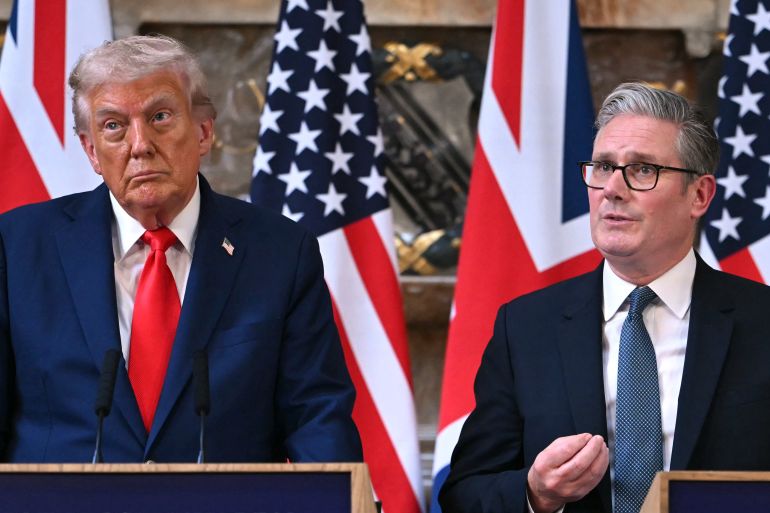 Photo: AP
The irony is striking. Leaders in France and the UK are suffering from plummeting approval ratings, while both nations are mired in political, economic, and ethnic crises. Across Europe, discontent is spreading: in the Netherlands, anti-migrant sentiments are rising openly; in Germany, the Alternative for Germany (AfD) party is gaining dominant positions in several federal states. Calls to restrict migration and deport illegal immigrants are becoming mainstream. President Trump, speaking at the UN General Assembly, warned that Europe faces “hell” unless it radically changes its migration policies. What we are witnessing is a clash between globalists and defenders of the nation-state. Should right-wing forces triumph in these countries, today’s recognition of Palestine could quickly be reversed.
Beyond politics, the fundamental question remains: is Palestine truly a state by international legal standards? According to the Montevideo Convention of 1933, a state must have: a permanent population; a defined territory; a single, unified government (not divided between Gaza and Ramallah); and the capacity to engage in relations with other states. The Palestinian territories—the West Bank and Gaza—fully meet only the first criterion. Ongoing territorial disputes with Israel undermine any claim to stable territorial integrity. Governance is another problem: the Palestinian National Authority (PNA), established under the Oslo Accords as a temporary administrative body, is split between Hamas in Gaza and Fatah in Ramallah. Furthermore, until clear borders are negotiated, Palestine remains restricted in its ability to sign international agreements in key areas such as economics, culture, science, and education.
Thus, this “recognition” is ultimately a symbolic gesture, unlikely to change realities on the ground. In fact, it may accelerate a different dynamic entirely. Israeli authorities are openly considering the annexation of the West Bank and the relocation of Gaza’s population to third countries. This position aligns with the Trump administration’s views. Washington has repeatedly warned European leaders that recognizing Palestine will be perceived as an anti-Israel move, fundamentally opposed to U.S. interests. Ahead of the UN General Assembly, the U.S. imposed sanctions on Palestinian officials and revoked the visa of PNA leader Mahmoud Abbas. Israel, in turn, has threatened to close the consulates of countries that recognized Palestine, beginning with France. From Israel’s perspective, such recognition legitimizes Hamas’s use of terror. Prime Minister Benjamin Netanyahu remains firmly opposed to the creation of a Palestinian state, favoring the status quo: Palestine as an autonomous territory with no defined legal status and Israeli military control over its borders.
In early September, Israeli Finance Minister Bezalel Smotrich proposed annexing most of Judea and Samaria as a direct response to the international recognition of Palestine. By mid-September 2025, the Israeli army had launched a new offensive on Gaza City. While Washington supports the operation, the Trump administration has urged it to proceed quickly, as it has its own plans for the region—especially Gaza. According to sources, the U.S. envisions turning Gaza into a “Middle Eastern Riviera,” a project still unofficial but clearly incompatible with the notion of an independent Palestinian state.
Palestinians, naturally, welcomed the diplomatic recognition from Europe. Yet they are also aware that the UK and France are no longer global superpowers. Moreover, right-wing political factions in these countries fiercely oppose the recognition, meaning it could be rescinded if they rise to power. The Daily Mail even speculated that a recognized Palestinian state could demand reparations for damages inflicted by British colonialism in the Middle East during the 20th century—an astronomical figure of two trillion pounds sterling was mentioned.
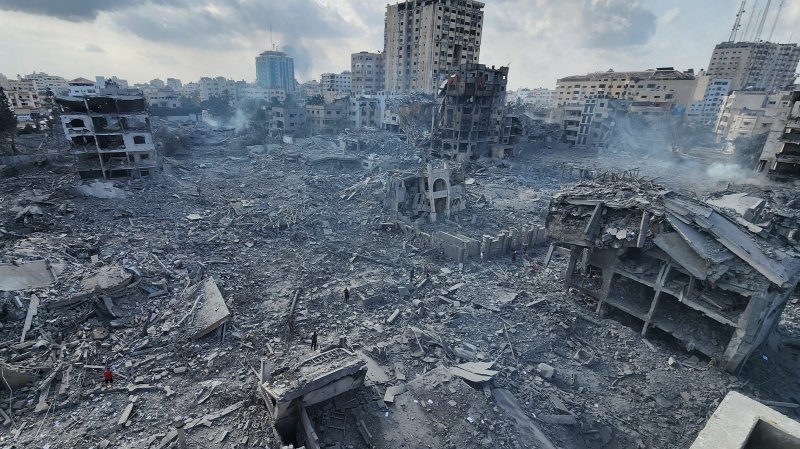 Photo: Al Jazeera
On September 24, President Trump presented a 21-point plan to leaders of several Muslim nations aimed at ending the war and restructuring Gaza. According to those familiar with the plan, it does not propose forcibly expelling Gaza’s residents. Instead, it envisions the creation of a “Property Rights Preservation Department” to protect Palestinian property. Should residents choose to leave voluntarily, they would retain the right to return and maintain ownership of their assets.
Meanwhile, the situation in the West Bank remains deeply entangled. Numerous Israeli settlements are interwoven economically with Palestinian towns and villages. A sudden separation would devastate the already fragile Palestinian economy. In July 2025, the Knesset voted 71–49 in favor of a resolution calling for the annexation of the West Bank. This vote has emboldened some local leaders, such as the sheikhs of Hebron’s clans, to threaten secession from the PNA and negotiate directly with Israel. If this occurs, it could set off a chain reaction, with other clans declaring their own micro-states.
The European recognition of Palestine, therefore, is unlikely to produce immediate tangible effects. Instead, it risks fueling further instability by emboldening both Israeli hardliners and internal Palestinian divisions. In the end, this move seems less about helping the Palestinian people and more about signaling political defiance toward Washington. Without genuine unity among Palestinians, clear borders, and sustainable governance, the dream of an independent Palestinian state remains just that—a dream.
(If you possess specialized knowledge and wish to contribute, please reach out to us at opinions@news.az).


Similar news