Trump`s Gaza resettlement plan: a pragmatic solution to an intractible conflict?



Editor's note: Vladimir Yankelevich is an Israeli expert, Soviet naval officer, and Captain 1st Rank. He was born in 1946 in Baku and graduated from the Higher Naval School in Leningrad. He served in the Pacific Fleet for 27 years. From 1985 to 1991, he was the director of a military factory in Vladivostok. After demobilization in 1992, he founded the Jewish community in the city, and in 1995, he established and led the Jewish Religious and Cultural Community Center. In 2006, he repatriated to Israel. The article expresses the personal opinion of the author and may not coincide with the view of News.Az.
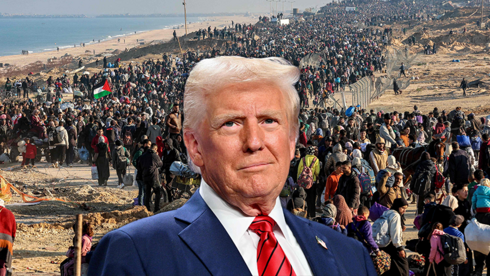
The discourse surrounding Donald Trump’s recent remarks on the voluntary resettlement of Palestinians from Gaza has largely been clouded by selective interpretation. While critics frame the proposal as forced displacement, they conveniently overlook a critical aspect—Trump’s suggestion applies only to those who wish to leave. Given the dire living conditions in Gaza, it is inevitable that some will seek a new beginning elsewhere.
The reality on the ground is bleak. Unexploded ordnance litters the landscape, toxins from relentless bombings permeate the air, and what remains of the built environment is structurally unsound. For many, returning to daily life in Gaza is simply not an option. Trump’s proposal, leveraging substantial U.S. aid to Jordan and Egypt, could exert significant pressure on these nations to facilitate relocation. But beyond logistical feasibility, a more pressing question emerges: Would such a plan contribute to long-term stability in the region?
History has shown that some geopolitical disputes are inherently resolvable, while others remain perennially intractable. Consider the Zangezur Corridor—a contested issue between Azerbaijan and Armenia. Though currently unresolved, a compromise could eventually be reached, and once it is, hostilities will subside. By contrast, the enmity between the Islamic Republic of Iran and Israel is of an entirely different nature. Iran’s regime does not seek negotiation or territorial adjustments; its official position is Israel’s annihilation, and it actively funds militant groups committed to that goal. This is not a disagreement that diplomacy can resolve—it is an existential confrontation. Gaza represents a similarly irreconcilable problem. The population harbors deep-seated hostility toward Israel, as tragically demonstrated by the October 7 attacks. This animosity is not circumstantial—it is rooted in historical and ideological forces that have shaped the region for over a century.
The ideological underpinnings of this conflict can be traced back to the early 20th century, when British authorities entertained the notion of a “Greater Syria,” encompassing modern-day Jordan, Iraq, Syria, Lebanon, and Palestine. This project required a unifying force, which they found in pan-Arabism—a movement that, while initially weak under Ottoman rule, gained traction in the wake of European colonialism. However, the movement’s expansion collided with an obstacle: the Jews. British officials perceived the Zionist movement as a disruption to their grand design. Meanwhile, pan-Arabist ideology continued to proliferate, eventually giving rise to the doctrine that Jews had no place in the region and should be expelled. This idea became foundational to groups like Hamas and Hezbollah, whose existence hinges on the complete destruction of Israel. With such a deeply entrenched ethos, peace agreements with Hamas are illusory. The notion of coexistence contradicts the movement’s very raison d’être. This is why Trump’s proposal deserves serious consideration—it acknowledges the impossibility of reconciliation and seeks an alternative solution.

Egypt, with a population exceeding 112 million, has vast swathes of uninhabited land. Accommodating 1 to 1.5 million Palestinians, given sufficient economic incentives, is logistically plausible. The question is whether President Abdel Fattah el-Sisi would accept such a proposal. Meanwhile, Jordan presents a far more delicate case. Jordan’s demographic makeup is a complex tapestry. The ruling Hashemite monarchy is supported by a coalition of Circassians, Bedouins, and Arab Palestinians—who constitute over 60% of the population. The kingdom has a turbulent history with Palestinian factions, most notably during the 1970 “Black September” crisis, when King Hussein violently suppressed a Palestinian uprising. Thousands perished, and many militants fled to Lebanon, ultimately transforming that country into a battleground for Hezbollah. Today, Jordan’s monarchy is significantly weaker. The army—once a pillar of Hashemite power—has seen its leadership shrink to a narrow circle of elite families, while its lower ranks are largely composed of Palestinians. Injecting more Palestinians from Gaza into this volatile equation could destabilize the kingdom, placing both Jordan and Israel at risk. In this context, resettlement in Jordan is far from an ideal scenario.
Jordan and Egypt are not the only potential destinations. Countries such as Sudan, Morocco, Indonesia, and even Russia could serve as viable options, provided the right incentives are in place. The key to success lies in structuring resettlement as an opportunity rather than an imposition. The conflict between Israel and Hamas is not one that can be resolved through traditional diplomatic means. The deep-rooted ideological and historical drivers of hostility make permanent reconciliation improbable. If a peaceful outcome is to be achieved, bold and unconventional solutions—such as voluntary resettlement—must be explored. Trump’s proposal, controversial as it may be, offers a pragmatic response to an otherwise unsolvable problem.
(If you possess specialized knowledge and wish to contribute, please reach out to us at opinions@news.az).


Similar news