Trump stirs chaos in the Middle East


By Tural Heybatov
The eccentric actions of the new U.S. President, Donald Trump, are beginning to take on alarming dimensions. Initially, many dismissed his claims over Greenland, the Panama Canal, and Canada's independence as absurd, almost surreal news. However, the situation is no longer a source of amusement for observers, as it has started to escalate beyond mere political theatrics.
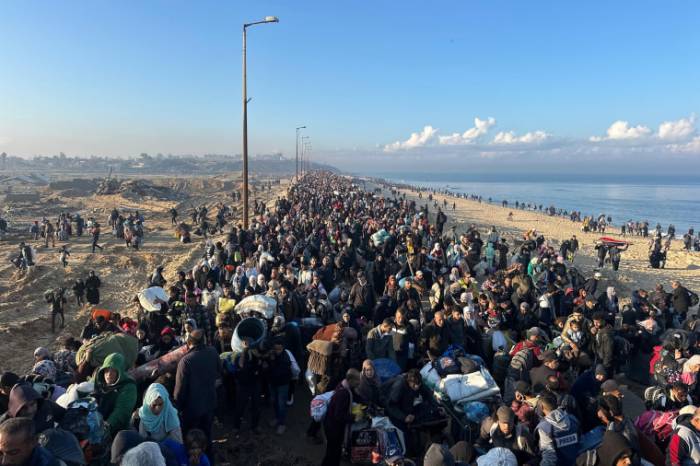
Trump's plans for the Gaza Strip defy any conventional logic. Even international analysts struggle to comprehend the situation, let alone assess it. His intention to forcibly evacuate the entire Arab population from Gaza and relocate them to neighboring countries came as an unprecedented shock to political strategists, leaving them at a loss. The fundamental question—"Can this even be done?"—remains unanswered because Trump’s logic is simply, "Because I want it this way." The new White House leader is determined to prove that the United States is the sole global hegemon, dictating terms to which all must submit.
As reported by international media, Trump has proposed that Jordan and Egypt serve as a "home" for the Palestinians evacuated from Gaza. By "evacuation," he means mass forced displacement. During a joint press conference with Israeli Prime Minister Benjamin Netanyahu at the White House, Trump declared that the United States would take control of the Gaza Strip and oversee the dismantling of unexploded ordnance, other weaponry, and the demolition of destroyed buildings. According to Trump, Gaza is now nothing more than a vast demolition site, completely devastated. The U.S. is prepared to take on the task of clearing it.
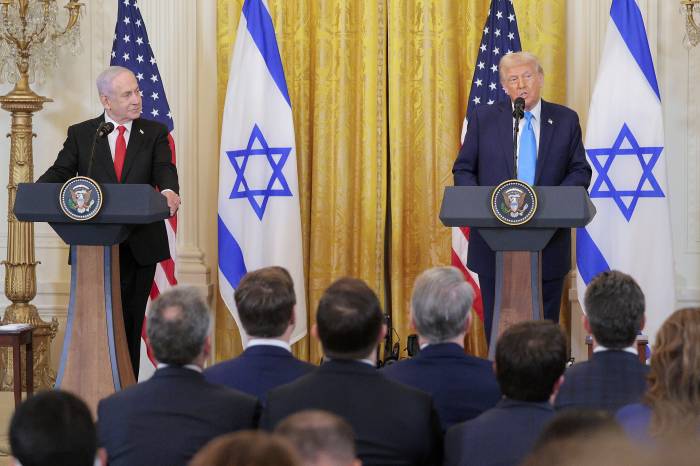 Israeli Prime Minister Benjamin Netanyahu and U.S. President Donald Trump speak during a joint press conference in the East Room of the White House on Feb. 4. Photo: Getty Images
On Wednesday, the U.S. President met with Jordan's King Abdullah II at the White House to discuss the evacuation plan. Trump stated that land would be allocated in Jordan and Egypt where Palestinians could live safely. He expressed confidence that obtaining consent from these countries would not be difficult. As for the right of Palestinians to return to Gaza, Trump argued that they would be far better off in their new settlements in Jordan and Egypt. In his vision, special territories would be created for them in these countries, but returning to Gaza would no longer be an option. The new "owner" of Gaza would not allow it. When asked by a journalist whether Palestinians would have the right to return, Trump bluntly replied, "No, they won’t, because they will have much better housing." He also promised Egypt and Jordan "billions of dollars annually" to fund the resettlement zones.
Meanwhile, the Indonesian Foreign Ministry issued a statement revealing that King Abdullah had rejected the idea of hosting Palestinians in Jordan, emphasizing that his country would act in accordance with its national interests. However, he expressed readiness to accept 2,000 Palestinian children in need of medical assistance. "Indonesia remains firm in its position: any attempt to relocate Gaza residents is unacceptable," the statement read.
Trump’s plans extend beyond Egypt and Jordan. His resettlement scheme also targets Morocco, as well as the unrecognized territories of Somaliland and Puntland in Somalia, where he envisions creating a "Middle Eastern Riviera."
These plans have been widely dismissed as insane. Apart from Jordan, Saudi Arabia, Palestine, the United Arab Emirates, Oman, the Organization of Islamic Cooperation, the Arab League, the Gulf Cooperation Council, the Arab Parliament, Yemen’s Houthis, and, of course, Hamas have all condemned them. Hamas’ opposition is understandable—the terrorist organization would lose both operational space and military capability. The designated relocation areas for Palestinians would undoubtedly remain under U.S. oversight, making it difficult for Hamas to maneuver. In reality, Hamas has little say in the matter, as the current fate of Gaza stems from its own actions—the terrorist attack on Israel’s border that ignited the ongoing conflict.
Trump’s opponents view his plan as a blatant violation of international law, warning that it will only deepen instability and exacerbate the conflict. Many accuse the U.S. of complicity in the genocide of the Palestinian people.
Trump likely anticipated resistance to his forced evacuation scheme. Since October 2023, global opinion on Gaza has solidified, with even traditional supporters of Israel becoming critics of Tel Aviv—including figures in Washington under the previous administration. At the same time, many of those rallying behind Palestine have done so less out of humanitarian concerns and more to align with the prevailing sentiment, especially given the growing criticism of Israel from across the Atlantic. Some have even speculated that this conflict could mark the downfall of Israel, as no one would come to its aid. But then came the U.S. presidential election, Trump returned to power—and everything changed. The wave of global solidarity with Palestine began to recede, and the latest White House plan sent shockwaves through the international community.
Donald Trump is determined. The lack of resistance from Western nations—whom he confronted with territorial claims immediately after taking office—has demonstrated to him that the world is unprepared to push back. This has emboldened the White House to pursue even more ambitious projects.
If Trump succeeds in implementing his Gaza plan, there may be a temporary lull in the region. But only temporary—until the Arab world recovers from the shock. Trump will not be in power forever, and his strategy ultimately places Israel in a vulnerable position. If the U.S. grip on the region weakens, anti-Israeli sentiment could erupt with unprecedented force. And as always, America will walk away, just as it did in Afghanistan and Iraq—leaving behind nothing but perpetual instability.


Similar news