U.S. expands tanker fleet amid growing Chinese naval power


By Asif Aydinli
In recent years, the U.S. has been working hard to strengthen its global naval presence and ensure reliable logistics support for its fleet. With China rapidly expanding and its navy already surpassing that of the U.S. in size, the U.S. has stepped up its efforts. To achieve this, the U.S. has been heavily investing in upgrading and expanding its navy, with a particular focus on military oil tankers and supply ships. One of the biggest moves in this effort was the signing of a contract between the U.S. Navy and shipbuilding company General Dynamics NASSCO, valued at over $6.7 billion . This contract includes building up to eight additional John Lewis-class oil tankers, which marks a significant boost to the U.S. Navy’s support fleet.
The first stage of the deal involves the construction of the 10th tanker in the series, at an initial cost of $780 million, with an option for seven more ships.
With this contract, the number of tankers being built under the John Lewis-class program jumps to 17 out of a planned 20, showing a rapid increase in the U.S. fleet’s ability to transport fuel and supplies — a critical component of military logistics.
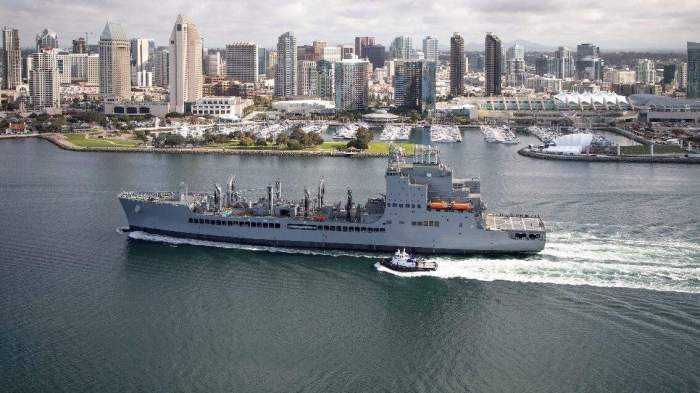
The flagship tanker of this series, the USNS John Lewis (T-AO 205), was delivered to the Navy in July 2022, followed by the USNS Harvy Milk (T-AO 206) and USNS Earl Warren (T-AO 207), which were put into service in July 2023 and May 2024. The USNS Robert F. Kennedy (T-AO 208) was launched in October 2023, with the USNS Lucy Stone (T-AO 209) scheduled for christening and launch in September 2024. Currently, the USNS Sojourner Truth (T-AO 210) and USNS Thurgood Marshall (T-AO 211) are under construction, and the USNS Ruth Bader Ginsburg (T-AO 212) will begin construction in October 2024.
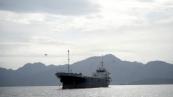
The older Henry J. Kaiser-class oil tankers (T-AO 187), which entered service in the 1980s, are gradually being phased out to make way for the more advanced and efficient John Lewis-class ships. These new tankers are designed to support carrier strike groups, amphibious forces, and other components of the naval fleet around the world. They are capable of carrying up to 162,000 barrels of fuel, including ship and aircraft fuel, along with small reserves of water and food supplies.
The new tankers boast impressive specifications: they are 226 meters long with a full displacement of almost 50,000 tons. Powered by two Fairbanks-Morse 12V48/60CR diesel engines, these tankers can reach speeds of up to 20 knots and have a range of 6,147 nautical miles. Additionally, the ships are equipped with a helicopter deck and defense systems to protect against torpedo and aerial threats, making them a vital part of naval operations worldwide.
Despite these advancements, experts note that the U.S. Navy still faces significant challenges, particularly in the event of a conflict in the Pacific. Military analysts estimate that at least 100 oil tankers of various types would be needed to fully support the fleet and ground forces. Currently, the U.S. lacks a clear plan for long-distance fuel delivery, and supply ships require stronger defenses against modern weapons systems.
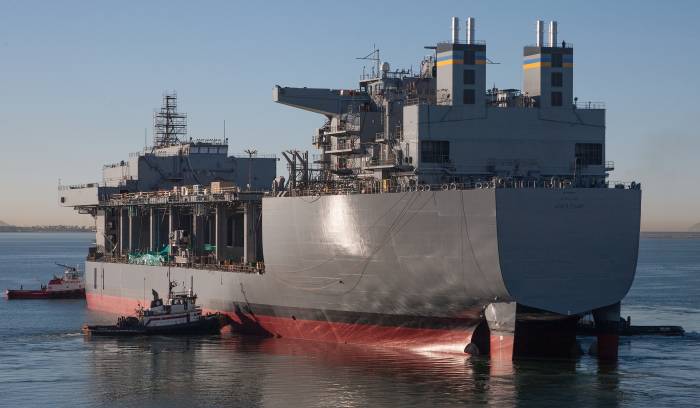
In addition to the John Lewis-class tankers, NASSCO is also actively building Expeditionary Sea Base (ESB) ships, which play a key role in maintaining the mobility and readiness of U.S. forces. These ships have impressive capabilities for supporting maritime operations, including the ability to service helicopters and tiltrotor aircraft. So far, four ESB-class ships have been commissioned, including the USS Lewis B. Puller (ESB 3) and the USS John L. Canley (ESB 6). In May 2024, the USNS Robert E. Simanek (ESB 7) was christened, with the launch of the USNS A. Cafferata Jr. (ESB 8) planned for 2025.
With the U.S. Navy actively ramping up its tanker and support ship capabilities, it's clear that the U.S. is focused on ensuring it remains a dominant global force. However, as military experts point out, the road ahead remains challenging, especially given the scale of the resources and logistics needed to support modern naval operations. The continued expansion of the John Lewis-class tankers is just one part of a broader effort to prepare for the demands of future conflicts — but it’s a crucial one.


Similar news