Pashinyan says EU referendum “illogical” without formal application


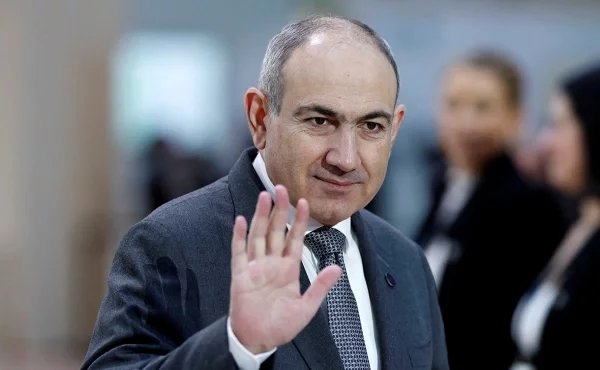
Armenian Prime Minister Nikol Pashinyan has said that holding a referendum on European Union membership would be “illogical” unless Armenia has formally applied for accession or is close to candidate status, arguing that the issue remains largely theoretical.
In a video address posted on his Facebook page on 1 June, Pashinyan, who leads the electoral list of the ruling Civil Contract party, said such a vote would be “unreasonable and unjustified” at the current stage, News.Az reports, citing News Armenia.
“Until Armenia officially applies to join the European Union or is very close to candidate status, holding any referendum is illogical, because there is essentially no justification for it,” he said.
RECOMMENDED STORIES
He added that the government would continue to work “calmly and steadily” within the Eurasian Economic Union (EAEU), which he said still holds “unused potential”.
Pashinyan also outlined Armenia’s model of a “balanced foreign policy”, which he has frequently referenced in recent years, saying statehood can only function through interaction with other countries.
He compared this balance to gravitational forces in space.
“When planets and celestial bodies exist and operate based on certain gravitational relationships, and when those relationships are disrupted and balance is lost, catastrophes occur,” he said.
The prime minister demonstrated a device reportedly developed by Armenian engineers, using it to illustrate how an imbalance between “scales” can lead to “fall or accident”. He stressed that balanced foreign policy does not imply abrupt shifts.
“Establishing balance, restoring balance and forming a new balance must take place as smoothly as possible, so that it remains manageable and does not lead to other types of accidents,” he said.
Pashinyan also said Armenia’s relations with Russia were undergoing transformation, which he described as a positive process.
“In the conditions of this new situation, we are establishing new relations with Russia, and I am confident we will succeed, including because our relations are open and sincere; we have not left any dark corners in these relations,” he said.
On economic policy, Pashinyan said independence meant “replacing dependence on a few with dependence on many”, using a hypothetical example of a single supplier of water to illustrate vulnerability to external pressure.
“If one person brings us water every day, that supplier could, for example, have an accident on the way or fall ill and be unable to deliver it,” he said, adding that a monopoly supplier could turn this dependence into political leverage.
By contrast, he said expanding partnerships reduces risks and improves negotiating positions over prices and volumes.
Pashinyan noted that since 2022 Armenia had established diplomatic relations with countries it had not previously recognised, including Saudi Arabia and Pakistan.
He also said the government was working to normalise relations with Türkiye and Azerbaijan, arguing that existing “imbalances” must be addressed.
“Those empty scales mean disproportions, and restoring that balance is not a matter of whim but a necessity for the state’s functioning,” he said.


Similar news