What India really wants from the EU trade agreement


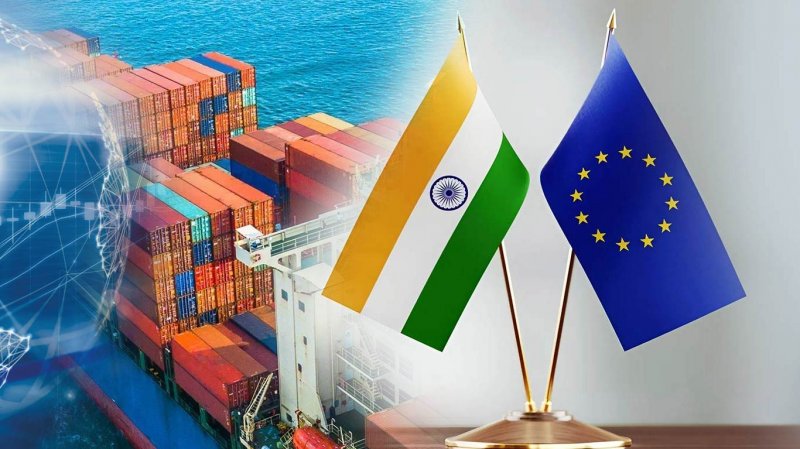
The signing of a free trade agreement between the European Union and India is being presented in Brussels as a major geoeconomic breakthrough and a step towards diversifying partnerships at a time when the old model of globalisation is steadily eroding. Behind the rhetoric of a “new era of cooperation”, however, lies a far more complex and uncomfortable reality. In its current form, the agreement contains deep asymmetries that favour India far more than Europe, while also exposing structural weaknesses in India’s own economic model.
This is not a story of a balanced partnership. It is a story of two economies attempting to use one another to delay confronting their internal problems.
The European Union is increasingly concluding trade agreements not because the terms are optimal, but because its range of strategic options is narrowing. India, by contrast, is exploiting this moment to expand access to the world’s largest consumer market without undertaking reforms that would amount to genuine and reciprocal liberalisation.

Source: NPR
One of the most publicised elements of the agreement is the reduction of Indian tariffs on imported European automobiles from around 110 percent to roughly 10 percent. On paper, this appears dramatic. In practice, it is a tightly managed concession designed to minimise disruption to India’s domestic industry.
India’s car market remains dominated by ultra-low-cost vehicles. European manufacturers cannot realistically compete in the €10,000–15,000 segment that defines mass demand. Even with lower tariffs, European brands remain largely confined to premium niches and to limited local production. India can therefore claim greater openness while subjecting its own producers to minimal competitive pressure.
From the EU’s perspective, this is presented as improved market access. From India’s perspective, it is a controlled experiment.
The imbalance is even more pronounced in information technology and digital services. Indian companies gain expanded opportunities to operate in Europe in software development, outsourcing, and digital support, reinforcing India’s long-standing role as a supplier of low-cost skilled labour to Western corporations.
Yet India’s own digital economy faces significant constraints. Much of its services export sector remains concentrated in routine, low-value-added activities. India has not developed globally dominant technology ecosystems comparable to those of the United States or China. Heavy dependence on Western clients leaves the sector vulnerable to external shocks and political shifts.
In effect, the agreement reinforces India’s position as a service provider rather than a technological rule-setter.
Europe’s comparative strength lies in industrial equipment, energy technology, and infrastructure. India needs power grids, renewable energy systems, transport networks, and industrial automation, and European firms are competitive in these areas.
Even here, however, India maintains a selective approach. New Delhi prioritises localisation, joint ventures, and technology transfer over large-scale imports of finished European products. While this represents rational industrial policy from India’s standpoint, it continues to fuel concerns among foreign investors about intellectual property protection, regulatory unpredictability, and policy reversals.
Source: CNN
These concerns are longstanding and continue to limit the scale and quality of long-term investment into India.
Energy is another central and often overlooked dimension of the relationship. India has benefited from discounted imports of Russian oil and other energy resources, sharply reducing production costs for Indian manufacturers. Europe, meanwhile, has chosen a path of higher energy prices shaped by sanctions policy and climate commitments.
This creates a structural competitiveness gap. Indian goods enter global markets with a cost advantage that no trade agreement can offset.
At the same time, India’s energy model carries its own vulnerabilities. Dependence on discounted imports ties competitiveness to geopolitical circumstances beyond New Delhi’s control. A shift in sanctions regimes, logistics, or global pricing could rapidly erode this advantage.
India’s growth narrative also masks serious internal strains. Regional inequality, high youth unemployment, weak rural infrastructure, and uneven educational outcomes limit the country’s ability to convert demographic scale into sustainable, innovation-driven growth. India remains rich in labour, but lacks the broad, highly skilled middle class required for a genuine technological leap.
For Europe, the agreement does little to address its own strategic crisis. Deindustrialisation, high energy costs, and regulatory overload continue to undermine competitiveness. Opening the European market further to cheaper imports intensifies these pressures.
Trade agreements do not build factories. They do not lower electricity prices. They do not train engineers.
One of the deal’s political selling points is the promise of reducing dependence on China. In practice, India itself remains deeply embedded in Asian supply chains that include Chinese components, machinery, and capital. Europe is not escaping dependence; it is merely changing its form.
Ultimately, the EU–India agreement looks less like a partnership between confident powers and more like a contract between two sides seeking to buy time.

Source: Reuters
India uses Europe as a market, a source of technology, and a platform on which to project its image as a responsible global actor, while avoiding deep domestic liberalisation. Europe uses India to sustain the appearance that it still has strategic alternatives.
This is the core problem. The agreement formalises a new reality in which the EU is no longer the architect of global trade rules, but increasingly a rule-taker.
Neither side secures a true engine for technological transformation. India gains export momentum and industrial scale. Europe gains delay.
And delay is not a strategy.
Europe is moving along a trajectory of persistently high costs, shrinking industrial capacity, and declining global influence. India is pursuing growth through scale, protectionism, and resource arbitrage. These paths do not converge.
In this configuration, the EU risks becoming not a centre of production and innovation, but a premium consumption zone for more aggressive and less constrained economies.
The EU–India free trade agreement does not reverse this trend. It conceals it.
That is why the deal should be seen not as a success story, but as a document of Europe’s strategic narrowing — a moment when Brussels increasingly chooses not between good and bad options, but between bad and worse.
And that is what ultimately makes the agreement so revealing: it speaks less about India’s rise than about how deeply Europe has lost confidence in its own economic model.
By Tural Heybatov


Similar news