Why Baku is betting big on the United Arab Emirates


Editor’s note: Abulfaz Babazadeh is a scientist, a scholar of Japanese studies, and a political observer, as well as a member of the Union of Journalists of Azerbaijan. The views expressed in this article are the author’s own and do not necessarily reflect the position of News.Az.
In today’s fragmented global landscape, where traditional alliances are under pressure and economic security is inseparable from geopolitics, Azerbaijan’s deepening partnership with the United Arab Emirates stands out as one of Baku’s most strategically calculated foreign policy moves.
This is no longer a relationship built on diplomatic symbolism or occasional high-level visits. It is evolving into a multi-layered strategic axis connecting energy transformation, infrastructure, defense cooperation, finance, logistics, and long-term investment planning. In many ways, the UAE has become one of Azerbaijan’s most consequential partners beyond its immediate neighborhood.
President Ilham Aliyev’s recent working visit to Abu Dhabi should be seen through this lens. It was not merely another stop on a diplomatic calendar; it reflected a broader shift. Azerbaijan is systematically integrating itself into the Gulf’s economic and investment ecosystem while positioning itself as a reliable Eurasian platform for Emirati capital.
What makes this partnership particularly significant is its balance. Unlike relationships built solely around hydrocarbons, Azerbaijan and the UAE are constructing a diversified cooperation model that spans both traditional energy and future-oriented sectors.
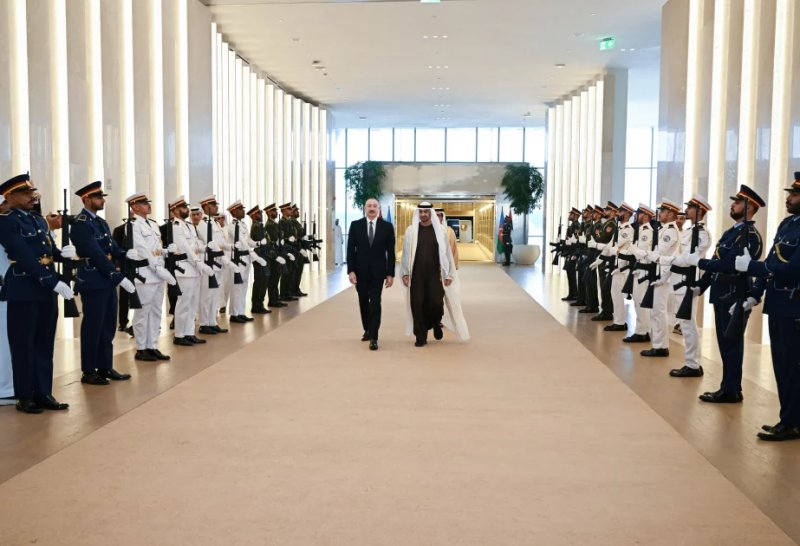 Photo: AZERTAC
Energy, of course, remains the backbone. But the logic has shifted. The partnership is no longer about simple upstream deals; it is about shared participation across value chains, infrastructure ownership, and long-term strategic assets.
The entry of XRG, the investment arm of Abu Dhabi National Oil Company (ADNOC), into a non-controlling stake in Azerbaijan’s Southern Gas Corridor is emblematic. This move signals that Emirati capital is not just investing in individual projects but in Azerbaijan’s role as a systemic energy transit hub connecting the Caspian basin to Europe. Few investments carry such geopolitical weight.
Cooperation between SOCAR and ADNOC in upstream projects, including the Absheron gas field and reciprocal stakes in Emirati fields, demonstrates a level of mutual trust that goes beyond transactional logic. These are partnerships rooted in long-term strategic convergence.
Yet the most transformative dimension of Azerbaijan–UAE ties lies in renewable energy. Azerbaijan has set an ambitious course toward becoming a regional green energy hub, and the UAE has emerged as a key driver of this ambition. The 230 MW Garadagh solar power plant, developed with Masdar, was only the beginning. New wind and solar projects with a combined capacity of around 1,000 MW and investments approaching $1 billion represent a structural shift in Azerbaijan’s energy landscape.
This cooperation does more than help Azerbaijan reduce carbon intensity. It strengthens energy sovereignty, frees up additional natural gas for export, and positions the country as a future supplier of green electricity and, potentially, green hydrogen.
In other words, Emirati investment is accelerating Azerbaijan’s shift from a traditional hydrocarbon exporter to a diversified energy power with multiple revenue streams.
Equally significant is what is happening beyond energy.
The establishment of a $1 billion joint investment fund between Azerbaijan and Abu Dhabi development institutions marks a new chapter. It provides a mechanism for systematic co-financing of projects in non-oil sectors, including manufacturing, logistics, agriculture, digital infrastructure, and urban development.
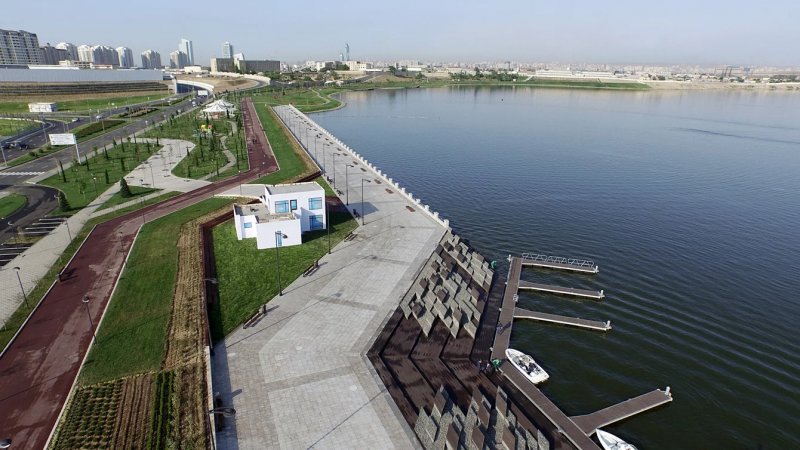 Photo: Wikimedia Commons
The planned $5 billion urban development project around Lake Boyukshor in Baku, in cooperation with Modon Holding, illustrates the scale of ambition. This is not about isolated real estate ventures — it is about reshaping urban ecosystems, creating modern residential, commercial, healthcare, and hospitality clusters that reflect global standards. Such projects contribute directly to Azerbaijan’s long-term goal of building a diversified, high-value economy rather than one dependent on commodity cycles.
Defense cooperation, including plans for deeper institutional interaction and joint exercises, adds another layer. While Azerbaijan pursues a balanced, non-bloc foreign policy, expanding practical military cooperation with technologically advanced partners strengthens its deterrence posture and operational interoperability. In a region marked by persistent volatility, diversified security partnerships provide strategic flexibility.
Tourism and people-to-people ties further reinforce the strategic depth of relations. The rapid growth in direct flights between Azerbaijani and Emirati cities, combined with rising tourist flows in both directions, reflects a maturing relationship that extends well beyond government corridors.
Economic interdependence is also tangible. Over the past decades, Emirati investments in Azerbaijan have reached several billion dollars, while Azerbaijani investments in the UAE are steadily growing. These figures are not just statistics — they are indicators of mutual confidence.
Taken together, these trends point to a clear conclusion: Azerbaijan’s partnership with the UAE is no longer a supplementary foreign policy track. It is becoming one of the central pillars of Baku’s external economic and strategic architecture.
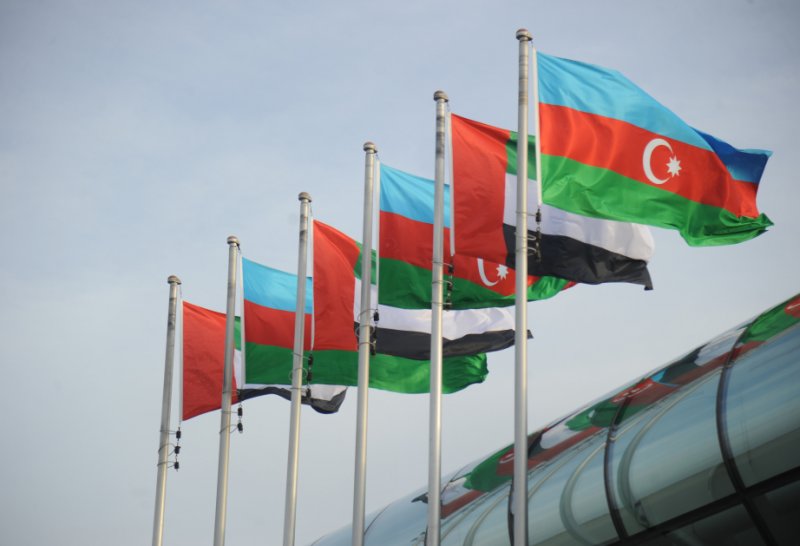 Photo: AZERTAC
For Azerbaijan, this partnership provides access to capital, technology, global investment networks, and new markets. For the UAE, Azerbaijan offers political stability, strategic geography, energy infrastructure, and a gateway to the wider Caspian, Central Asian, and European regions.
This is a classic win-win formula, one that works because both sides approach it with long-term thinking. In an era when many countries struggle to convert diplomatic goodwill into concrete economic outcomes, Azerbaijan and the UAE are demonstrating how strategic alignment can be translated into real assets, projects, and influence.
It is for this reason that this partnership should not be seen as a collection of deals but as a blueprint for how mid-sized powers can build resilient, forward-looking alliances in a rapidly changing world.
(If you possess specialized knowledge and wish to contribute, please reach out to us at opinions@news.az).


Similar news