Why is the West punishing Georgia?


By Tural Tagiyev
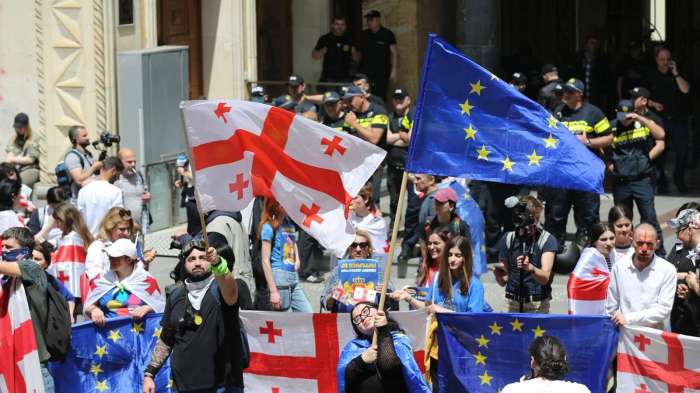
In recent months, Georgia has come under significant pressure from Western countries. This is related to Georgia's adoption of the "Law on the Transparency of Foreign Influence," which the West views as a Russian initiative.
The EU has decided to suspend Georgia's integration into the union. EU Ambassador to Georgia, Pawel Herczyński, stated that the law "on foreign agents" and anti-Western rhetoric contradict the goals of the country's accession to the EU. This decision came as a surprise to many in Georgia, as the country had been striving for European integration for many years, seeing it as a path to economic and political development. Nevertheless, the new EU requirements have sparked a wave of discontent among Georgian politicians and citizens.
On July 9, Russia's Foreign Intelligence Service stated that the US is planning a change of power in Tbilisi. It is claimed that Georgian President Salome Zourabichvili could play a key role in inciting anti-government sentiments, and American overseers have already instructed the opposition to plan protests for the autumn parliamentary elections. However, US State Department spokesman Matthew Miller denied this statement. The Russian intelligence agency's statement also mentioned Western attempts to destabilize the situation in the country through financial and political support of opposition forces.
In Tbilisi, a founding meeting of a new socio-political movement "United Neutral Georgia," which opposes integration into the EU and NATO, took place. The movement's leader, Vato Shakarashvili, stated that European integration had become a religion, which is a crime against the people. He criticized the government for turning NATO integration into a constitutional goal. Shakarashvili emphasized that such a policy harms Georgia's national interests and called for a revision of the country's foreign policy course.
Western-oriented Georgians had high hopes for the NATO summit in Washington. However, the declaration adopted at the summit showed that the situation with Georgia remains tense. Senior Fellow at the Hudson Institute, Luke Coffey, noted that mentions of Georgia's aspiration to NATO membership were excluded from the final document. This caused disappointment among Georgian politicians striving for integration into Western structures and raised new doubts about the country's future.
The US canceled the multinational NATO exercise "Noble Partner," held in Georgia since 2016. The US is also reviewing all cooperation programs with Tbilisi to change the strategic course of the Georgian government. This decision caused serious concerns in Tbilisi, as the "Noble Partner" exercises played a significant role in preparing the Georgian armed forces and strengthening the country's defense capabilities. The suspension of the exercises is seen as an attempt to pressure the Georgian government and force it to change its foreign policy.
France and Germany have refused financial support to Georgia. French Ambassador to Georgia Sheraz Gasri stated that after the adoption of the "foreign agents" law, France is suspending financial assistance to the Georgian government. France's decision caused serious economic problems in the country, as many projects and programs depend on foreign funding. Germany also decided to suspend financial assistance, exacerbating the economic situation in Georgia.
Political expert Ilgar Velizade noted that recently Georgia has been directing its efforts towards China. "Chinese companies are involved in the construction of infrastructure projects, Chinese banks are active in the country, and visas for Chinese citizens have been simplified. China's economic proposals seem more advantageous, so Georgia is developing relations with Beijing." Velizade emphasized that China offers more attractive conditions for cooperation than the West, and this is one of the main factors pushing Georgia to strengthen ties with Beijing.
Russia remains the main market for Georgian products, a quarter of tourists in Georgia come from Russia, and financial transfers between the countries are significant. The West demands that Georgia limit relations with China and Russia, but will this benefit the Georgian economy? The Georgian government seems to have already found an answer to this question. Georgia is striving for a more balanced foreign policy, taking into account its national interests and economic feasibility," noted I. Velizade.
The political scientist also touched on statements by Russian officials about the planned coup in Tbilisi by the West. "Western countries finance NGOs to support the Western political course of Georgia. If the Georgian government starts cooperating with China and Russia, NGOs begin to resist. The Georgian government is aware of this and is questioning how to respond to Western interference in the country's internal affairs. In this situation, Georgia must find a balance between its national interests and external pressure to ensure stable development and security for the country," the expert stated.


Similar news