APEC leaders pledge inclusive trade in joint declaration


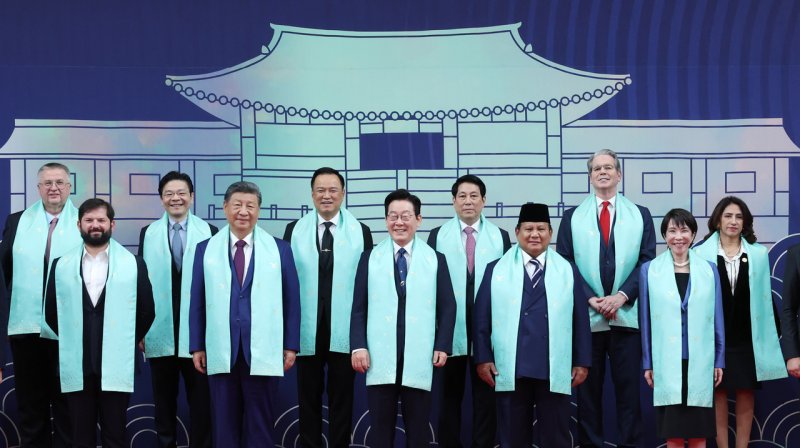
Leaders of the Asia-Pacific Economic Cooperation (APEC) on Saturday emphasized that trade and investment should advance in ways that benefit all, according to a joint declaration issued at the conclusion of their regional forum.
The Gyeongju Declaration was adopted following a two-day gathering of the 21 APEC member economies, which together account for more than half of the global economy, News.Az reports, citing Yonhap.
The declaration underscored the members’ shared commitment to robust trade and investment as essential drivers of growth and prosperity in the Asia-Pacific region. It also highlighted the importance of deepening economic cooperation to navigate the evolving global economic environment.
"We acknowledge the importance of a trade and investment environment that promotes resilience and benefits for all," it said.
The 21 APEC member economies include the United States, China, Japan, Russia, Canada, and others in Southeast Asia and the Pacific, as well as Peru and Chile.
Compared to the declarations issued in the past APEC meetings, this year's document omitted the language reaffirming shared commitment to uphold the multilateral trade system, reflecting the widening gap in the views of trade among the world's major economies.
Whether and to what extent the leaders will reach a consensus on free trade had been a key point of attention for this year's APEC, given the return of the Donald Trump administration with its "America First" policy and the ongoing tit-for-tat trade war with China.
For the past few years, most of the APEC economies have endorsed the World Trade Organization (WTO)-based free trade order in their joint declarations.
This year's declaration showed that the reference to the WTO system has been dropped.
Between 2021 and 2024, all APEC summit declarations included mention of a rules-based multilateral trading system with the WTO "at its core," which first appeared in the 2021 declaration, after Trump's first term ended.
The APEC leaders' declaration can only be adopted by consensus, with support from every single member economy.
Aside from trade, the declaration puts an emphasis on technological advancements driven by artificial intelligence (AI) and demographic changes -- the two key initiatives South Korea has pushed to highlight as this year's host.
The declaration, for the first time, recognizes cultural and creative industries as a new growth driver for the Asia-Pacific region and reflects the member economies' shared understanding and commitment to cooperation on AI and demographic changes, the presidential office said.
Alongside the declaration, the leaders also adopted two separate documents on an AI initiative and responding to demographic changes.


Similar news