China's BYD to delay mass production at Hungarian plant


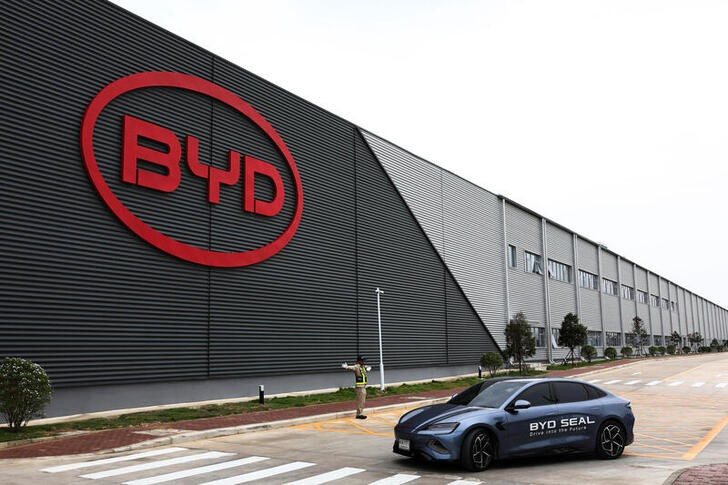
China's leading automaker, BYD, will delay the start of mass production at its new electric vehicle (EV) factory in Hungary until 2026, according to sources familiar with the situation.
The plant will also operate below capacity for the first two years, News.Az reports, citing Reuters.
At the same time, China's No. 1 automaker will start making cars earlier than expected at a new plant in Türkiye where labour costs are lower, and will vastly exceed its announced production plans, one of the sources said.
Shifting production away from Hungary in favour of Türkiye would be a setback for the European Union, which has been hoping that its tariffs on EVs made in China would bring in Chinese investments and well-paid manufacturing jobs.
BYD's 4 billion euro ($4.64 billion) plant in Szeged, in southern Hungary, will start mass production in 2026 but only make a few tens of thousands of vehicles over the whole year, the sources said.
That would be a fraction of the plant's initial production capacity of 150,000 vehicles BYD. It should eventually have a maximum capacity of 300,000 cars per year.
A third source confirmed the slower 2026 start-up.
BYD has said it will launch operations at Szeged in October, but has not said publicly when mass production will start. Production at Szeged is due to increase in 2027, but will still be below planned capacity, the sources said.
Meanwhile, the automaker's $1 billion plant in Türkiye, which had been slated to start production at the end of 2026 with an annual capacity of 150,000 cars, will make more cars than the Hungarian plant next year, one of the sources said.
Production at the plant in Manisa, western Türkiye, will far exceed 150,000 cars in 2027 and BYD will greatly increase output again in 2028, the source added.
The sources spoke on condition of anonymity because they were not authorised to discuss BYD's production plans publicly.
BYD is building the plant in Hungary to sell cars in Europe tariff free. All the cars it currently sells in Europe are made in China, and subject to EU anti-subsidy tariffs on Chinese-made EV imports on top of the standard 10% duty. In BYD's case, the total tariff is 27%.
Many of the cars made at the new plant in Türkiye will also be destined for Europe and face no tariffs when exported to the European Union.
A shift toward cheaper production in Türkiye would highlight the challenge for Chinese carmakers that want to build cars in Europe to avoid punitive tariffs, but balk at the region's higher wages and energy costs.
Under right-wing Prime Minister Viktor Orban, Hungary, which will be the headquarters for BYD's European operations, has become an important trade and investment partner for China.
Turkey has long served as a low-cost manufacturing hub for major automakers including Toyota, Stellantis, Ford, Hyundai and Renault.
In March, the Turkish government said China's Chery will invest $1 billion in a plant with an annual production capacity of 200,000 vehicles.


Similar news