Chinese President Xi Jinping visits North Korea amid shifting geopolitical realities


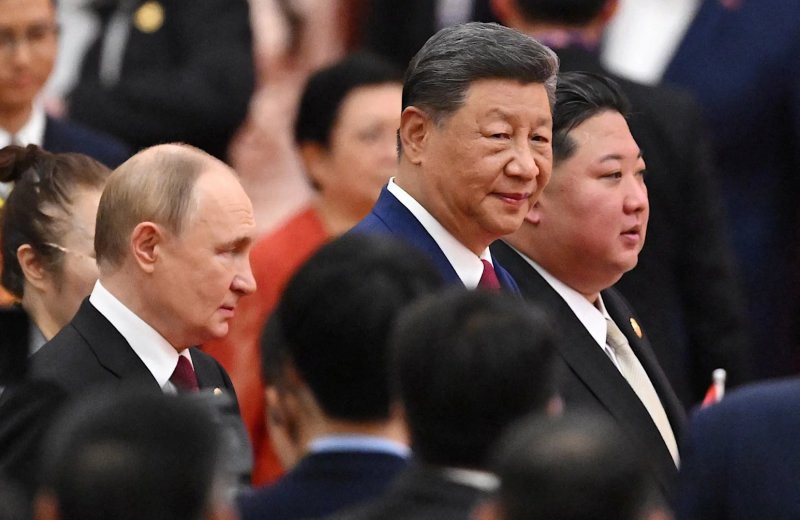
Chinese President Xi Jinping has traveled to Pyongyang, marking his first trip abroad in more than six months and his first visit to North Korea since 2019.
Prior to this departure, Xi had stayed put in China for over half a year, during which an impressive and long list of international leaders traveled to Zhongnanhai, the compound at the heart of power in Beijing, to meet with him, News.Az reports, citing Al Majalla.
This call list included French President Emmanuel Macron, British Prime Minister Keir Starmer, US President Donald Trump, and Russian President Vladimir Putin, as well as German Chancellor Friedrich Merz and South Korean President Lee Jae-myung. Chinese officialdom has framed Xi’s high-profile visit to Pyongyang as a reciprocal protocol visit following North Korean leader Kim Jong Un's trip to Beijing in September 2025, which marked the 80th anniversary of Japan’s defeat in the Second World War.
RECOMMENDED STORIES
Western observers and experts have viewed the visit through the lens of the "high school dating effect"—a metaphor implying that China has taken a renewed interest in Pyongyang after years of relative coolness, spurred by the recent Russian-North Korean rapprochement and Donald Trump’s campaign-trail interest in reopening communication channels with Kim Jong Un. Given the powerful symbolism of Xi’s movements as China’s geopolitical weight grows, the trip is widely interpreted as a forceful sign of Beijing’s desire to reshape its relationship with Pyongyang.
Historically captured by Mao Zedong’s famous dictum, “If the lips are gone, the teeth will be cold,” which placed North Korea at the center of China’s national security equation before the 1970s, the relationship now faces a period of redefinition. The four axes that have traditionally defined their ties—the nuclear question, economic interdependence, the China-North Korea-Russia triangle, and regional calculations involving Japan and South Korea—all require recalibration amid current global transformations.
The diplomatic developments, that Xi’s visit to North Korea took place less than a month after he received Trump in Beijing. Strikingly, the Chinese statement issued after that bilateral summit was the first to explicitly mention discussions regarding the North Korean file. This prompted a US clarification two days later via a published "fact sheet," which confirmed that both leaders had discussed the denuclearization of the Korean Peninsula—a specific detail that had been conspicuously omitted from China's official account of the meeting.
Since North Korea’s first nuclear test, China has officially supported the principle of denuclearization, actively participating in the Six Party Talks and approving United Nations sanctions imposed on Pyongyang. However, this long-standing position now faces mounting challenges as North Korea has firmly entrenched itself as a nuclear power.
Pyongyang has steadily increased its production of nuclear fuel and radioactive materials while developing intercontinental ballistic missiles capable of carrying nuclear warheads. Consequently, North Korea now explicitly links any future diplomatic negotiations to the formal recognition of its status as a de facto nuclear state, drawing parallels to the international standing of India and Pakistan.
By Leyla Şirinova


Similar news