The exchange of strikes between Iran and its adversaries is rapidly transforming a regional conflict into a source of global energy risk. Drone attacks on Saudi Aramco facilities in Ras Tanura, a fire at infrastructure in the Ahvaz area, and reports of an almost complete halt in tanker traffic through the Strait of Hormuz together paint an alarming picture for the global oil market.
The oil refining complex in Saudi Arabia is not merely an industrial site. Saudi Aramco accounts for a significant share of global crude exports, and any disruption to its operations is viewed by traders as a direct supply risk. Even if the actual damage proves limited, the mere suspension of production heightens market anxiety.
At the same time, reports have emerged of a fire on an oil pipeline in Ahvaz, a strategic center of Iranian oil production in Khuzestan province. Historically vulnerable during the Iran–Iraq War, the region has once again come into focus as a zone of military risk. Ahvaz is a key transit hub for crude from the largest fields of Iran, which provide up to a quarter of the country’s output. Any threat to this infrastructure increases concerns about supply stability. Moreover, Ahvaz is one of the country’s primary oil production centers and is home to Iran’s largest oil field, which produces approximately 750,000 to 800,000 barrels per day, or 20 to 25 percent of total crude output.
However, the central issue is neither Ahvaz nor Saudi Aramco. What most concerns global exporters and importers is the fate of the Strait of Hormuz. Around one-fifth of global oil consumption and a significant share of liquefied natural gas trade pass through this corridor. According to estimates by the U.S. Energy Information Administration, about 20 million barrels of oil and petroleum products move daily along this route. Iran itself exports between 90 and 99 percent of its oil through the Strait of Hormuz. Oil and gas account for roughly 25 percent of the country’s GDP and 45 percent of state budget revenues.
Experts warn that even a partial reduction in shipping could trigger a spike in oil prices. A full and prolonged blockade would effectively draw major Asian importers, primarily China and India, which depend heavily on Middle Eastern crude, deeper into the conflict. For this reason, analysts argue that Iran would be unable to keep the strait closed for long.
On March 1, Reuters reported that the naval forces of the Islamic Revolutionary Guard Corps announced via VHF radio that vessels were prohibited from crossing the Strait of Hormuz and that the IRGC was closing it. Major oil companies had already suspended shipments of crude, fuel, and LNG through the strait even before the IRGC’s announcement.
Meanwhile, Iranian Foreign Minister Abbas Araghchi said in an interview with Al Jazeera that Tehran does not intend to block the Strait of Hormuz or disrupt maritime traffic. At this stage, he said, no measures are planned that would interfere with navigation in the strait.
Iran’s ambassador to Azerbaijan, Mojtaba Demirchilou, also confirmed on Monday that the Strait of Hormuz remains open to shipping, noting that it is one of the world’s key economic arteries.
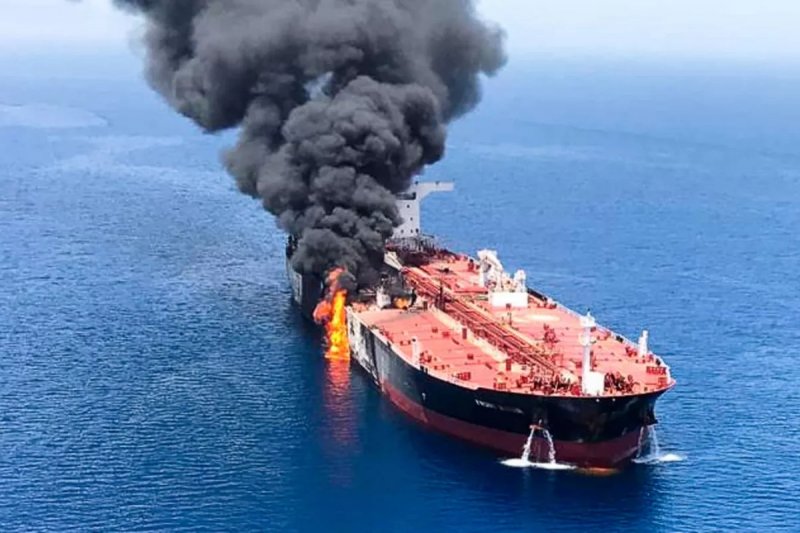
Nevertheless, an Iranian missile strike on the Skylight tanker, sailing under the flag of Palau, has raised doubts among carriers. The vessel caught fire and sank on March 1. Other tankers have been reluctant to enter the strait despite assurances from Iran’s Foreign Ministry. According to Reuters, at least 100 tankers have gathered off the coasts of the UAE and Oman, outside the Strait of Hormuz.
Global oil prices are closely tied to developments in the Strait of Hormuz.
Source: Reuters
As reported by Deutsche Welle, on March 2 the price of April Brent crude rose 14 percent in the first minutes of trading to $82.37 per barrel, reaching its highest level since July 2024. U.S. West Texas Intermediate crude climbed to $75.33, its highest level since June 2025. After the initial surge, prices eased slightly, but gains remained at around 9 percent.
If the conflict drags on, if attacks on oil infrastructure in Iran and the Gulf states continue, and if trade routes are blocked, experts estimate that oil prices could rise above $100 per barrel.
Not only oil but also gold rose on Monday. At the start of trading on March 2, the price per troy ounce reached $5,393, once again approaching the record of $5,600 set at the end of January.
Investment firm Goldman Sachs forecasts a sharp rise in gas prices as well. Gas prices are typically less affected by geopolitical shocks, which are usually reflected primarily in oil prices as the benchmark of the global fuel market. This time, however, as Bloomberg notes, a halt in LNG supplies due to the closure of maritime routes could lead to a 130 percent increase in European natural gas prices and Asian spot LNG prices.
Even without a dramatic price spike, current developments will inevitably affect the oil market. During the 12-day war, Brent prices jumped 7 percent to $74 per barrel just hours after the strike on Iran, even though Iranian and neighboring oil and gas infrastructure were not damaged at that time. The exchanges of fire were less intense and subsided quickly. Now, however, the situation is different. Donald Trump has vowed to bomb Iran “for as long as necessary to achieve the objective.” Iran’s retaliatory strikes have also become more serious.
Although Monday’s news offers little reassurance, there remains hope that reason will prevail. Yet that hope appears far fainter today than it did in June last year.
News.Az