Global trade truce or tactical pause? Busan turning point in U.S.–China relations


.png)
Editor’s note: Faig Mahmudov is a journalist based in Azerbaijan. The views expressed are the author’s own and do not necessarily reflect those of News.Az.
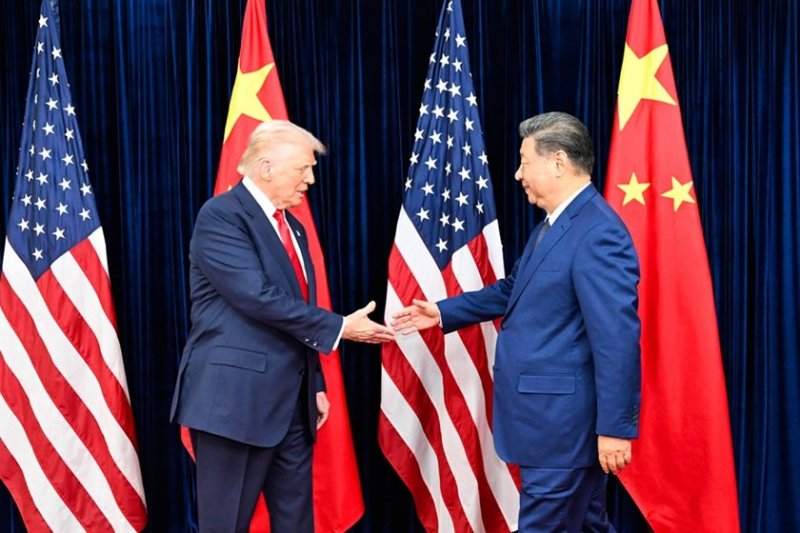
Donald Trump and Xi Jinping met in Busan, South Korea, on October 30, 2025, for talks that may mark a turning point in the U.S.–China trade and geopolitical relationship. The meeting, which lasted about 1 hour 40 minutes, ended with both sides announcing a limited but symbolically important easing of tensions.
The United States agreed to reduce tariffs on Chinese goods, with Trump saying the average rate would fall from 57 % to 47 %, while China pledged to postpone new restrictions on rare-earth exports and resume large-scale purchases of American soybeans and other agricultural products.
The package also included Chinese commitments to tighten controls on fentanyl precursor exports, an issue Washington had pressed throughout the talks. Although these steps remain mostly political declarations at this stage, the direction is clear: a shift from confrontation to managed de-escalation.
Source: Insider
At the same time, the U.S. Senate voted 51–47 to terminate the national emergency powers that had allowed the Trump administration to impose sweeping global tariffs on more than 100 countries. The vote, while largely symbolic, reflects growing unease in Congress and the business community over the economic costs of the high-tariff regime and its inflationary impact. The move does not immediately lift tariffs, as the House of Representatives still has to act, but it signals political backlash against unilateral trade measures.
Taken together, the Busan meeting and the Senate vote suggest that Washington and Beijing are looking to pause their economic confrontation - not end it, but manage it more predictably.
China’s one-year suspension of additional export curbs on rare earths may calm markets in the short term. These 17 elements are essential for electric vehicles, wind turbines, semiconductors, and defense electronics. China dominates global processing, refining, and magnet manufacturing, accounting for about 69% of global rare-earth ore production in recent years, and more than 90% of refining capacity. Some sources estimate China controls about 92% of rare-earth refining and 98% of permanent-magnet production. This gives Beijing significant leverage. For example, China produced roughly 270,000 metric tons of rare-earth oxide equivalent in 2024; the U.S. produced around 45,000 tons.

Source: Ciphernews
The Busan deal, therefore, defers risk rather than removing it. Companies now have more time to diversify supply chains, while the United States is expected to continue supporting domestic mining and processing and building alliances with partners such as Japan, Australia, and Canada. Trump declared that “the rare earth issue is settled,” but Chinese statements were more cautious, calling the outcome “a hard-won consensus” that leaves room for adjustment. In practice, Beijing’s licensing regime remains in place, and only some of the newly proposed restrictions have been postponed.
Lower U.S. tariffs could modestly ease inflationary pressure and reduce costs for manufacturers dependent on Chinese components. Analysts note that imported consumer goods could become cheaper, and supply chains disrupted since 2018 may partially normalize.
China’s pledge to buy 25 million tons of soybeans annually for three years restores an export channel worth billions to U.S. farmers, while increasing competition for Brazil and Argentina. For China, the deal helps stabilize the food supply and keeps inflation in check. For the global economy, it suggests a temporary truce that may stabilize commodity and logistics markets.

Source: Reuters
However, structural risks remain. None of the major disputes, including advanced chip export controls, Taiwan, cybersecurity, or intellectual property, have been resolved. The agreement is a breathing space, not a reset. Trade tensions could quickly re-emerge if political or security triggers appear. The Senate vote, while notable, does not bind the executive branch, and future tariff changes could be reversed overnight. In other words, the Busan meeting has paused escalation, but not ended competition.
For the Caspian and Central Asian region, especially Azerbaijan, Kazakhstan, and Uzbekistan, the deal opens a narrow but important opportunity. As global buyers seek alternatives to Chinese rare-earth supply, these countries can position themselves as emerging sources of strategic minerals. They can accelerate exploration, processing, and ESG certification to attract Western investors and align with European Union and U.S. standards.
The Trans-Caspian route, also known as the Middle Corridor, could serve as a logistics backbone for transporting refined materials to European and Asian markets. Regional cooperation on geological mapping, mineral processing, and value-added production could turn the region into a genuine player in the critical-minerals supply chain.

Source: CNN
Tariff easing may also benefit the energy and petrochemical sectors. For example, Azerbaijani projects such as SOCAR’s petrochemical operations could gain from smoother trade logistics and potential cost savings on equipment imports. But given the volatility of global policy, new contracts should include clauses addressing tariff and export-control risks.
Meanwhile, China’s return to large U.S. soybean purchases could reduce global feedstock prices, indirectly lowering feed costs for livestock producers in Azerbaijan and Central Asia.
Regional governments should act quickly and strategically. A “smart hedging” approach is essential, securing dual supply sources, inserting risk clauses in contracts, and pursuing technology partnerships in battery materials, magnets, and critical-mineral processing. The next six months could be decisive: conducting mineral audits, establishing ESG certification systems, modeling logistics scenarios along the Middle Corridor, creating trilateral supply consortia among Azerbaijan, Kazakhstan, and Uzbekistan, and developing industrial clusters for refining and magnet production. These steps could transform the region from a raw-material exporter into an integrated node in the global value chain.
In essence, the Busan meeting between Trump and Xi represents not a reconciliation, but a recalibration of rivalry. It shifts the relationship from open confrontation to managed competition. Tariff reductions and the pause in rare-earth restrictions offer temporary relief to global markets, but the world remains heavily dependent on Chinese processing and technology.
For the Caspian and Central Asian economies, this is a strategic window: to modernize their resource industries, strengthen their logistical role between East and West, and insert themselves into the evolving global supply network. The actions taken now will determine whether the region stays on the periphery of global trade or emerges as a critical link in the new economic order.
(If you possess specialized knowledge and wish to contribute, please reach out to us at opinions@news.az).


Similar news