
JPMorgan has identified six speculative growth stocks it considers particularly vulnerable to a reversal if any major macroeconomic event occurs, News.Az reports, citing Bloomberg.
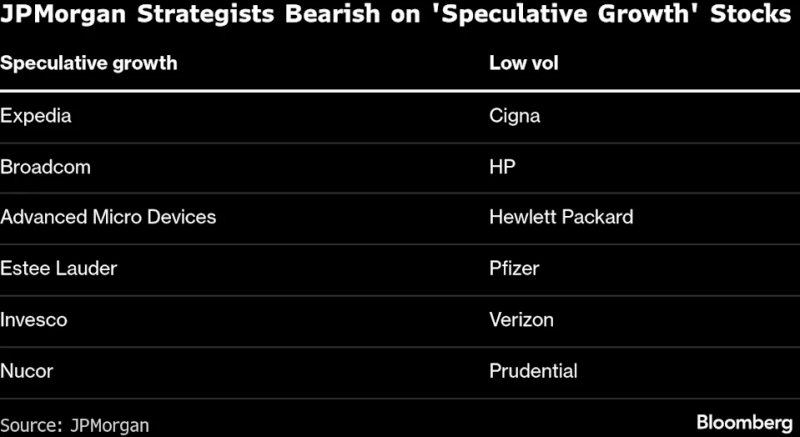
The list includes Broadcom Inc., Advanced Micro Devices Inc., Expedia Group Inc., Estee Lauder Cos Inc., Invesco Ltd., and Nucor Corp.
The S&P 500 dropped 1.2% on Wednesday, marking a fourth consecutive day of losses following a record high last week. Tech shares led the selloff as investors rotated out of recent winners—precisely the scenario JPMorgan quants had warned about. They noted that crowding in these high-risk, volatile stocks has reached the 99th percentile—an “extreme” level that could trigger a sharp unwind, prompting investors to consider hedging.
“These companies are more sensitive to shocks, leaving them at risk of sudden repricing,” wrote Bram Kaplan, JPMorgan’s head of Americas equity derivatives strategy. He added that low-volatility stocks now offer a more attractive risk-reward profile compared to the more speculative, highly volatile names, many of which are tied to second-order AI plays.
Since Dec. 10, Broadcom shares are down more than 21%, while Advanced Micro Devices has dropped 11%. Estee Lauder, Invesco and Nucor are in the red as well, with only Expedia up about 3%.
Investors looking for winners from the artificial intelligence trade this year fanned out from Big Tech names like Nvidia Corp. and Microsoft Corp., and piled into names they expect to benefit from the AI wave. JPMorgan called the ones that made its list “second-order speculative AI beneficiaries” and said they are vulnerable to big swings because they have to tap capital or debt markets to fund expansion, rather than rely on internal growth.
Kaplan offers a simple recipe for clients looking to trade the moment: buy bearish put options on speculative names and take bullish positions on less volatile stocks. Investors can consider shorting some of the high-momentum names, while taking long positions in duller “low volatility” stalwarts like Cigna Group, Pfizer Inc. and Verizon Communications Inc.
There is the chance, of course, that the four-day slump in these momentum stocks could merely be a temporary rotation away from a few hot stocks, rather than any significant change to the landscape. That criticism is bolstered by Micron Technology Inc.’s blowout earnings on Wednesday, that are pushing AI stocks higher once again.
“Real asset owners — retail investors and large institutions — are the only market participants capable of moving markets beyond short-term, shallow and technical drawdowns,” Alexis Maubourguet, chief investment officer of the Swiss hedge fund Adapt Investment Managers, said in an interview. “It will take a meaningful fundamental change for them to liquidate their positions, such as a material shift in the AI narrative.”
Nevertheless, there’s been a growing sense that the AI trade is no longer capable of lifting all boats, with investors trying to sort out winners and losers.