Kaliningrad honors Azerbaijani heroes of Königsberg assault


.png)
In Kaliningrad, Russia, ceremonial events are being held these days to mark a historic date – the Day of the Heroic Storming and Capture of Königsberg. One fact underscores the significance of the victory over this German fortress in 1945: during the Great Patriotic War, medals were established for the capture or liberation of European capitals. The only award dedicated to a “mere” city in an administrative sense was the Medal “For the Capture of Königsberg.”
Hitler refused to believe that this supposedly impregnable citadel – considered the pride of German military fortification and romantically referred to in Third Reich propaganda as the “iron door of Germany” – had been taken by Soviet forces in just three days, News.Az reports.
RECOMMENDED STORIES
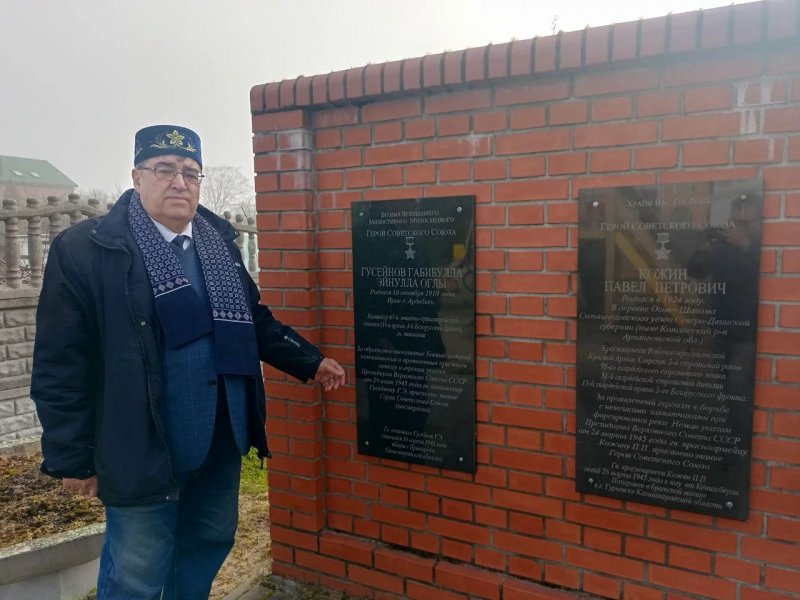
Among the frontline heroes who stormed Königsberg were many Azerbaijanis. The chairman of Kaliningrad's Ikhsan Muslim community, Yaver Huseynov, has created an open-air museum on the grounds of a mosque in the outskirts of Kaliningrad. It commemorates Heroes of the Soviet Union of various nationalities who took part in the assault on the fortress city of Königsberg. Each memorial plaque bears an appeal to God: “May the Lord protect you!” or “In the name of the Most Merciful, the Most Compassionate.”
Among more than 15 memorial plaques, two are dedicated to the brave sons of the Azerbaijani people.
Meet Mirza Jabiyev, born in the village of Khamosham (now in Azerbaijan’s Astara district). In April 1945, Jabiyev’s platoon was the first to break into Fort No. 5 in Königsberg. The battle lasted more than a day, and on April 8, Mirza Jabiyev personally raised the Red Banner over the fort’s main tower. He was wounded in battle but remained in the ranks and assumed command of the company. After the Victory, Jabiyev returned to his homeland, worked as chairman of a village council, and later as director of a state farm. He died early, just 12 days before his 53rd birthday.
Interestingly, a fellow villager of Mirza Jabiyev, also from Khamosham, now serves at the Kaliningrad mosque. Thus, in that distant Azerbaijani village, people are aware of how respectfully the memory of their compatriot is preserved.
The second hero is Colonel Habibulla Huseynov. After the capture of Königsberg, the Red Army faced the task of eliminating a German grouping blocked on the Zemland Peninsula. Huseynov personally commanded anti-aircraft artillery units at a forward observation post. Under his leadership, artillery crews destroyed enemy personnel and equipment with direct fire, clearing the way for infantry. Habibulla Huseynov was killed in one of these battles and was posthumously awarded the title Hero of the Soviet Union.
Azerbaijan made a significant contribution to the victory over fascism. More than 600,000 Azerbaijanis went to the front. During the war, Baku supplied 70% of the oil, 80% of the gasoline, and 90% of the motor oil used at the front.
The father of Yaver Huseynov, the head of the Kaliningrad mosque, also took part in the storming of Königsberg. His son recounts:
“Young mothers come here who were born after the collapse of the USSR. Many of them have no idea that there once was a multinational country, but when a child walks here, he will surely ask his mother – who is this? And the mother, willingly or not, will read: for example, here is Azerbaijani Mirza Agamurad oglu Jabiyev – a Hero of the Soviet Union. He raised the Red Banner over Fort No. 5! I also give tours to those who behave improperly in the city, regardless of whether they are Azerbaijani, Uzbek, or Tajik. First, I invite them to the mosque, and then I bring them here. I ask: ‘How old are you?’ And how old was, for example, the Kazakh Tulen Kabilov when he performed his feat? He wasn’t even 20! This is what he was doing – and what are you doing? After all, he is your relative, we are all of the same blood.”
Huseynov notes that the museum was built without a “single state ruble,” entirely funded by national-cultural autonomies of the Kaliningrad region.
“It is important for us to show the modern generation that our main strength lies in the unity of the peoples living across the vast Eurasian space. Just as 80 years ago we – Azerbaijanis, Russians, Kazakhs, and other nations – united to repel a common evil, so today, in a very difficult time, we must stand together. After all, our geopolitical opponents only dream of sowing discord within our unity,” the head of the mosque in western Russia said as he concluded.
Eldar Guliyev
Kaliningrad


Similar news