S. Korea launches homegrown Nuri rocket - VIDEO


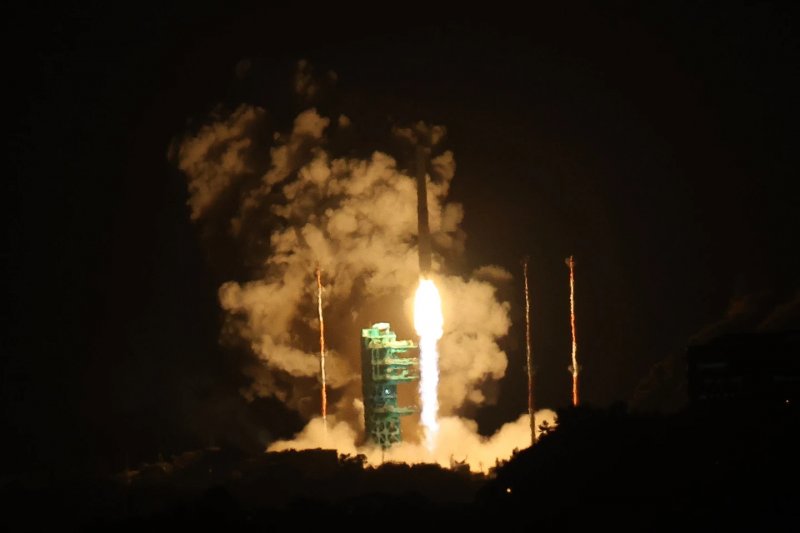
South Korea on Thursday confirmed the successful launch of its homegrown space rocket, Nuri, from the Naro Space Center, deploying 13 satellites, with the main unit establishing communication with King Sejong Station in Antarctica.
The 200-ton Nuri lifted off from Goheung, a southern coastal village about 330 kilometers south of Seoul, at 1:13 a.m., slightly delayed from the planned 12:55 a.m. launch due to a sensor issue, News.Az reports, citing Yonhap.
According to the Korea Aerospace Research Institute (KARI) and the Korea Aerospace Satellite Agency (KASA), the main satellite, CAS500-3, successfully contacted South Korea’s Antarctic research station at 1:55 a.m., allowing experts to verify its condition.
Science Minister Bae Kyung-hoon called it the “fourth successful launch of Nuri” and highlighted that all satellites have been placed into orbit. He added that the launch marks a turning point, shifting South Korea’s space ecosystem focus from government-led efforts to private-sector involvement, with ambitions to rank among the world’s top five space powers.
🇰🇷🚀 Korea’s Nuri rocket (KSLV-II) has begun its 4th launch sequence, and the first-stage separation was successfully completed!
— 360ANAVY (@NavyWor) November 26, 2025
Exciting moment for Korea’s space program.
Source: https://t.co/GZCwQijGIY pic.twitter.com/gG7IhXZQEq
Yoon Young-bin, administrator of the Korea AeroSpace Administration (KASA), echoed the view, while stressing the government's plan to continue efforts to bolster South Korea's space exploration capabilities.
President Lee Jae Myung hailed the successful launch of Nuri in a social media post, calling it "a moment that opens a new chapter" in the country's space exploration history.
Researchers will continue to monitor the main satellite through communication with other ground stations, including those in the central city of Daejeon and Norway, space authorities added.
The CAS500-3, built by Korea Aerospace Industries Co., is a medium-class satellite unit developed using the standard platform technology from the first CAS500 model.
The satellite will conduct observations of Earth's auroras and upper atmosphere, and be used in various experiments, including the verification of three-dimensional stem cell cultivation using bio 3D-printing technology.
About two minutes after liftoff, Nuri separated the first stage, followed by the second-stage four minutes and 30 seconds into the flight.
After reaching the target altitude of 600 km, Nuri separated the main satellite, along with 12 cube satellites.
The main satellite will be tasked with conducting space science research, including measurement of space magnetic fields and plasma along with observation of auroras.
Nuri's flight ended at 1:31 a.m., completing its 18-minute mission. It will later reenter Earth's atmosphere and disintegrate as it falls.
South Korea first launched the Nuri rocket in October 2021, which failed to enter orbit while carrying a 1.5-ton dummy satellite. In June 2022, the rocket successfully put a Performance Verification Satellite (PVSAT) and a 1.3-ton dummy satellite into orbit.
The third launch was held in May 2023 with South Korea putting a next-generation small satellite and seven cube satellites into orbit.
The latest launch marked the first time for Hanwha Aerospace Co. to oversee the entire assembly process as part of the government's long-term plan to hand over space technologies to the private sector.
South Korea, meanwhile, plans to carry out the fifth launch in 2026, followed by another in 2027.


Similar news