Scientists discover new crystal type formed by world’s first nuclear explosion


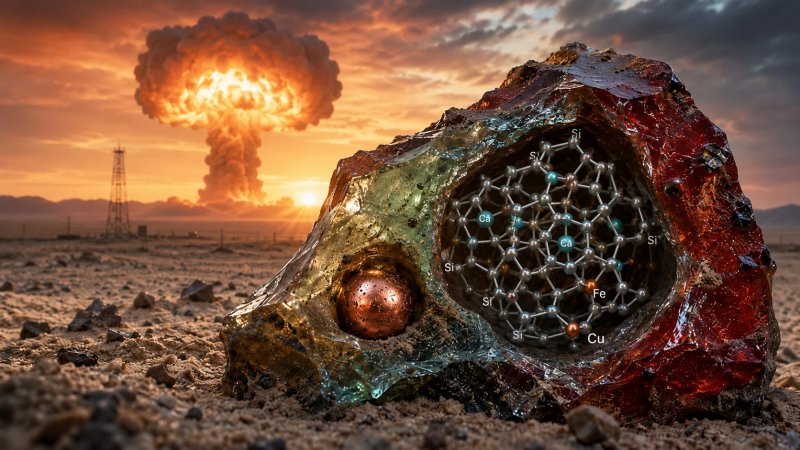
Nearly 80 years after the Trinity nuclear test in 1945, scientists have identified a previously unknown type of crystal formed in the aftermath of the world’s first nuclear explosion, adding new insight into the extreme conditions created by the blast.
The Trinity test near Alamogordo, New Mexico, generated the glassy substance known as trinitite when sand and surrounding materials were fused by the explosion’s heat. New research shows that within this material, scientists have now identified a rare clathrate crystal structure formed under extreme conditions, alongside previously known quasicrystals, News.Az reports, citing Popular Mechanics.
The original explosion, part of the Manhattan Project and overseen by physicist Robert Oppenheimer, released an estimated 18.6 kilotons of energy and vaporized surrounding materials, creating a unique environment where unusual mineral formations could emerge.
RECOMMENDED STORIES
Researchers studying red-tinted trinitite samples discovered that the material contains both quasicrystals and a newly identified silicon-based clathrate, in which atomic structures form cage-like shapes trapping other elements inside.
The clathrate was found to contain silicon and calcium, with traces of copper and iron, while the quasicrystal formed in copper-rich metallic droplets. Scientists say both structures originated from the same nuclear detonation but exhibit fundamentally different atomic arrangements.
Further analysis suggests the clathrate is metastable under low copper conditions, but becomes unstable as copper levels rise, highlighting the extreme sensitivity of the structures formed in such environments.
Researchers say the findings could help explain how other high-energy natural events, such as meteor impacts and lightning strikes, produce rare crystalline structures not reproducible under normal laboratory conditions.
By Leyla Şirinova


Similar news