Scientists investigate whether "suspiciously similar" planets are a beacon for alien life


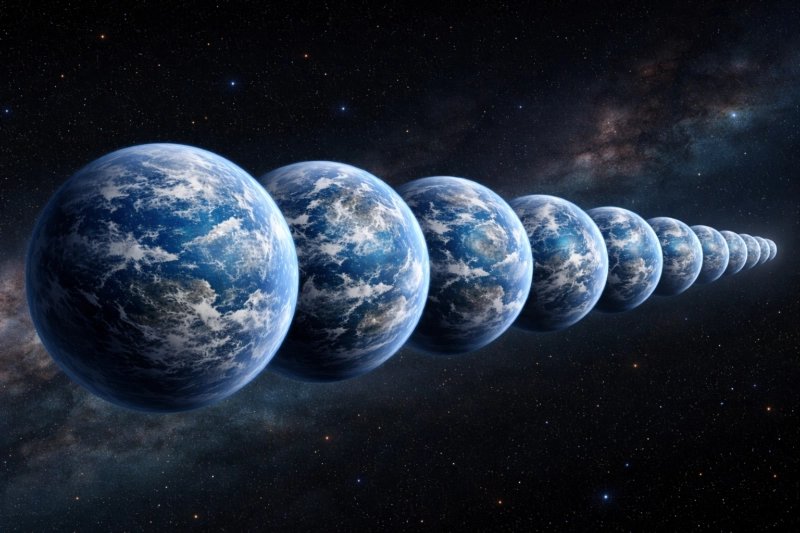
Astronomers have identified a fascinating new lead in the search for extraterrestrial intelligence, focusing on the discovery of "suspiciously similar" planets orbiting the same stars.
Unlike the vast diversity usually seen within planetary systems, these sibling worlds share nearly identical sizes, masses, and atmospheric compositions, News.Az reports, citing Earth Sky.
This unusual level of uniformity has led some researchers to theorize that such systems might not be a product of natural cosmic evolution, but rather the result of intentional "terraforming" or "galactic gardening" by an advanced alien civilization.
RECOMMENDED STORIES
The concept hinges on the idea that nature rarely produces identical twins on a planetary scale. In our own solar system, for instance, the differences between Earth, Mars, and Venus are stark despite their proximity. When telescopes detect multiple rocky planets in a single system that appear to be carbon copies of one another—particularly when they both sit within the habitable zone—it defies standard models of planetary formation. Scientists suggest that an advanced society might deliberately replicate the conditions of their home world onto neighboring planets to create a "backup" or to expand their living space across their solar system.
To test this hypothesis, researchers are looking for "technosignatures" that would differentiate a naturally occurring twin from an engineered one. This includes searching for specific atmospheric chemical imbalances that wouldn't exist without industrial activity or biological maintenance. If two planets share the exact same ratio of oxygen, nitrogen, and artificial pollutants, the probability of it being a coincidence drops significantly. Current missions like the James Webb Space Telescope are providing the high-resolution data needed to peek into these atmospheres and look for these tell-tale signs of intentionality.
While the idea of planetary engineering remains speculative, the "suspiciously similar" planet theory offers a fresh framework for narrowing down where to look for life. Instead of scanning billions of random stars, astronomers can prioritize systems that exhibit this peculiar, non-random symmetry. It shifts the focus from finding a single "Earth 2.0" to identifying entire "Solar Systems 2.0" where the hand of an intelligent architect might be visible through the telescope.
As we continue to map the exoplanets in our galactic neighborhood, these synchronized worlds represent a tantalizing mystery. Whether they are a rare quirk of physics or the ultimate infrastructure project of an ancient civilization, they challenge our understanding of how planetary systems should look. For now, the search continues as scientists wait for the data that might finally confirm if these identical worlds are a natural wonder or a deliberate signpost in the dark.
By Leyla Şirinova


Similar news