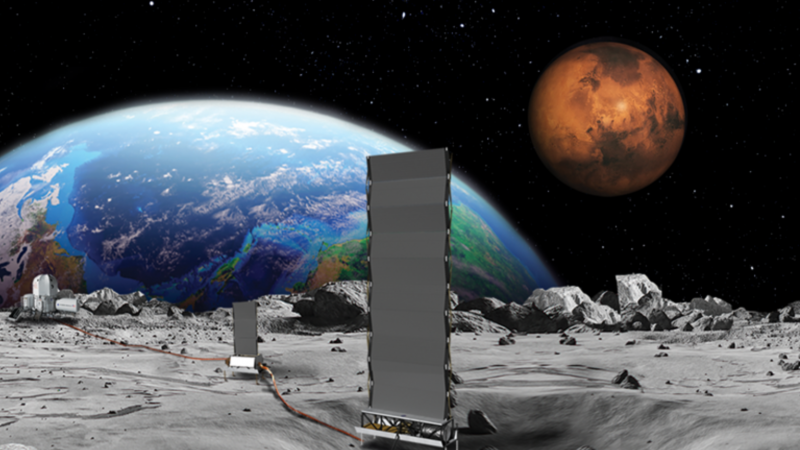
The proposed system is being developed under NASA’s Fission Surface Power Initiative and would significantly surpass the radioisotope generators that have powered spacecraft such as Voyager 1, Voyager 2, and Mars rovers for decades. Unlike those smaller systems, a 500-kWe reactor could provide continuous, high-output electricity for sustained lunar operations, News.Az reports, citing foreign media.
According to NASA, a reactor of this scale would be capable of supplying power to lunar habitats, industrial machinery, communications infrastructure, and resource extraction activities—key components of any long-term human presence on the Moon.
RECOMMENDED STORIES
“It might sound like science fiction, but it’s not,” said Sebastian Corbisiero, national technical director of the Space Reactor Initiative. “It is very realistic and can significantly boost what humans can do in space because fission reactors provide a step increase in the amount of available power.”
Although no fission reactors are currently operating in space, NASA has issued a directive focused on fission surface power and reportedly intends to place a reactor on the Moon by fiscal year 2030. The strategy is detailed in a new report funded by Idaho National Laboratory (INL).
The report, titled Weighing the Future: Strategic Options for US Space Nuclear Leadership, outlines three potential pathways.
The most ambitious option, described as “Go Big or Go Home,” calls for a large-scale 100–500 kWe reactor program led by NASA or the Department of Defense, with support from the Department of Energy. The document argues that scaling to 100–500 kWe systems is essential if the United States intends to maintain leadership in space nuclear technology.
A second approach, named “Chessmaster’s Gambit,” proposes the development of two smaller systems below 100 kWe through public-private partnerships. Under this plan, NASA would build a reactor designed for lunar orbit or surface deployment, while the Department of Defense would focus on developing an in-space nuclear power system.
The third and most cautious option suggests beginning with a small, sub-1 kWe radioisotope power system. This pathway would prioritize establishing regulatory frameworks and technical groundwork before expanding to larger-scale nuclear power systems in space.
The decision on which strategy to pursue will shape the future of US space energy capabilities, as nuclear power is increasingly viewed as critical for sustaining human operations on the Moon and supporting deeper exploration missions.