What is behind the Belfast anti-immigrant riots?


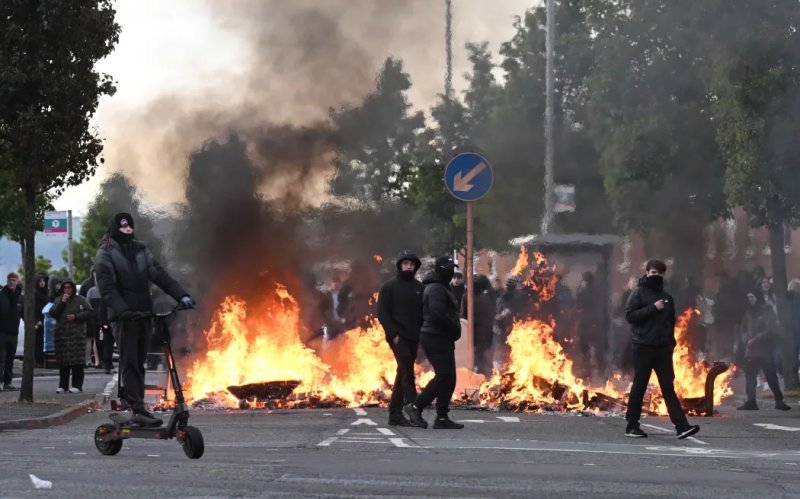
Violent anti-immigrant protests erupted in Belfast after a Sudanese asylum seeker was charged over a knife attack that left a local man seriously injured.
Protesters set fire to vehicles, attacked property and clashed with police, prompting political leaders to call for calm, News.az reports.
While the knife attack acted as the immediate catalyst, the reasons behind the unrest are much deeper and reflect broader social, political and economic tensions that have been building in both Northern Ireland and the wider United Kingdom for years.
What triggered the riots?
The immediate trigger for the violence was a knife attack that took place in north Belfast. A 30-year-old Sudanese man was arrested and charged with attempted murder after allegedly attacking a man in his 40s with a kitchen knife. The victim suffered severe injuries, including wounds to his face, back and eyes.
What transformed the incident from a criminal investigation into a wider public crisis was the rapid spread of graphic video footage on social media. The footage showed members of the public attempting to stop the attacker before police arrived. The shocking nature of the images generated strong emotional reactions, including fear, anger and outrage.
Within hours, discussion about the attack moved beyond the crime itself and became focused on the suspect's nationality and immigration status. As a result, the incident quickly evolved into a wider debate about migration, asylum policies and public safety, ultimately triggering protests that escalated into riots.
Why did the attack spark such a strong reaction?
Violent crimes committed by migrants or asylum seekers often attract disproportionate public attention because they touch on broader societal fears. In Belfast, many residents viewed the attack not simply as an isolated criminal act but as evidence of what they perceive to be failures in immigration and border policies.
The severity of the assault also played a crucial role. The victim suffered life-changing injuries, and the public nature of the attack intensified concerns about safety. The fact that ordinary citizens reportedly intervened to stop the attacker further contributed to a narrative that communities are being forced to protect themselves.
The emotional impact was amplified by the circulation of video footage online. Graphic images often provoke immediate reactions before facts are fully established. In this case, public anger grew faster than official explanations, creating conditions in which rumours, speculation and political grievances could flourish.
For many people already concerned about immigration, the attack appeared to confirm existing fears, making the public response particularly intense.
Immigration tensions were already rising
The Belfast unrest did not occur in isolation. It comes amid years of heated debate across the United Kingdom regarding immigration levels, asylum claims and border security.
The UK has experienced record levels of both legal and illegal migration in recent years. Political parties across the spectrum have faced growing pressure from voters who believe immigration is placing strain on housing, healthcare, education and welfare systems. Concerns about cultural integration and community cohesion have also become increasingly prominent.
In Northern Ireland, these concerns are often intensified by local economic challenges and longstanding political sensitivities. Some residents feel that government authorities are failing to address social and economic problems affecting local communities while allocating resources to support newcomers.
Although many experts argue that migration contributes positively to the economy and helps address labour shortages, public perceptions are often shaped more by visible local pressures than by national economic statistics. As a result, incidents involving migrants can rapidly become symbols of wider dissatisfaction and frustration.
How did social media fuel the unrest?
Social media played a critical role in transforming a local criminal incident into a citywide political flashpoint.
The video of the attack spread rapidly across multiple platforms, reaching thousands of people within hours. Unlike traditional media, social media allows emotionally charged content to circulate immediately, often without context or verification. This can intensify public reactions and encourage people to form conclusions before investigations are completed.
Online discussions quickly shifted toward questions about the suspect's immigration status and the government's handling of asylum claims. Influential anti-immigration activists and political commentators amplified these discussions, drawing national attention to the incident.
Social media algorithms often reward content that generates strong emotional responses such as anger, fear and outrage. As a result, highly provocative narratives can spread much faster than nuanced explanations. This dynamic contributed significantly to the mobilisation of protesters and the escalation of tensions on the ground.
Did the suspect's immigration status become a political issue?
Yes. Almost immediately after the attack, public debate focused on how the suspect had entered and remained in the United Kingdom.
Police later confirmed that the suspect had been granted a five-year visa in September 2023 and had reportedly travelled through several European countries before seeking asylum in Belfast. Although authorities stressed that he was not known to security services and had no record on national security databases, these reassurances did little to calm public concerns.
Critics of the government's immigration policies argued that the case highlighted weaknesses in asylum screening procedures. Several political figures demanded greater transparency regarding the suspect's background and the decisions that allowed him to remain in the country.
For anti-immigration campaigners, the incident became evidence supporting long-standing arguments that the UK's migration system requires significant reform. For others, however, focusing solely on the suspect's nationality risks unfairly stigmatizing entire migrant communities for the actions of one individual.
Are wider UK political tensions contributing to the unrest?
The Belfast riots reflect broader political trends that have been developing across Britain for years.
Immigration has become one of the most divisive issues in British politics, influencing elections, party strategies and public discourse. The issue was central to the Brexit campaign and remains a major source of disagreement between political parties.
Growing support for anti-immigration movements and parties demonstrates that concerns about migration resonate with a significant segment of the electorate. At the same time, advocates of multiculturalism and refugee protection argue that migrants should not be collectively blamed for isolated crimes.
The Belfast incident occurred against this highly polarized backdrop. As a result, the attack was quickly interpreted through political lenses rather than being viewed solely as a criminal matter. This polarization made it more difficult for authorities to contain tensions and restore public confidence.
Why are authorities warning against further violence?
Political leaders and police officials have repeatedly stressed that attacks on migrants, asylum seekers and their property cannot be justified by the actions of a single suspect.
Authorities fear that the unrest could deepen social divisions, increase racial tensions and encourage extremist groups to exploit public anger for political purposes. There are also concerns that continued violence could lead to retaliatory actions, creating a cycle of confrontation between communities.
Northern Ireland has a long history of conflict and communal tensions. Although the current unrest is different in nature, officials are keenly aware of how quickly localized incidents can escalate into broader social instability.
For this reason, police and political leaders have urged the public to allow investigators to determine the facts surrounding the knife attack while rejecting vigilantism and collective punishment.
What is the deeper significance of the Belfast riots?
The violence in Belfast demonstrates how a single criminal act can become a catalyst for much larger societal conflicts. While the knife attack provided the immediate spark, the underlying causes include public anxiety about immigration, concerns over community safety, economic pressures, political polarization and the growing influence of social media.
The riots reveal that immigration debates in the United Kingdom are no longer confined to policy discussions in parliament. They have become deeply connected to questions of identity, security, social cohesion and trust in public institutions.
As the investigation into the attack continues, the events in Belfast are likely to remain part of a broader national conversation about how Britain balances border control, public safety, humanitarian obligations and community relations in an increasingly polarized political environment.
By Faig Mahmudov


Similar news