What is behind the latest IS-linked attack in Congo?


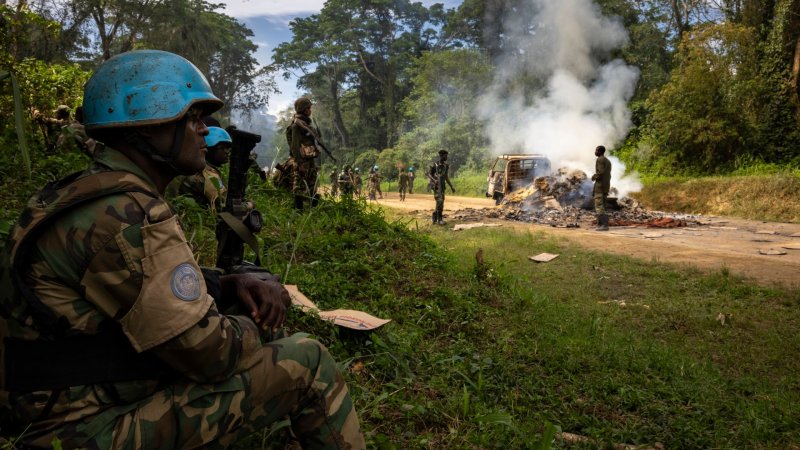
The killing of 16 people by fighters linked to the Islamic State in eastern Democratic Republic of Congo has once again highlighted the complex security crisis affecting one of Africa’s most volatile regions.
The attack, which took place in an area previously affected by Ebola outbreaks, underscores the overlapping challenges of armed conflict, public health emergencies, humanitarian crises, and weak state control, News.az reports.
RECOMMENDED STORIES
For years, eastern Congo has been plagued by violence carried out by numerous armed groups competing for territory, resources, and influence. Among them is the Allied Democratic Forces (ADF), a rebel group that has increasingly been linked to the Islamic State and has become one of the deadliest militant organizations operating in Central Africa.
The latest attack has raised concerns among regional governments, international organizations, and humanitarian agencies, particularly because it occurred in a region where communities continue to recover from repeated Ebola outbreaks and other public health challenges.
This FAQ Explainer examines what happened, who was responsible, why the region remains vulnerable, and what the implications may be for Congo and the wider region.
What happened in eastern Congo?
According to local authorities and security sources, fighters linked to the Islamic State carried out an attack that killed at least 16 people in eastern Democratic Republic of Congo.
The assault reportedly targeted civilians in an area that has experienced repeated episodes of violence in recent years. Such attacks have become a recurring feature of life in parts of North Kivu and Ituri provinces, where militant groups often target villages, travelers, farmers, and local communities.
While details surrounding individual incidents often emerge gradually because of limited access to remote areas, the attack once again demonstrates the ability of militant groups to strike vulnerable populations despite ongoing military operations.
The violence occurred in a region that was previously at the center of major Ebola outbreaks, adding another layer of concern for humanitarian organizations already operating under difficult conditions.
Who are the attackers?
The attack has been attributed to fighters linked to the Allied Democratic Forces, commonly known as the ADF.
The ADF originated in neighboring Uganda during the 1990s. Initially established as an anti-government insurgent movement, the group later relocated much of its activity into eastern Congo, where weak governance and difficult terrain provided opportunities for survival and expansion.
Over time, the group evolved from a localized insurgency into a more organized militant network.
In recent years, security analysts and international organizations have increasingly linked the ADF to the Islamic State. The militant organization has claimed responsibility for various attacks carried out by the group and has referred to it as part of its Central Africa Province.
This relationship remains the subject of ongoing analysis, but there is broad agreement among security experts that the ADF has adopted tactics and ideological elements associated with the Islamic State.
Why is eastern Congo so unstable?
Eastern Congo has experienced conflict for decades.
Several factors contribute to instability:
• Weak state institutions
• Porous borders
• Competition over mineral resources
• Ethnic tensions
• Presence of numerous armed groups
• Limited infrastructure
• Poverty and unemployment
The region contains significant deposits of gold, cobalt, coltan, tin, and other valuable minerals. Control over these resources often provides funding for armed groups.
The mountainous terrain, dense forests, and remote villages also make it difficult for government forces to maintain effective control over large areas.
As a result, armed organizations are able to establish bases, recruit fighters, and conduct operations with relatively limited interference.
Why is the Ebola connection important?
The area where the attack occurred has previously been affected by Ebola outbreaks.
Eastern Congo experienced one of the world's largest Ebola epidemics between 2018 and 2020. The outbreak killed thousands of people and required a massive international response.
During that period, healthcare workers frequently faced attacks from armed groups.
Medical facilities were targeted.
Health personnel were threatened.
Vaccination campaigns were disrupted.
Public health operations became significantly more difficult.
The combination of violence and disease created a particularly dangerous environment for local populations.
Although Ebola is no longer spreading at the levels seen during previous outbreaks, the region remains vulnerable because healthcare infrastructure is fragile and many communities continue to struggle with the long-term consequences of the epidemic.
Why do armed groups target civilians?
Attacks on civilians often serve several objectives.
Militant groups may seek to:
• Spread fear
• Demonstrate power
• Undermine government authority
• Punish communities accused of cooperating with security forces
• Gain control over territory
• Disrupt economic activity
Such attacks can also generate media attention and increase the perceived influence of the organization responsible.
Unfortunately, civilians frequently become the primary victims of conflicts involving insurgent groups.
Farmers, traders, local leaders, women, and children often bear the greatest burden of insecurity.
How significant is the ADF threat?
The ADF is considered one of the most dangerous armed groups operating in eastern Congo.
Over the past decade, the organization has been blamed for thousands of deaths.
Its attacks have included:
• Village massacres
• Ambushes
• Bombings
• Kidnappings
• Assassinations
The group's operational capabilities have fluctuated over time, but it has repeatedly demonstrated an ability to survive military pressure and adapt to changing conditions.
Security experts believe that the organization benefits from mobility, local networks, and the ability to exploit weak governance structures.
What is the role of the Islamic State?
The Islamic State has sought to expand its influence beyond the Middle East by establishing or supporting affiliated groups in various parts of Africa.
These affiliates operate in countries including:
• Democratic Republic of Congo
• Mozambique
• Nigeria
• Niger
• Mali
• Somalia
By associating with local militant organizations, the Islamic State can project an image of global reach even when its central leadership faces setbacks elsewhere.
For local groups, association with the Islamic State may provide ideological legitimacy, propaganda support, and increased international attention.
What has the Congolese government done?
The government of Democratic Republic of Congo has launched numerous military operations against armed groups operating in the east.
In some cases, these efforts have involved cooperation with neighboring Uganda.
Joint military operations have targeted ADF bases and logistical networks.
Authorities argue that such operations have weakened the group and eliminated some of its leaders.
However, critics contend that military victories have often been temporary and have not fully addressed the underlying causes of insecurity.
The persistence of attacks suggests that armed groups continue to maintain operational capabilities despite sustained pressure.
How is Uganda involved?
Uganda has a direct interest in combating the ADF because the group originally emerged on Ugandan territory.
In recent years, Uganda and Congo have expanded military cooperation.
Ugandan forces have participated in operations targeting ADF positions inside Congo.
Both governments argue that cross-border collaboration is necessary because militant groups frequently operate across national boundaries.
The partnership reflects growing recognition that regional security challenges cannot be addressed by any single country acting alone.
What is the humanitarian impact?
The humanitarian consequences are severe.
Millions of people in eastern Congo have been displaced by conflict.
Many communities face:
• Food insecurity
• Limited healthcare access
• Lack of education
• Economic hardship
• Psychological trauma
Repeated attacks disrupt daily life and make long-term development extremely difficult.
Humanitarian organizations often struggle to reach vulnerable populations because insecurity limits access to affected areas.
The result is a cycle in which violence, poverty, and displacement reinforce one another.
Why is the international community concerned?
The latest attack raises concerns far beyond Congo itself.
International organizations worry that continued instability could:
• Fuel regional insecurity
• Increase displacement
• Strengthen extremist networks
• Undermine development efforts
• Create conditions for future humanitarian emergencies
The presence of Islamic State-linked groups in Central Africa also highlights the evolving nature of global terrorism.
Rather than being concentrated in a single region, extremist movements increasingly operate through decentralized networks across multiple continents.
What are the main challenges facing security forces?
Security forces confront several obstacles.
These include:
• Difficult terrain
• Insufficient resources
• Intelligence gaps
• Corruption
• Weak infrastructure
• Limited government presence
Armed groups often exploit these weaknesses to evade military operations.
Even when militants are forced from one area, they may relocate and resume activities elsewhere.
This creates a persistent challenge for both national and regional authorities.
What could happen next?
Several scenarios are possible.
Military pressure may continue to limit the operational space available to militant groups.
However, unless broader governance and development challenges are addressed, the conditions that enable armed groups to recruit and operate are likely to persist.
Future stability will depend on a combination of:
• Effective security operations
• Regional cooperation
• Economic development
• Improved governance
• Humanitarian assistance
• Community resilience
Without progress in these areas, eastern Congo is likely to remain vulnerable to further violence.
What is the key takeaway?
The killing of 16 people by Islamic State-linked fighters in eastern Congo is more than an isolated security incident.
It reflects the broader challenges facing a region where conflict, extremism, poverty, displacement, and public health crises intersect.
Despite years of military operations and international assistance, armed groups continue to exploit local vulnerabilities and threaten civilian populations.
The latest attack serves as a reminder that lasting stability in eastern Congo will require more than military action alone. It will depend on sustained efforts to strengthen governance, improve economic opportunities, support affected communities, and address the root causes of insecurity that have fueled violence for decades.
By Faig Mahmudov


Similar news