Why did Pussy Riot storm Russia’s Venice Biennale pavilion?


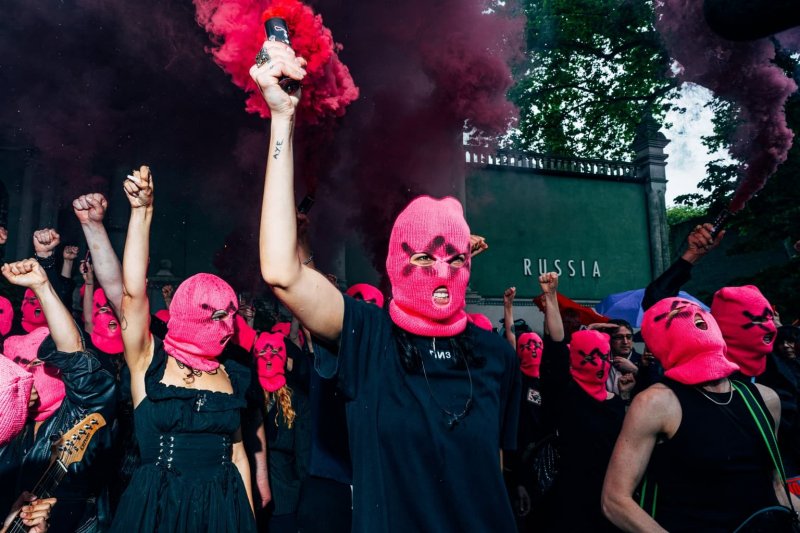
The intersection of politics, protest, art and international diplomacy once again became a global talking point after members of the activist art collective Pussy Riot staged a dramatic action linked to the Russian pavilion at the Venice Biennale. The incident quickly spread across international headlines, reigniting debates about artistic freedom, anti war activism, censorship, Russian cultural representation abroad and the growing politicization of global art institutions.
The Venice Biennale has long been considered one of the most influential cultural events in the world, attracting artists, curators, critics, collectors and political observers from across the globe.
RECOMMENDED STORIES
But in recent years, especially following geopolitical tensions involving Russia and the wider European security environment, the event has increasingly transformed into a stage not only for art, but also for ideological confrontation and political symbolism.
The latest protest by Pussy Riot has once again pushed the Biennale into the center of a wider international conversation.
What is Pussy Riot?
Pussy Riot is a Russian feminist activist collective known for politically charged performances, anti establishment protests and provocative artistic actions. The group emerged internationally in the early 2010s after staging demonstrations criticizing the Russian political system, authoritarianism and restrictions on civil liberties.
The collective became globally famous following a controversial protest performance inside Moscow’s Cathedral of Christ the Savior in 2012. Several members were arrested and sentenced to prison, turning Pussy Riot into an international symbol of political resistance and artistic dissent.
Over the years, the group expanded beyond music and performance art into broader activism involving human rights, anti war messaging, LGBTQ advocacy and opposition politics.
Different members and affiliates have participated in various actions globally, meaning Pussy Riot often functions more as a decentralized activist collective than a traditional music group.
What happened at the Venice Biennale?
According to reports circulating internationally, activists associated with Pussy Riot entered or targeted the Russian pavilion during events linked to the Venice Biennale and staged a political protest action intended to criticize Russia’s policies and challenge the symbolism of Russian state representation in international cultural spaces.
The action reportedly involved visual protest elements, political slogans and symbolic disruption aimed at drawing global media attention.
The Russian pavilion has already become a politically sensitive subject in recent years because of broader international tensions involving Russia and Western countries. Questions over whether Russian state affiliated artists should participate in global cultural events have triggered repeated controversy throughout Europe’s art world.
The Pussy Riot action intensified those debates once again.
Why is the Venice Biennale so important?
The Venice Biennale is often described as the Olympics of the art world. Founded in 1895, it is one of the oldest and most prestigious international cultural exhibitions.
Countries from around the world maintain national pavilions where they present curated artistic projects representing contemporary cultural identity, political themes, experimental art and global creative trends.
Winning recognition at the Biennale can dramatically increase an artist’s international influence and market value.
Because of its global visibility, the event has increasingly become a platform for political expression. Issues involving war, migration, colonialism, climate change, gender politics and authoritarianism frequently dominate exhibitions and performances.
As a result, protests at the Biennale often receive worldwide attention far beyond the traditional art community.
Why is the Russian pavilion controversial?
Since geopolitical tensions escalated between Russia and Western governments in recent years, Russian participation in international cultural events has become highly controversial.
Some artists, curators and activists argue that Russian state linked cultural institutions should not receive prestigious international platforms during periods of conflict and diplomatic confrontation.
Others argue that art should remain independent from politics and that excluding Russian artists from global institutions represents cultural censorship.
The Russian pavilion at Venice has therefore become more than simply an exhibition space. It has evolved into a symbolic battleground involving questions about soft power, propaganda, freedom of expression and the role of culture during geopolitical crises.
In some previous editions of the Biennale, Russian artists and curators either withdrew voluntarily or faced intense external pressure linked to political developments.
Why does Pussy Riot focus on artistic protest?
Pussy Riot’s strategy has always combined performance art with direct political messaging. Rather than separating activism and culture, the collective treats art itself as a political weapon.
Their demonstrations are designed to attract viral attention, provoke emotional reactions and challenge institutional authority.
This approach reflects a broader tradition of political performance art dating back decades. Artists throughout modern history have used public disruption, symbolism and visual spectacle to criticize governments, corporations, religious institutions and social norms.
For Pussy Riot, visibility is central. Their actions are often intentionally confrontational because controversy increases media coverage and public debate.
How has the global art world reacted?
Reactions within the international art community have been divided.
Some curators, artists and activists praised the protest as a legitimate expression of political dissent and artistic freedom. Supporters argue that cultural institutions cannot remain politically neutral during periods of international conflict and that protest itself is a form of contemporary art.
Others criticized the action as disruptive and argued that targeting artistic spaces undermines the principles of open cultural dialogue.
Certain critics also warned that escalating politicization could transform major art exhibitions into ideological battlegrounds rather than creative forums.
Despite disagreements, the incident succeeded in one major objective: generating enormous international attention.
Why are art and politics becoming increasingly connected?
The relationship between art and politics has intensified globally over the past decade.
Major museums, film festivals, music awards and cultural institutions increasingly face pressure to take positions on geopolitical conflicts, human rights issues and social justice movements.
Several factors are driving this shift:
First, social media dramatically amplifies activist campaigns and public pressure.
Second, younger audiences increasingly expect institutions to reflect ethical and political values.
Third, artists themselves are becoming more openly political.
Fourth, global conflicts and polarization have made neutrality more difficult for cultural organizations.
As a result, cultural spaces are now frequently expected to function as political arenas in addition to artistic ones.
How has Russia used culture internationally?
Like many major powers, Russia has historically used culture as an element of international influence and diplomacy.
Russian literature, ballet, classical music, cinema and visual art have long served as important components of the country’s global image.
International exhibitions and cultural partnerships were traditionally viewed as tools for strengthening soft power and projecting national prestige.
However, geopolitical tensions complicated this strategy significantly. Some Western institutions reduced cooperation with Russian state affiliated cultural organizations, while debates intensified over whether Russian artists should be separated from Russian government policy.
This broader context explains why actions involving Russian cultural spaces attract such intense attention internationally.
What role does social media play in these protests?
Social media is essential to modern activist performance art.
Unlike earlier generations of political protest, contemporary movements often design actions specifically for viral online circulation.
A short protest inside a globally recognizable location can rapidly dominate international headlines if videos and images spread online.
Pussy Riot has historically understood this dynamic extremely well. Their performances are structured not only for live audiences, but also for digital amplification across platforms such as X, Instagram, TikTok and YouTube.
This strategy allows relatively small groups to generate worldwide visibility within hours.
Could this affect future Biennale events?
The incident may increase security measures and political sensitivity surrounding future Venice Biennale exhibitions.
Organizers of major international cultural events increasingly face difficult questions:
Should political protest inside exhibitions be tolerated as artistic expression?
Should national pavilions represent governments or artists independently?
Can cultural institutions realistically remain politically neutral?
How should controversial states participate in global cultural forums?
These questions are becoming harder to avoid as geopolitical tensions increasingly spill into artistic spaces.
Future Biennale editions are likely to continue facing activism connected to war, climate issues, migration, human rights and ideological conflict.
Why do activist groups target symbolic locations?
Symbolic visibility is one of the most powerful tools in modern activism.
Protesting at an internationally famous event like the Venice Biennale guarantees global media coverage because journalists, influencers and political observers are already present.
The symbolism matters as much as the action itself.
By targeting the Russian pavilion, Pussy Riot ensured that the protest would be interpreted not only as an artistic intervention, but also as a statement about national identity, political legitimacy and international representation.
This tactic reflects broader modern protest strategies seen at sporting events, film festivals, climate summits and political conferences worldwide.
Could political protests change the future of museums and art exhibitions?
Many experts believe cultural institutions are entering a new era where political neutrality becomes increasingly difficult.
Museums and exhibitions are no longer viewed simply as passive spaces displaying art objects. They are increasingly perceived as institutions with ethical responsibilities and political influence.
This transformation could permanently reshape:
curatorial decisions
artist selection
sponsorship policies
international participation rules
security planning
public relations strategies
activist engagement policies
Some institutions may attempt to embrace activism openly, while others may try to preserve traditional neutrality.
But the pressure surrounding global political issues is unlikely to disappear.
What broader trend does this incident reflect?
The Pussy Riot protest reflects a much larger global trend: the collapse of boundaries between politics, entertainment, activism and culture.
Today, concerts become political statements.
Film festivals become ideological debates.
Fashion shows become activism platforms.
Sports competitions become diplomatic battlegrounds.
Art exhibitions become geopolitical flashpoints.
In the digital era, visibility itself has become political power.
The Venice Biennale protest demonstrates how modern activist groups increasingly use cultural symbolism, media spectacle and global attention economies to shape international conversations.
Whether praised or criticized, such actions are becoming one of the defining characteristics of contemporary global culture.
Conclusion
The Pussy Riot action connected to the Russian pavilion at the Venice Biennale was far more than a brief protest inside an art event. It reflected the growing collision between culture and geopolitics in the modern world.
As international tensions increasingly influence artistic institutions, global cultural events are becoming arenas for ideological confrontation, symbolic activism and debates about freedom, representation and political responsibility.
The controversy surrounding the protest highlights how art is no longer viewed solely as creative expression. In 2026, it is also diplomacy, activism, identity, resistance and global communication.
The Venice Biennale incident may eventually be remembered not simply as a protest, but as another example of how modern culture has become inseparable from politics in an increasingly polarized world.
By Faig Mahmudov


Similar news