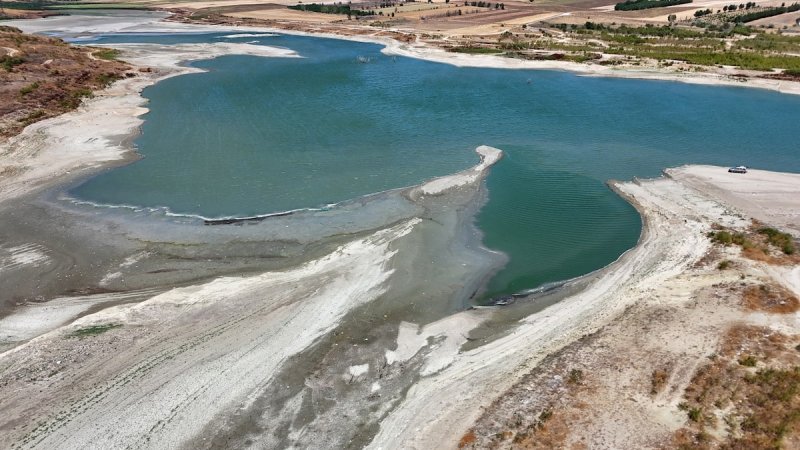
A drone view shows the receding waterline and exposed lakebed in the dried basin of Turkmenli Dam. Reuters
The problem of freshwater scarcity has reached Türkiye. Until now, Iran was often cited as the primary country in the region suffering from a water deficit. However, Türkiye is now facing serious challenges of its own. Global warming has struck the country as well, and quite severely.
According to reports, scientists at Pusan National University in the Republic of Korea have warned that the cities of Adana and Mersin could run out of drinking water as early as 2030, followed by Istanbul and Diyarbakır by 2050. For residents of these cities, the so-called “day zero” will arrive when water no longer flows from their taps. The researchers found that under high CO₂ emissions, rivers will dry up more quickly, causing reservoirs to shrink.
In fact, the problem is not new. Droughts in Türkiye have become more frequent since the early 2000s, particularly in the southern and coastal regions. Of course, Türkiye is not alone. India, Africa, and the U.S. state of California face similar risks.
Nevertheless, the presence of fellow sufferers should not lull the Turkish government into complacency. The problem is growing by the day. Water shortages are already being felt across much of the country. For instance, in Çeşme (İzmir), water is turned off for 12 hours a day to conserve resources.
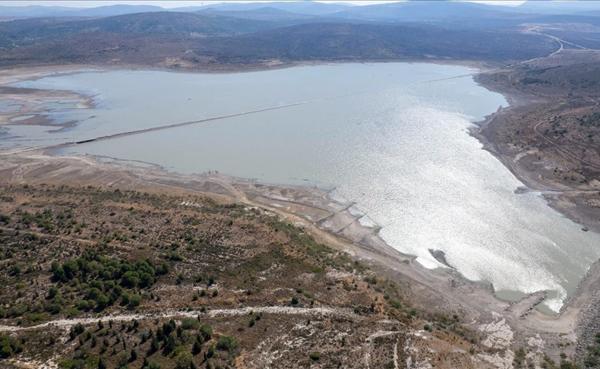
Çeşme have announced scheduled nightly water cuts. Hurriyet
According to Turkish media, if rain does not fall in Ankara soon, the city’s reservoirs will have enough water for only four to five months. This comes as nearly 90 percent of the country’s territory faces the threat of desertification, as confirmed by a United Nations report.
Over the next decade, around 80 percent of Türkiye’s agricultural land could be affected by drought. Evaporation also plays a major role in the loss of freshwater, prompting scientists to recommend deepening reservoirs and reducing their surface area to minimize evaporation.
In August, media outlets reported a severe drought in the province of Tekirdağ. As a result of this natural disaster, the region’s main dams ran out of drinking water, putting additional pressure on infrastructure and leaving some homes without water for several weeks due to a sharp decrease in rainfall in 2025. The Naip Dam in Tekirdağ was completely emptied by August 2025 after precipitation levels dropped by 95 percent.
The water level in the Türkmeneli reservoir, used for agricultural irrigation and drinking, fell below 5 percent. According to reports, the mayor of Marmara-Ereğlisi, Onur Bozkurt, said the reservoir is almost dry. “We are facing a serious drought; even the wells are empty. The reservoir has turned into mud, there is no water left,” he said, adding that authorities are actively searching for new sources, but there is no water even in the boreholes.
Due to a sharp rise in population during the summer, water supply had to be restricted. The Marmara-Ereğlisi district normally has about 30,000 residents, but in summer the population surged to 400,000 because of vacationers and tourists.
According to the internationally recognized Falkenmark Water Stress Index, Türkiye is already among the countries experiencing water scarcity. If the trend continues, Türkiye could soon fall into the category of nations with annual water availability of less than 500–1000 cubic meters per person.
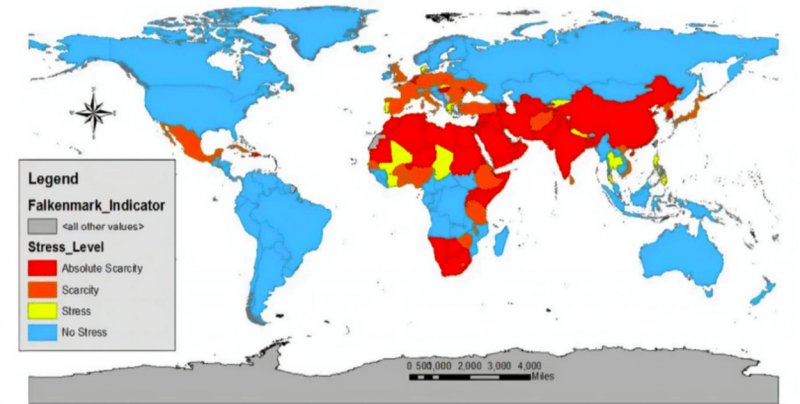
World Map of Water Scarcity as per the Falkenmark Indicator. (Source: University of Texas)
The situation has become so serious that it now has its own Wikipedia entry titled “Water Crisis 2025 in Türkiye.”
The crisis has affected nearly the entire country. The drought this summer was the most severe Türkiye has experienced in the past 50 years. Precipitation dropped by about 27 percent nationwide and by as much as 70 percent in some regions. As a result, water levels in reservoirs serving major cities such as Ankara, Istanbul, and İzmir, as well as in areas like Tekirdağ, the Konya Plain, and Southeastern Anatolia, fell below 10 percent. In September, Istanbul’s reservoir levels stood at just 30 percent, compared with 82 percent in April.
In early October, reports emerged of a water crisis in Bursa. Historically, the province was known as the “city of water,” famed for its numerous springs. Today, however, Bursa faces a severe shortage. The crisis reached a critical point when the Nilüfer Reservoir, built in 2007 with a capacity of 60 million cubic meters, completely dried up. The water volume in the Doğancı Reservoir fell to just 6.8 percent.
Over the past 60 years, 75 lakes have disappeared in Türkiye. an alarming sign of environmental decline.
In March 2025, the Turkish government launched a National Initiative to Improve Water Use Efficiency, aimed at conserving water through public awareness campaigns and revised tariffs. Heavy users will pay more than moderate consumers, encouraging people to save drinking water and avoid wasting it on garden irrigation or car washing.
In September 2025, with support from the World Bank, Türkiye launched a $600 million project to combat floods and droughts. The program envisions new infrastructure, environmentally friendly solutions, improved monitoring, and an early warning system.
The government of Türkiye is now urgently seeking a way out of the crisis.
Tural Heybatov
News.Az