India threatens Indus Treaty exit, raising fears of water war with Pakistan


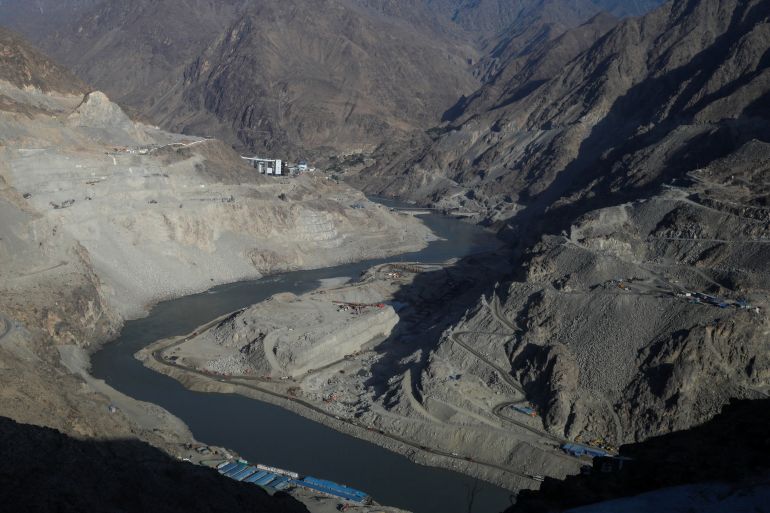
Over the past two months, Pakistan has been devastated by some of the deadliest floods in recent years, a grim reminder of the country’s growing vulnerability to both natural disasters and geopolitical risks. Torrential monsoon rains, which began in June, have claimed hundreds of lives, leaving entire communities submerged and displacing countless families. According to official figures, more than 150 people were killed in July alone, while in August the toll surged to 340, with many more missing. Behind these statistics lie thousands of stories of grief and loss — families torn apart, homes swept away, and vital infrastructure destroyed.
For Pakistan, monsoon season is an annual ordeal, but 2025 has been particularly cruel. Although the rains typically taper off by September, the country now faces a different kind of flood threat, one rooted not in the skies but across its eastern border. India, Pakistan’s long-time rival, has signaled that it may release excess water from its overflowing reservoirs, sparking fears of deliberate or uncontrolled flooding downstream. Reuters has reported that at least 150,000 Pakistanis have already been evacuated as a precaution, especially in Punjab province. This is not just any region — Punjab is the country’s breadbasket, producing the majority of Pakistan’s wheat, rice, and sugarcane. It is also home to nearly half of the population, meaning that any large-scale inundation would carry not only humanitarian but also economic and political consequences.
The warnings from New Delhi came suddenly. Last week, India informed Islamabad of its plan to discharge water from the Madhopur Dam in its part of Punjab, and on Monday a second warning followed. Crucially, these notifications were delivered through diplomatic channels rather than the Indus Water Commission — the bilateral mechanism established under the 1960 Indus Waters Treaty. For many observers, this deviation signaled something more than routine water management: it underscored how fragile and politicized water-sharing has become in South Asia.
The stakes are high. If Pakistan experiences further flooding and devastation, Islamabad is almost certain to blame New Delhi, further inflaming one of the world’s most combustible rivalries. Punjab’s agricultural base is already under immense stress from recurring natural disasters and the long-term effects of climate change. Another blow — this time perceived as man-made — could tip the balance toward food insecurity on a scale not seen in decades.
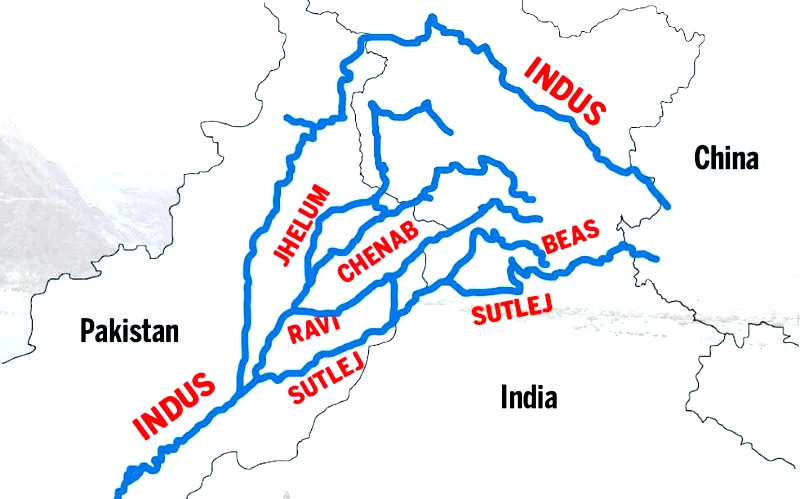
The Indus Waters Treaty, brokered by the World Bank in 1960, is often described as one of the most successful water-sharing agreements in history, having survived wars and diplomatic crises between India and Pakistan. It granted India control over three eastern rivers — the Sutlej, Beas, and Ravi — while Pakistan retained rights over the western Indus, Jhelum, and Chenab, which collectively provide Islamabad with around 80 percent of its water resources. For decades, the treaty functioned as a stabilizing anchor, ensuring that even in times of military tension, water flows continued.
Yet recent years have exposed the treaty’s fragility. In April, India’s government declared its intention to cut off the Indus waters flowing into Pakistan altogether, with then–Water Resources Minister Chandrakant Raghunath Patil vowing that “not a single drop” would reach its neighbor. New Delhi went so far as to declare its unilateral withdrawal from the treaty — a move legally dubious since the agreement contains no provision for unilateral termination. This announcement was more than rhetoric; it was a stark illustration of how water is becoming weaponized in South Asia’s power politics.
International law does not support unilateral actions of this kind. Transboundary water use is governed by frameworks such as the 1992 UN Convention on the Protection and Use of Transboundary Watercourses and International Lakes, which emphasize cooperation and sustainability, as well as Council of Europe resolutions that stress conflict prevention through joint resource management. For Islamabad, these principles underscore its case; for New Delhi, they pose a diplomatic dilemma.
Experts caution, however, that despite its threats, India is unlikely to cut off Pakistan’s water supply overnight. Hydrological realities make such a drastic step technically difficult and time-consuming. Analysts cited by DW argue that even if New Delhi pursues this strategy, Pakistan would not experience catastrophic shortages for at least another 30 to 50 years. Still, the possibility of gradual reductions, sudden diversions, or politically motivated discharges remains a potent tool of pressure.
Already, Islamabad has accused India of foul play. In May, Pakistani authorities alleged that the flow of the Chenab River — allocated to Pakistan under the treaty — had abruptly declined. Officials in Punjab province insisted the reduction did not appear “natural,” suggesting deliberate interference. For a country where agriculture accounts for nearly a quarter of GDP and sustains millions of livelihoods, such suspicions fuel deep anxieties. Wheat, rice, and sugarcane — the pillars of Pakistan’s food security — would be the first to suffer in the event of prolonged disruptions. Add to this the broader climate crisis: Pakistan has seen increasingly erratic rainfall, with the winter and spring of 2025 bringing 25 percent less precipitation than the previous year. The cumulative picture is bleak.
Even without a full-scale cutoff, India has shown it can create emergencies by releasing water unpredictably. On April 26, New Delhi discharged water from the Uri hydropower dam into the Jhelum River without warning, causing levels to spike in Pakistan-administered Kashmir. The sudden surge triggered chaos in the Hattian district, forcing residents to abandon their homes. For Pakistanis, such episodes reinforce a sense of vulnerability and mistrust — the belief that India can, at will, unleash devastation by manipulating rivers.
Yet Pakistan is not India’s only concern. New Delhi itself now faces the specter of water insecurity, this time from China. Beijing has begun construction of the region’s largest dam on the upper reaches of the Brahmaputra, known in China as the Yarlung Tsangpo. Alarmed by this development, India has announced its own plans for a massive multipurpose dam in the Himalayas near Tibet. Reports in Indian media describe how the country’s largest hydroelectric firm has already moved design documents to the site under police protection, underscoring the project’s strategic importance.
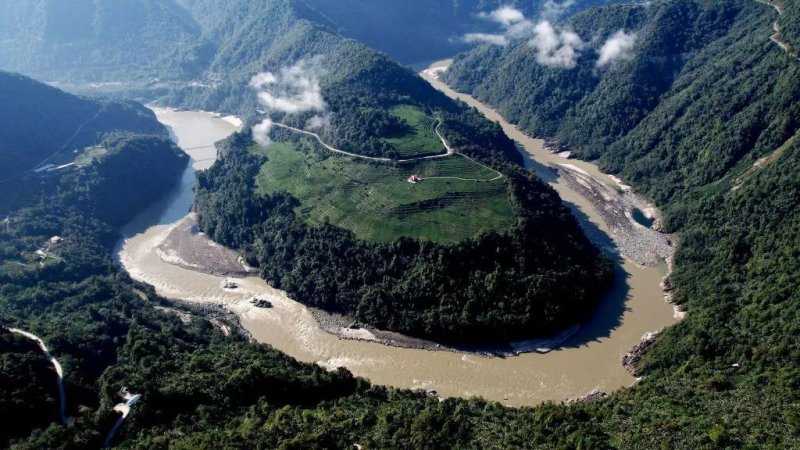
The implications are profound. Indian experts warn that China’s dam could reduce the Brahmaputra’s dry-season flow by as much as 85 percent. The river sustains over 100 million people across China, India, and Bangladesh, making it one of Asia’s most vital water sources. New Delhi fears that Beijing, which continues to claim Arunachal Pradesh as Chinese territory, could one day use control over the river as leverage in its broader geopolitical rivalry with India. Though Beijing has never explicitly threatened to do so, the mere possibility is enough to unsettle Indian policymakers.
This dynamic places India in an ironic position. For decades, it has been accused by Pakistan of wielding water as a tool of coercion. Now, India itself may feel the same vulnerability in relation to China. The difference, however, is that many in New Delhi assume Beijing will act more predictably, governed by economic and strategic rationality, rather than resorting to what Pakistan calls “water blackmail.”
In the end, South Asia’s water disputes reflect a deeper truth: rivers are no longer just lifelines but instruments of power. In an era of climate change, rapid population growth, and intensifying nationalism, the management — or mismanagement — of transboundary water resources could become one of the defining security issues of the 21st century. For Pakistan, the floods of 2025 are a reminder that nature is unforgiving. For India, China’s dam is a warning that even powerful states are not immune to dependence. And for the region as a whole, the lesson is clear: cooperation is not a choice but a necessity.
By Tural Heybatov


Similar news