North-South, West-East... What should Azerbaijan do?


By Tural Heybatov
It has been known since ancient times that those who control trade routes control the world.
On the day of the helicopter crash involving the President of Iran, the media reminded us of the US threats to impose sanctions on the International North-South Transport Corridor. Earlier, the State Department stated that Indian companies risk facing sanctions due to any investments in Iran after New Delhi signed a 10-year contract to operate the strategic Iranian port of Chabahar. "Any organization interested in trading with Iran must understand all the potential risks it exposes itself to, including sanctions. We are already aware that Iran and India have signed an agreement on Chabahar," the State Department stated.
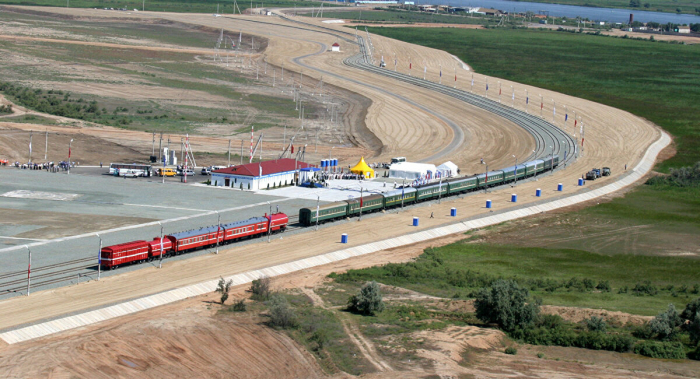
The Chabahar contract was signed on 13 May after 10 years of lengthy discussions and doubts. The US State Department reacted to this the very next day. Through the Chabahar port, India plans to transport goods to Iran, Afghanistan, and Central Asian countries, bypassing the Pakistani ports of Karachi and Gwadar. Considering the situation, it would be more accurate to say "planned" because much has changed since the document's signing. Chabahar was expected to become a key hub for the International North-South Transport Corridor, a multimodal transit route stretching for 7,200 km between India, Iran, Afghanistan, Armenia, Azerbaijan, Russia, Central Asia, and Europe. The deal between Tehran and Delhi was met with great enthusiasm in Russia, which, after the imposition of sanctions, relied on the southern route. So much so that it took on the financing of the Iranian long-term project - the Rasht-Astara railway. Only the absence of this railway hinders the full utilization of the North-South railway from Russia to Iran through Azerbaijan.
How the helicopter crash of President Raisi will affect Iran's foreign policy and priorities is still unknown. However, many analysts lean towards the opinion that Iran's projects with India and Russia are put into question in any case, because the US, apparently, is seriously determined to prevent the Chabahar project from coming to fruition. As long as the North-South corridor was limited to transit from Iran to Russia through Azerbaijan, the US watched the development calmly. But attempts to reach the Persian Gulf and the global ocean, giving this route a global character by shifting international logistics to the South, prompted Washington to take a firm stance on the issue.
India had long awaited the moment to reorient regional logistics towards itself. The US supported it in the goal of ousting China from the market and shifting the East-West route to the Middle East. In September last year, India, the US, and the European Union signed a memorandum on the construction of a transport corridor from India to Europe through the Middle Eastern countries, bypassing Iran, Turkey, and, of course, the South Caucasus. From the very beginning, it was clear that the "Indo-Arab-Mediterranean Corridor" was impracticable due to constant wars and conflicts in the region. The Palestinian-Israeli conflict that erupted in October and turned into a war put an end to these plans, and six months later, India decided to play its own game and make a deal with Iran and Russia, still hoping to take the lead from China. But the US did not like this. Washington did not plan to strengthen the role of Tehran and Moscow and give them the opportunity to control regional logistics.
What follows from this? It follows that in terms of global logistics, priorities are once again shifting to the route passing through the South Caucasus. Azerbaijan has much to consider here. It is still unknown how the new leadership of Iran will be ready to continue the rapprochement between Tehran and Baku, which manifested itself at the meeting of the two presidents in Khudaferin on the day of Raisi's death. The agreement signed by India and Iran on 13 May is also in question. It is possible that the new Iranian leadership will have its own perspective on these issues. However, the previous authorities were not in a hurry to connect their railways with those of Azerbaijan.
Azerbaijan is a link not only for the North-South International Transport Corridor but also for the Middle Corridor, which goes to Europe from China. Even if the ancient Silk Road passed somewhat to the south, modern realities make the South Caucasus the safest and most efficient way to organize the international transit of goods. The leading force on the Middle Corridor is China, which does not suit the West. But the countries along the route are "clean," meaning they are not involved in political scandals, not subjected to sanctions, neutral in their policies, and ready for cooperation. Unlike India-Iran-Russia. It seems that now all attention will once again be focused on the Middle Corridor. Politics is politics, but it is trade that determines mutual interests.
In light of recent events in the region, Azerbaijan, it seems, should not rush to invest in the North-South corridor. Iran and Russia are under sanctions, and there are no expected relaxations in this regard. Any attempts by these countries to go beyond the possibilities set by the US will be noted and persecuted. This does not mean that the already existing North-South route will be closed. No, it will certainly continue to operate, and transit from Iran to Russia and back through Azerbaijani territory will continue. But Baku should not get involved in anything that goes beyond these well-trodden paths to avoid getting caught in the crossfire.
When it comes to Azerbaijan's benefits, the Middle Corridor has always been a priority for it, and Baku has never hidden this. The North-South corridor has always been secondary, more in terms of regional cooperation with neighbours than in terms of global transit. Currently, the Trans-Caspian International Transport Route, in which Azerbaijan plays a key role and concentrates its main interests, is being rapidly implemented.
It is worth noting that on 20 May, cargo transportation on the Baku-Tbilisi-Kars (BTK) railway resumed after the completion of modernization and expansion work on its sections passing through Georgia. This 829-kilometre BTK railway line, connecting Turkey with Central Asia and China through Georgia and Azerbaijan, was closed for cargo transportation in May 2023 due to repair work on the Georgian section. A year later, the first train with 20 containers and 632 tons of raw materials from Azerbaijan arrived at the station in the Turkish city of Kars, marking the resumption of cargo traffic. The goal is to increase the number of container trains between Turkey and China to 200 per year in the medium-term and 1,500 in the long-term, reducing transit time from 12 to 10 days.
Baku-Tbilisi-Kars is a very serious and important railway artery connecting East and West, Europe and Asia. The complex geopolitical situation on the continent has necessitated increasing the capacity of the highway due to the opportunity to attract more cargo in this direction. For a long time, logistics chains were formed in various directions, mainly sea routes. The main land route in our region was the northern direction. But with the start of the war in Ukraine and the sanctions imposed against Russia, as well as the recent events in the Red Sea, the importance of alternative routes is increasing. And one of them, even the main one, is the Middle Corridor, of which BTK is a part. Modernization was carried out to increase cargo transportation volumes from 1 million tons to 5 million tons. Overall, the volume of cargo transportation along the Middle Corridor is expected to reach 10 million tons.
Not only Azerbaijan, but other key countries on this route, Kazakhstan and Turkey, are currently doing significant work to modernize their transport infrastructure to increase the corridor's capacity. None of this is seen in the North-South direction. One might say that only Azerbaijan, being merely a transit country, has shown activity and adapted its infrastructure to the scale of international logistics. Although no one, of course, expected great prospects for the corridor, having partners under sanctions to the north and south.
Once again, it is emphasized that the US has never threatened Azerbaijan with sanctions for the transit of goods from Iran to Russia and back. The only time a warning came from the State Department to Baku concerned the construction of the South Araz Corridor from Agband to Nakhchivan through Iran's territory. But that was only once, and almost immediately there were justifications from Washington, and no one talked about it anymore.
Given Baku's pragmatic policy, there is no doubt that Azerbaijan will choose the most advantageous path for itself. The country has repeatedly demonstrated its ability to navigate dangerous reefs. It will find a way out now as well. The US threats regarding the India-Iran-Russia project are not addressed to Azerbaijan, but it could end up among the losers if it bets on this route. Something tells us that Baku will not make such a bet and never planned to.


Similar news