Serbia at a crossroads: EU integration or ties with Moscow?


.png)

Editor's note: Faig Mahmudov is an Azerbaijan-based journalist. The article expresses the author's personal opinion and may not coincide with the view of News.Az.
Serbia finds itself at a pivotal moment, navigating the delicate balance between its aspirations for European Union (EU) membership and its longstanding ties with Russia. As an EU candidate since 2012, Serbia has made strides toward aligning with European standards, recognizing the economic and political benefits of membership. However, its deep-rooted relationship with Russia presents a significant challenge.
For decades, Russia has been a key ally, providing Serbia with energy resources, military cooperation, and diplomatic support—especially on Kosovo, whose independence Serbia refuses to recognize. These historical ties complicate Serbia’s path to EU integration, particularly as Brussels pressures Belgrade to impose sanctions on Moscow following the Ukraine conflict.
Public opinion is divided. While many see EU membership as a gateway to economic growth and political stability, others value Russia’s historical support and cultural affinity.
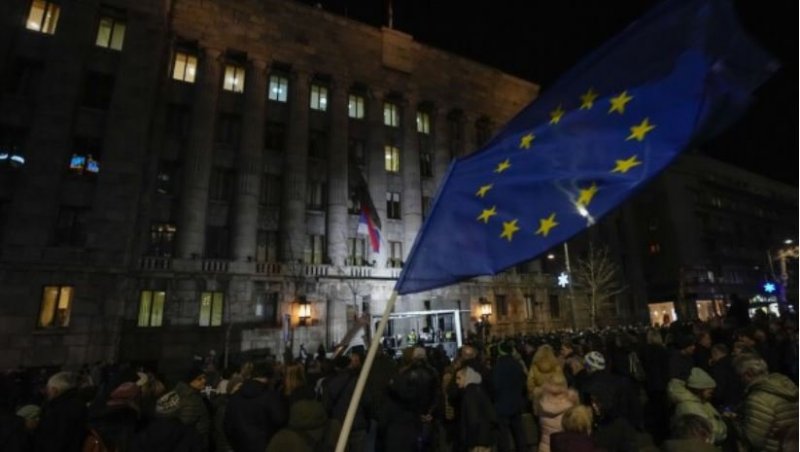
Source: The Associated Press
Serbia recently witnessed its largest protest in decades, with hundreds of thousands taking to the streets of Belgrade. The immediate trigger was a tragic infrastructure failure in Novi Sad, which resulted in significant casualties. However, the demonstrations also reflected deeper frustrations over government accountability, corruption, and political transparency.
While the protests were primarily domestic, Serbia’s ongoing geopolitical dilemma—whether to align more closely with the EU or maintain its strong ties with Russia—remains a crucial underlying factor.
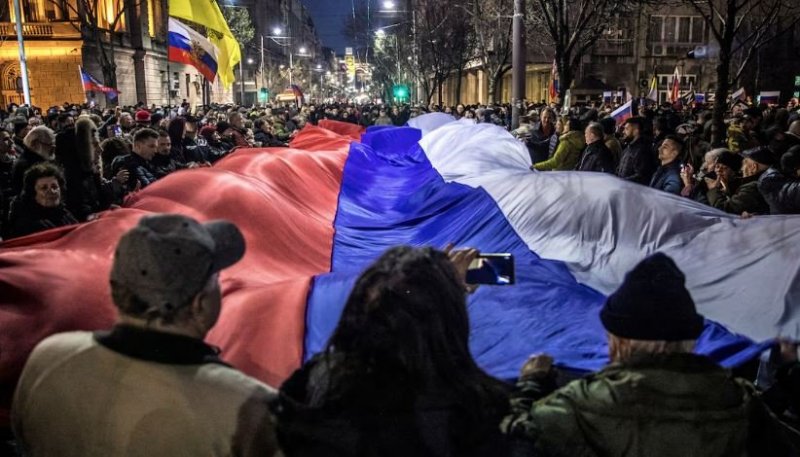
Source: Reuters
The protests were initially sparked by public outrage over governance failures. The collapse of the Novi Sad railway station, which claimed 15 lives, became a powerful symbol of state neglect, lack of transparency, and weak accountability. What began as an outcry over infrastructure failures quickly evolved into a wider movement demanding political reforms and justice.
Students, civil servants, and professionals from various sectors joined the demonstrations, calling for a government overhaul. Their concerns were largely domestic—focused on inefficiency, corruption, and President Aleksandar Vučić’s administration. While Serbia’s foreign policy remains contentious, the protests were not explicitly pro-EU or pro-Russia. However, the political climate inevitably influences discussions about Serbia’s future direction.

Source: Evocs.org
Serbia has been negotiating EU accession since 2014, but progress has been slow due to political and economic hurdles. Brussels has repeatedly stressed the need for substantial reforms in governance, the rule of law, and human rights before Serbia can advance toward full membership.
The EU remains Serbia’s largest trading partner and investor, with billions of euros in financial aid flowing into the country. Many Serbians see EU membership as a means to achieve economic stability, better governance, and alignment with Western democratic values. However, a major obstacle remains: Brussels insists that Serbia must recognize Kosovo’s independence as a prerequisite for membership—an unpopular condition among many Serbs.
Although the recent protests were driven by domestic concerns, they indirectly tie into the broader EU debate. Many demonstrators advocate for a system modeled after Western European democracies—one that prioritizes transparency, anti-corruption measures, and civil liberties, aligning with EU expectations.
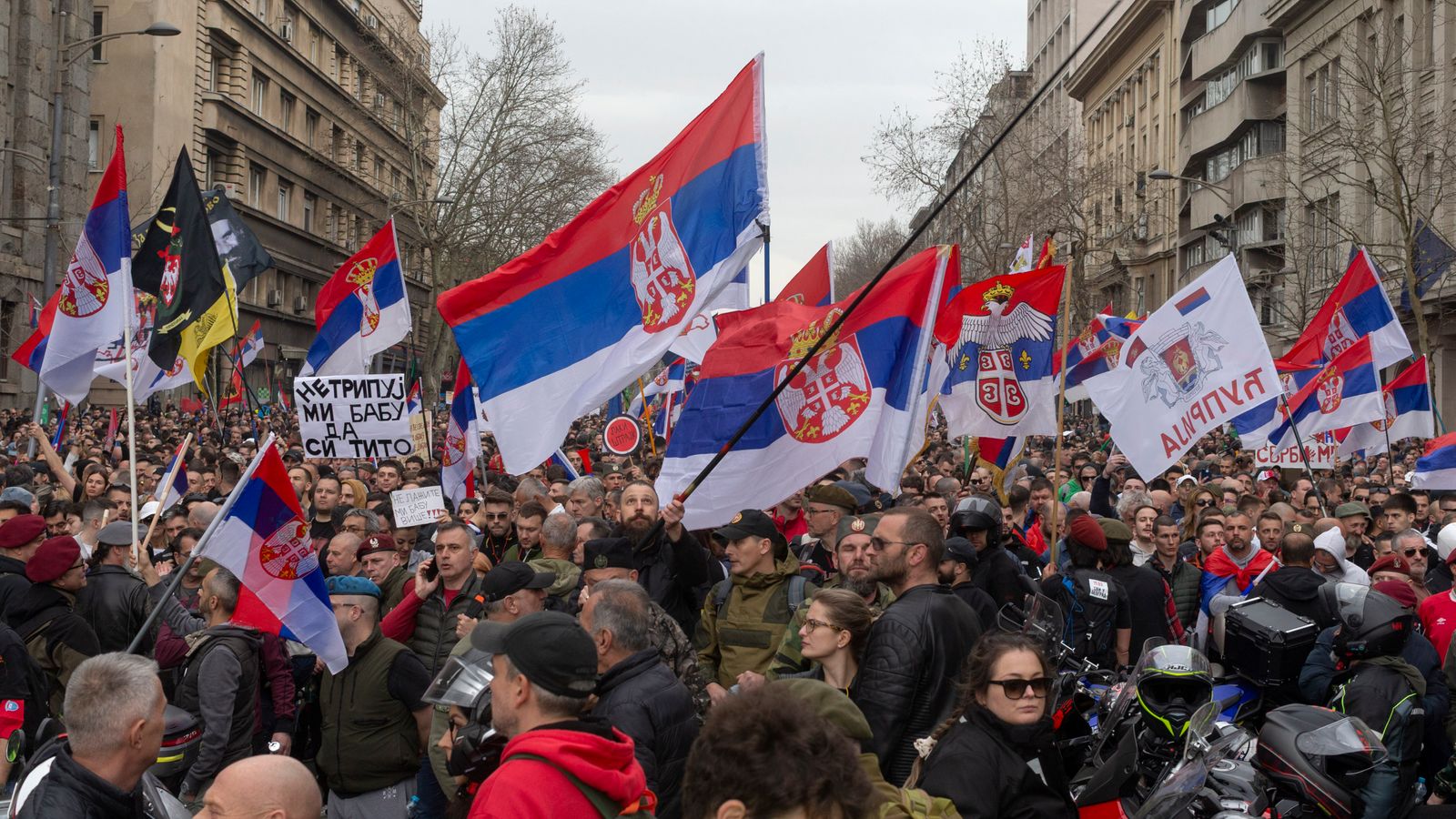
Source: SKY News
Despite its EU aspirations, Serbia maintains deep cultural, historical, and economic ties with Russia, rooted in shared Slavic and Orthodox Christian traditions. Russia has consistently supported Serbia in international forums, particularly in opposing Kosovo’s independence at the United Nations.
While Russia is not Serbia’s largest economic partner, energy dependence remains a critical factor. Serbia heavily relies on Russian gas, and energy agreements with Moscow reinforce this dependency. Additionally, Russian media holds significant influence in Serbia, shaping public opinion in favor of maintaining close ties with Moscow.
Unlike the EU, which demands governance reforms, Russia imposes no such conditions, making it an attractive ally for the current administration. Vučić has long balanced relations between Moscow and Brussels, but this strategy is becoming increasingly difficult as Western pressure mounts for Serbia to align with EU foreign policy—particularly regarding sanctions against Russia.
Serbian society remains split on its geopolitical future. Younger, urban populations tend to favor EU integration, while older generations and rural communities lean toward maintaining strong ties with Russia. This divide is also reflected in Serbia’s political landscape, where nationalist parties advocate for closer relations with Moscow, while pro-European factions push for deeper integration with the West.
Although the recent protests were not explicitly part of this geopolitical debate, their demands for transparency, judicial independence, and accountability align more with European democratic norms than with Russia’s governance model.

Source: npr.org
President Vučić has long pursued a pragmatic approach, leveraging Serbia’s position between the EU and Russia for strategic gain. However, the scale of the protests presents a serious challenge to his administration. If the demonstrations persist and evolve into a sustained political movement, Vučić may be forced to make more definitive choices regarding Serbia’s future.
His government’s response will be closely monitored by the EU and Western nations. A harsh crackdown could jeopardize Serbia’s EU accession prospects, while meaningful concessions might embolden the opposition. At the same time, distancing Serbia from Russia carries economic and political risks, particularly concerning energy security and nationalist sentiment.
Serbia’s largest-ever rally underscores deep public frustration with corruption and governance failures while also highlighting the country’s broader geopolitical dilemma. Although the protests were not explicitly framed as pro-EU or pro-Russia, their underlying demands for greater transparency and democracy align more with European values than with Moscow’s influence.
The coming months will be crucial in determining how the Serbian government responds and whether the protests evolve into a larger political movement. Serbia faces a defining choice: continue balancing between East and West or make a decisive move toward EU integration. The outcome will shape not only its domestic politics but also its role in the broader geopolitical landscape.
(If you possess specialized knowledge and wish to contribute, please reach out to us at opinions@news.az).


Similar news