Ukraine and Azerbaijan: New gas route to Europe


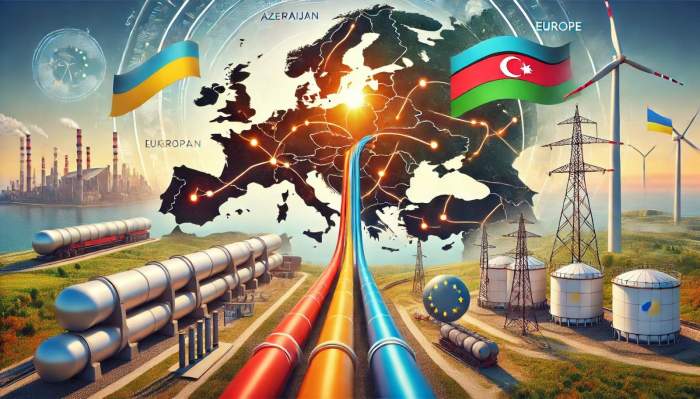
Image:Chatgpt
Editor's note: Ivan Us, chief consultant of the Center for Foreign Policy Research of the National Institute for Strategic Studies (Ukraine), Ph.D. in Economics. The article expresses the personal opinion of the author and may not coincide with the view of News.Az.
Amid geopolitical turbulence and Europe’s ongoing energy transition, Ukrainian President Volodymyr Zelensky’s recent announcement of Ukraine’s readiness to transport Azerbaijani gas underscores Kyiv’s ambitions to solidify its role as a key player in the European energy landscape. His statement, delivered during a press conference with Moldovan President Maia Sandu and reflecting discussions with Azerbaijani President Ilham Aliyev in Davos, highlights Ukraine’s strategic positioning in the evolving energy market.Zelensky emphasized Azerbaijan's robust export potential, citing an annual gas production of 40 billion cubic meters (bcm), of which 25 bcm are earmarked for export. However, experts have questioned the short-term availability of these volumes, noting that Azerbaijan’s current surplus amounts to only a few bcm—just enough to satisfy Moldova’s immediate needs. Despite these constraints, transit through Ukraine offers a strategic avenue for integrating the country into Europe’s energy framework, particularly as the continent distances itself from Russian gas supplies.
Since halting Russian gas transit on January 1, Ukraine has refused to renew its agreement with Gazprom. Zelensky has firmly stated that Ukraine will not transport Russian gas disguised as Azerbaijani gas, a stance that has garnered support from the European Commission, despite criticism from Slovak Prime Minister Robert Fico.
Europe’s energy map is undergoing significant transformation amidst worsening relations between Russia and its neighbors. A notable example is the recent downing of an Azerbaijani aircraft by Russian air defenses, which has strained Moscow-Baku relations. Azerbaijani President Ilham Aliyev’s strong response, including a refusal to allow Russian gas to masquerade as Azerbaijani, reflects a broader trend of Azerbaijan asserting its independence in the energy sector.
This geopolitical shift works to Ukraine’s advantage. By positioning itself as a reliable gas transit partner, Kyiv has the potential to play a pivotal role in reshaping energy flows. The Trans-Balkan pipeline, which could transport Azerbaijani gas to Moldova via Bulgaria, Romania, and Ukraine, appears increasingly viable. This route would enhance Moldova’s energy security while simultaneously strengthening Ukraine’s geopolitical and economic standing.
Zelensky’s proposal extends beyond economics, serving as a political signal that Ukraine is ready to contribute to Europe’s energy independence. By offering its infrastructure for Azerbaijani gas, Kyiv is positioning itself as an integral part of the global energy equation and an alternative to Russian gas. Notably, Ukraine has excluded the Russian-controlled region of Transnistria from the transit process, reinforcing its alignment with friendly states like Moldova.
Realizing these projects will demand significant investment and close cooperation with European and Azerbaijani stakeholders. If successful, Ukraine’s status as a vital energy transit hub in the region will be further consolidated.
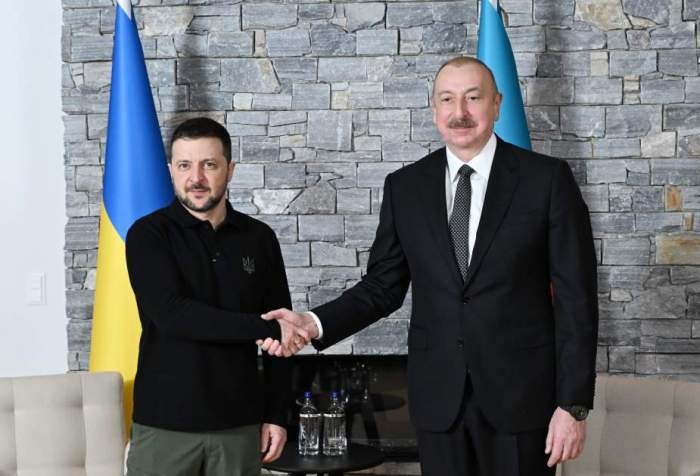
Photo: Official web-site of the President of the Republic of Azerbaijan
Despite Zelensky’s optimism, Azerbaijan’s current export capacity is limited. Much of its gas is already committed to Turkey and other countries within the Southern Gas Corridor. Nevertheless, the long-term prospects are promising. Increased production at the Shah Deniz field and the development of new projects could significantly enhance Azerbaijan’s role in Europe’s energy market.
A critical question remains: Is Europe prepared to prioritize Azerbaijani gas? Given the EU’s commitment to reducing its reliance on Russian energy, supporting Azerbaijan’s gas projects could become a strategic necessity. However, such initiatives require substantial time and investment to materialize.
Ukraine’s shift away from Russian gas transit represents both a challenge and an opportunity. By repurposing its extensive infrastructure for new energy partnerships, Kyiv seeks to minimize economic losses while participating in global energy processes. However, the success of these initiatives hinges on several factors: Azerbaijan’s capacity to increase exports, Europe’s readiness to diversify its energy sources, and Ukraine’s ability to maintain transparent and reliable transit operations.
Zelensky’s remarks about Azerbaijani gas transit underscore Ukraine’s determination to adapt to a rapidly changing energy reality. By offering alternative routes and aligning itself with Europe’s energy goals, Ukraine aims to strengthen its position in the region. However, realizing these ambitions will require political resolve, strategic partnerships, and robust investments in infrastructure.
As geopolitical tensions and shifting energy flows reshape global markets, Ukraine must prove itself as a trustworthy partner for both Europe and Azerbaijan. While challenges remain, Kyiv’s proactive approach signals its commitment to playing a central role in the new energy order—an opportunity it cannot afford to miss.
(If you possess specialized knowledge and wish to contribute, please reach out to us at opinions@news.az).


Similar news