Azerbaijan achieved sustainable development in economic sphere: President Aliyev’s interview with local channels


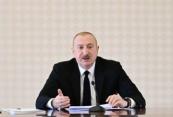
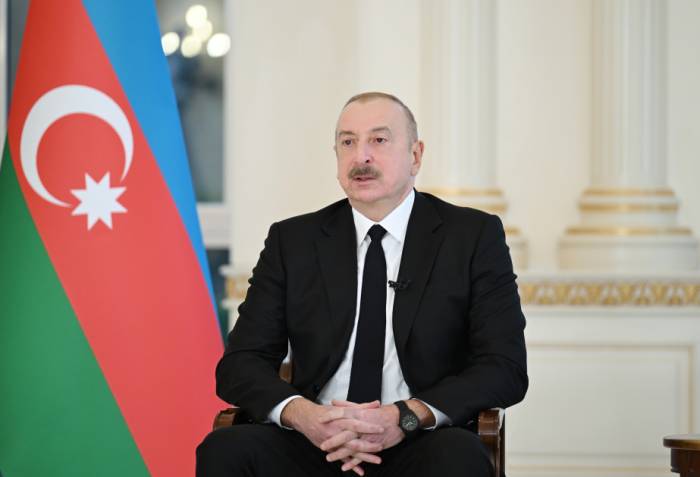
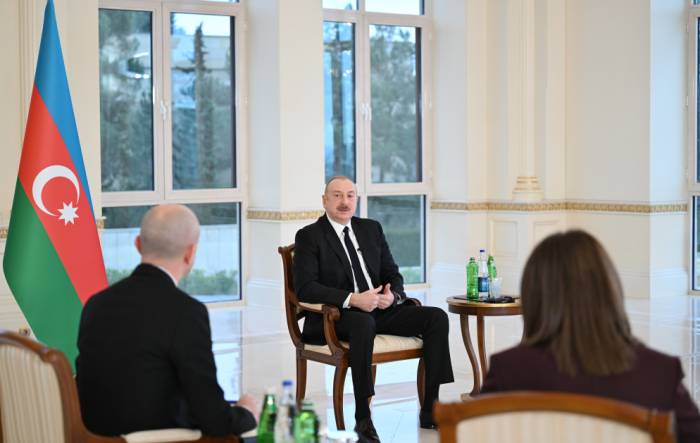
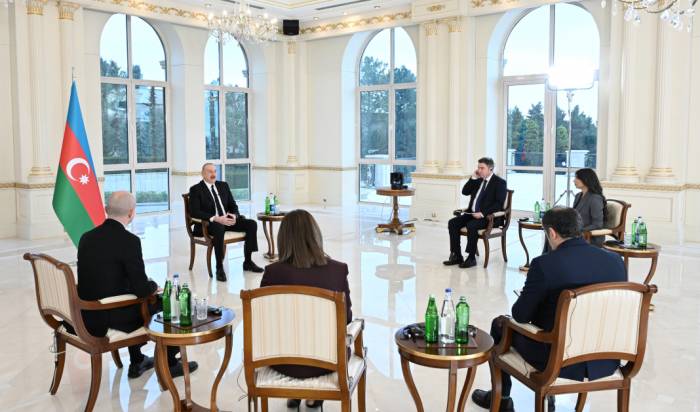
On January 7, President of the Republic of Azerbaijan Ilham Aliyev was interviewed by local TV channels.
News.Az, citing AZERTAC , presents the interview.Vusal Matlab from Azerbaijan Television: Good to see you, Mr. President. First of all, with your permission, we would like to thank you for this interview format, which has already become a tradition. Because it gives us the opportunity to find out your detailed views on issues of public interest. We are grateful for such an opportunity.
I would like to begin with the results of 2024. What can you say about the indicators of the socioeconomic performance in 2024 and what forecasts do these indicators create for 2025?
President Ilham Aliyev: Last year was also a successful year in terms of economic development. Azerbaijan’s economy developed. I believe that the pace of development, if we look at today's world in general, can be seen as positive. The gross domestic product has increased by more than 4 percent. In fact, the main indicator for us is the development of the non-oil sector. Because, as you know, we have been facing a decline in oil production, and I believe that as a result of the negotiations and efforts made, this decline will be stopped and oil production will remain stable. Thus, the decline in oil production will no longer have a negative impact on the gross domestic product. Therefore, when we look at overall economic indicators, we, first of all, take into account the parameters of the non-oil sector. Here too, the development has been more successful, as it has increased by more than 6 percent. Considering that for many years now, one of our main goals for economic development has been to increase industrial production, growth in the non-oil industrial sector is even higher. This is more than 7 percent. In other words, if we look at the growth rates of the world economy and the development rates of developed countries, or rather, their recessions, we will see that the Azerbaijani economy has developed successfully. Of course, this is based on a well-thought-out policy.
These indicators are not just the result of the last year. As a result of many years of economic reforms, transparency, the fight against monopolistic trends, attraction of investments, and improvement of the investment climate, we are observing a positive change in the attitude of leading international rating agencies to Azerbaijan. That is, they cannot deny the reality either. However, I believe that our international rating deserves a higher level than it currently is, but for certain reasons, leading rating agencies are still displaying a modest approach. In other words, all this suggests that we have been able to achieve sustainable development in the economic sphere, and I am sure that this dynamic will be maintained this year and in the coming years.
As for our financial situation, last year we were able to significantly improve our performance and increase our reserves, although last year's budget was at a record level and many social programs were implemented, including the fact that major funds were mobilized for the restoration of Karabakh. Despite this, we have optimized our processes in such a way that our foreign exchange reserves have further increased. Throughout the year, our foreign exchange reserves increased by more than $5 billion. Today, this figure is equal to $72 billion. For a country with a population of 10 million, this is a very large indicator. Because everything is measured in comparison. A calculation of foreign exchange reserves of countries worldwide should, of course, be based on reserves per capita, and according to this indicator, Azerbaijan is among the leading countries in the world.
The second important indicator is the ratio of gross domestic product to external debt. I believe that we are among the world leaders here as well. Because our external debt accounts for only 7.2 percent of our gross domestic product. For comparison, I can say that in most developed countries it is in excess of 100 percent, and a level of 7.2 percent is a truly great result. That is why I believe that international rating agencies should demonstrate a fairer position to Azerbaijan. Of course, the comparison of foreign exchange reserves with external debt is also one of the important factors. Here too, our foreign exchange reserves exceed our external debt 14 times. So if someone shows me a second such country – we are talking about developed countries – if anyone can come up with this set of figures, I would certainly be grateful. But there are no such analogues among developed countries. So, all of this gives us reason to say that the economy is stable, relies on its own resources and does not need any external financing. However, we have now begun to make efforts to slightly increase our external debt. It may increase to some extent, because it has decreased significantly. Five years ago, when our external debt accounted for about 20 percent of the gross domestic product, I set a goal that we should reduce it to 10 percent. Now it is 7.2 percent. So what will external financing give us? Considering that the country has many serious investment-requiring issues, this will slightly reduce the burden on the budget. Therefore, considering that a repayment schedule of our external debt has also been determined, our external debt, which is equal to $5.2 billion today, will decrease even more over the years. Therefore, attracting additional financial resources can be considered expedient, and the government has already begun to work in this direction. I have given the appropriate instructions.
Of course, the budget parameters also reflect the economic potential of each country: both parameters and dynamics. That is, this year's budget is at a record high. Budget expenditures exceed 41 billion manats. The overall budget is in excess of 48 billion manats. There has never been such a large budget in the history of Azerbaijan. Listing all these factors, I want to show once again that we have achieved these results solely at the expense of internal resources, as a result of transparency, governance, and sound economic policies. I have repeatedly stated this, and I think everyone now sees this, that the political independence of each country depends on its economic independence. If you are not dependent on anyone in economic and financial matters, you can conduct an independent policy. Therefore, in general, there are, of course, many other parameters,. But these are the main economic indicators. Of course, this allows us the opportunity to implement social programs more actively.
As you may know, from 1 January this year, the minimum wage increased by 55 manats to reach 400 manats. The minimum pension has increased by 40 manats to reach 320 manats. The average increase is 14-15 percent. For a country that has made such large investments and has such a tall task of restoring Karabakh, paying attention to this area, of course, shows the essence of our policy. In other words, Azerbaijani citizens should be able to live better year after year. If we compare this increase with the inflation rate, which was a little more than 2 percent last year, then this increase is just another aid from the government to the vulnerable population. Everything should be fair in society, in politics and in the family. The principles of social justice have always been important to us. As soon as the opportunity arose, we first of all paid attention to this area. Over the past few years, four social packages have been implemented and more than 7 billion manats have been spent for this purpose. From now on, social and economic development will go hand in hand. As economic opportunities increase, we will always pay attention to addressing social issues – increasing the minimum wage, pensions and social benefits.
Guy Shawn from AnewZ Television: Mr. President, thank you very much for speaking to AnewZ, an international channel that broadcasts in English. I particularly want to thank you for agreeing to speak with us today in English for our viewers.
I’d like to ask you about COP29. The whole world pretty much came to Baku. There were many tough negotiations. There were some noticeable absentees - the President of France and the President of the European Commission did not attend. Despite that, a deal was done. Could I ask for your reflections on the achievements of the event and also what needs to happen this year and beyond to keep that momentum?
President Ilham Aliyev: Yes, COP29 was a big challenge for us, and of course, a big opportunity. Our task was to convert the challenge into success. Of course, we clearly realized that Azerbaijan, not being a biggest gas emission country, cannot play a decisive role in bringing the world together. But we thought that our experience in international institutions and a diversified foreign policy would help us to build bridges.
So, as soon as we were awarded COP29 in December 2023, we started to be deeply involved in the substance. Frankly speaking, before, we were not very actively involved in this process. You see that one of the main impediments to achieving success is the lack of trust between the Global South and the Global North – between the countries, which are the big polluters, if I could name them like that, and those that suffer from this. And we have seen the disbalance; the countries which have an existential threat with respect to climate change, have their gas emission below 0.1 but they are really under threat. So their life, their future, and the whole existence of the countries, especially small island states, are under threat.
So we started to use our homework preparation, being very active in the Global South, having great experience in chairing the Non-Aligned Movement for four years with great success - with unanimous support from this institution, which was reflected in a unanimous decision to extend our chairmanship for one more year. At the same time, being actively involved in European politics Azerbaijan signed or adopted strategic partnership declarations and agreements with ten members of the European Union. So we decided that could work.
We started to work immediately. So, we work on two tracks mainly: preparation and substance. On both, there have been a lot of rocks and bumps. But I think the final results demonstrate that it was a success story. Preparation was a big challenge because, unlike previous COPs, we had not two years but only eleven months to prepare. We had to build all those great installations in the stadium and around it - close to 200 thousand square meters of covered space - and everybody was happy with the organizational side. It was not only about creating that site, but also logistic, transportation, accommodation, certification of our hotels, and finding other spaces for guests to stay because we do not have so many rooms. We had 76,000 registered participants from 197 countries.
Another problem, which we did not expect, was attempts to boycott COP29 due to political reasons, and that was very unexpected. I don’t think that any other country which hosted this event faced this kind of resistance. But we also managed to deal with that. So the boycott failed. Though, as you mentioned, some countries, especially France, were doing their utmost to discredit the event. I have information from my colleagues, presidents, that the French president personally was contacting many of them, saying not to go to Baku. So, even that was used to stop leaders from coming. But it failed. Eighty heads of states and governments came to Baku. That once again demonstrated that Azerbaijan is considered a reliable partner.
With respect to what you said about the absence of the President of the European Commission, as far as I know, this was the first COP where the President of the European Commission did not attend, though the participation of the President of the Commission was confirmed a couple of months before. Even at the initiative of the European Commission, a special session was planned to address the issue of the green cable project with the participation of the leaders of Azerbaijan, Georgia, Hungary, and Romania, the countries, which are involved. Again, that event was proposed by the European Commission, and we found a place to squeeze it in because it was too busy, but it was the “last-minute cancellation” of the visit which was a surprise.
I know that the Organizing Committee of COP29 communicated with the European Commission, saying that COP is for two weeks. And there was a lot of time to come. By the way, the Secretary-General of the United Nations came twice: at the opening and at the closing. But again, this message was ignored by the European Commission. And of course, COP29 did not suffer from that, but the absence of the European Commission, which is a party to COP, of course, raises a lot of questions.
But nevertheless, from the point of view of the organizational side, it was definitely a success story. I already said once that we had only ten complaints, which were addressed immediately.
So now, with respect to the results, many people call it – and I join that - Baku Breakthrough because for almost ten years, the parties could not agree on the carbon market. The first days of COP already started with success, and an agreement on the carbon market - Article 6 of the Paris Agreement - was achieved. And that was really a great success, and everybody was happy about that. So, what couldn’t have been agreed on for ten years was agreed upon in Baku.
Of course, the financing, because the main topic of COP was finance. I know that there were a lot of expectations that a trillion dollars would be allocated, but that was absolutely unrealistic. So, what was achieved is that we tripled the financing for the coming years. Because before COP29, the latest agreed figure was USD 100 billion. So, here in Baku, we made it 300 billion USD. So, when someone says that it was a failure, it’s not fair. It was a real success and also a legacy that will be used for the future.
There were a lot of other important initiatives. The total number of initiatives from Azerbaijan was 14. I don’t want to mention all of them. It demonstrates that we treated this issue very seriously. Of course, another legacy, which I am sure will remain at future COPs, is the creation of the Troika between the current, previous, and future host countries. So, that is how it was organized. This creates synergy because we built our success on the success in the UAE, on the success of COP28 UAE consensus. And we used their experience. So this year, COP in Brazil will definitely build its—I hope—success story on UAE and Azerbaijan’s success.
Of course, our green agenda, which is another topic, absolutely fits in the global green agenda and green transition. I think we have already done a lot, and many more projects are to be implemented in the near future.
So, I would once again call it a very big success. An important factor for us was also the country presentation. Never in our region has something similar been held. Never have so many guests gathered in one place in our region. So, it was a country presentation, and all those, whom I met, said, many of them – I mean, those who visited us for the first time – said they were impressed with what they had seen. Because the lack of information about Azerbaijan and also deliberate misinformation about the country actually has influenced the minds of many people. So, when they come to Azerbaijan, they see a vibrant society, educated people, trained personnel, the beauty of the city, and the total comfort of the society. Of course, it impresses.
So, we had different targets, and all of them were achieved. So, another success for Azerbaijan.
Nigar Sabirgizi from Public Television: Mr. President, you talked about COP29. Of course, COP29 was an indicator of Azerbaijan's international authority. My question will also be about Azerbaijan's place in the international community. It is known that our country closely cooperates with a number of international organizations, is a member of these organizations, and this process continues. Recently, at the end of last year, on 19 December, Azerbaijan was admitted to another influential organization, D8. This organization expanded its ranks with Azerbaijan after almost 30 years. What does membership in D8 mean to Azerbaijan in terms of Azerbaijan's place in the political system of the world? I would like to ask what this means for Azerbaijan and what prospects it opens up for our country?
President Ilham Aliyev: This was another successful step for us. Because Azerbaijan's acceptance into this organization once again demonstrates the authority of our country. You know very well that this organization was established almost 30 years ago at the initiative of Türkiye and included eight countries. No other members were accepted during these years. Azerbaijan was the first member accepted after the first enlargement decision. Of course, this shows the authority of our country as well as our role in the international arena. D8 is the largest organization uniting Muslim countries. It is an organization with a population of more than one billion and accounts for 60 percent of the economy of Muslim countries. If we consider the gross domestic product of this organization, it exceeds 5 trillion dollars. There are about 60 Muslim countries in the world, and Azerbaijan has been elected as a new member. Of course, this is both a great honor and a great responsibility for us. All instructions have already been given so that Azerbaijan can be active in this organization and make its contribution.
It was Türkiye that supported our candidacy from the very first day. At the invitation of President Recep Tayyip Erdogan, I once attended the D8 summit in Türkiye as a guest about seven or eight years ago. Since then, the issue of Azerbaijan's membership has been on the agenda. But, of course, there had to be a consensus among all member countries, and finally, this consensus was achieved.
We will, of course, be in closer contact with member states. However, we already have very active relations with all member states. We still consider this decision to be a recognition of our successes. I repeat, this is just the first such step. The main issue will be related to the future activities of D8. Of course, we have our own ideas and our own agenda. We will constantly be in contact with member states and make our proposals. I think it is quite realistic that D8 will have great influence as an organization. I believe that, in one way or another, the expansion has already begun, it will not be limited to Azerbaijan, perhaps other countries will also be invited. Of course, these issues will be considered on the basis of consensus.
Azerbaijan has always been a valuable member of the Muslim world. If you pay attention to the statements of the leaders of the Organization of Islamic Cooperation, you will see that this organization, which unites all Muslim countries, has had a very positive opinion about Azerbaijan at all times. We have taken consistent steps related to Muslim solidarity, including respect for the Islamic religion in Azerbaijan, interfaith relations, and hosting many events, including the Fourth Islamic Solidarity Games. We always defend the interests of Muslim countries in all international organizations, including the UN. In all organizations, if an election is held for a leadership position in any organization and there is a representative of a Muslim country there, we automatically vote for that representative. That is, this was my instruction, and once the instruction is given, I repeat, it is automatically resolved. We have provided assistance to many Muslim countries. We do not boast about it, and when we do so, we do not talk about it much. But even the information available in the media is sufficient to say that we are very active in this area, both during COVID and in other issues. We have been at the forefront of addressing the disaster facing the Palestinian people. After the collapse of the Assad regime in Syria and the formation of a new government, Azerbaijan became the second country after Türkiye to provide humanitarian assistance there, and we are ready to provide any other assistance. For this purpose, a delegation from the Foreign Ministry of Azerbaijan recently visited Syria.
So, we perceive the interests of all Muslim countries as our own, which is probably why Azerbaijan was the first choice after the decision to expand D8 was made. Of course, our country's economic potential, political weight, and military power were taken into account as well. Our policy of Islamic solidarity, which I mentioned, was taken into account. At the same time, this organization is expanding its geography. D8 has already expanded to both the Caucasus and the Caspian region, and the wider our geography, the broader our opportunities.
It is no secret to anyone that a new world order is shaping up. I believe that we are at the beginning of this process, many gaps are emerging and will emerge. The system that emerged after World War II has already lost its potential. This is evidenced by the processes, conflicts, wars, and other events taking place in many places. At the same time, the political and moral crisis in leading Western countries is also obvious. In other words, the most critical of the situation facing the West today is the elected president of a leading Western country. And he is right in criticizing it. Because this system has already exhausted itself. I am not the one saying this. This is what Mr. Trump, who will become the President of America in a few days, is saying. Naturally, these gaps will widen further, and it is necessary for a new actor, a new serious player with a serious agenda, to emerge. For example, we believe that the Organization of Turkic States can become a serious power center on a global scale. Because it has vast geography, human resources, natural resources, transport and communications, and unity. I believe that D8 can also fill this gap. I repeat, more than 1 billion, perhaps 1.3 billion people, live in these countries. 60 percent of the economy of Muslim countries is in D8, and 60 percent of the population is also in D8 countries. Therefore, this is an opportunity. We cannot miss this opportunity, we cannot waste time, and we become a member of this organization with this agenda. I believe that our ideas and proposals will be carefully considered.
Nigar Sabirgizi: Thank you very much.
Sanan Rzayev from CBC Television: Mr. President, our channel broadcasts in Russian. With your permission, I would like to ask you the question in Russian.
President Ilham Aliyev: Please, go ahead.
Sanan Rzayev: Mr. President, if we talk about last year, one of the landmark events was the liberation of four villages of Gazakh district from Armenian occupation. It is noteworthy that this, as it were, happened as a result of some form of dialogue between Yerevan and Baku. Moreover, in the same area, it was also possible to achieve the delimitation and demarcation of a certain section of the state border within a short period of time, which was actually surprising. I would like to know your opinion. What do you think was the key to success? What made it possible? What factors made this possible? Because after all, we have a very complicated history of relations with Armenia, to put it mildly, and all of a sudden, there was this.
- I would say that it happened as a result of a monologue rather than a dialogue. This is because it is clear that the dialogue with Armenia has failed for decades. Armenia's policy of occupation did not allow for any dialogue, and they used the format of negotiations as a cover-up for continuing their occupation. And the information that recently appeared in the media, namely the fascist statements of the first president of Armenia, once again confirms what we have known for quite a long time in principle, that Armenia was not going to vacate a single centimeter of Azerbaijani territory. They felt quite comfortable, as they thought, receiving billions of dollars’ worth of free arms from one ally and political and moral support from the other two. Thus, all three co-chairs of the OSCE Minsk Group during the period for which I am responsible were unequivocally on the side of the occupier. I am telling you this as a person who has been conducting negotiations within the framework of the Minsk Group since 2004 and has met with this “troika” a great number of times. Therefore, of course, we could not expect to get these territories back through dialogue. Neither could we expect to restore our territorial integrity through dialogue.
I think there were several factors that led to Armenia voluntarily, well, let's say voluntarily and coercively, returning these villages. The first is the Patriotic War and its results. The second is the anti-terror operation. I think that this should have completely dispelled any illusions the Armenian leadership may have had that someone would confront Azerbaijan together with them. My last demand about the four villages of the Gazakh district was put forward to the Armenian Prime Minister almost a year ago, in February last year. This topic had always been on the agenda since the end of the Second Karabakh War. Before that, there was no point in talking about that because the main issue of occupation had not been resolved. But as soon as the Trilateral Statement was signed, actually even before it was signed, this topic was constantly on the agenda. I will tell you more – we also raised the topic of the occupied villages of the Gazakh district in the process of agreeing the conditions for the conclusion of the Trilateral Statement. It could not be done for certain reasons at that time, but we knew that we would achieve it in any case – just as we knew that we would regain full control over all the territories. Because the 10 November 2020 Statement did not fully resolve the issue of occupation, as we all know very well. Therefore, acting with strategically rigid logic, we took steps consistently, purposefully and persistently. The Patriotic War, certain clarification of the conditional border between Azerbaijan and Armenia, the anti-terror operation and four villages of the Gazakh district. One of them was occupied during the Soviet Union in 1990, while the other three were occupied in the spring of 1992. So last February, at a meeting with the Prime Minister of Armenia in Munich, this issue was raised in the form of a monologue. I am glad that we did not have to resort to other methods in order to return these villages. I think that the lessons of the last four years are being taken into account by the Armenian side, though not fully memorized yet. So I think this is a good first step not only in the delimitation but also in the demarcation of the border, which I think is a unique situation when delimitation and demarcation take place almost at the same time.
So we achieved justice in this matter and regained our territories. I sent a group of specialists to these villages long ago. There is an issue of proximity to Armenian settlements there and there are certain threats in the event of escalation, so I have asked for the most secure place to be identified for the construction of housing for the residents of these villages, so that their safety could be ensured. Because having such an aggressive neighbor, we should first of all think about the safety of our population.
So I think that the process was as transparent as possible. It was also positively received by Armenia’s new patrons, because the demarcation process also took place. And, of course, it should give impetus to the clarification of the entire perimeter of the borders. The protocol that was agreed between the Armenian and Azerbaijani commissions on delimitation and demarcation says that many factors should be taken into account when clarifying the border: security, communications, settlements, historical factors, environmental factors, etc. That is, the existing conditional border between Armenia and Azerbaijan is not a dogma, and our position has always been that it needs to be clarified taking into account these and many other factors I mentioned. As far as I know, this month, we have at least put forward this initiative, the next meeting of the Azerbaijani and Armenian delimitation commissions should be held to continue the process of delimitation. We have our approach on methodology, we have given it to the Armenian side, and the verbal response we received, which has been reported to me, indicates that there are no particular objections from their side. So let’s wait and see.
Vafa Aghabalayeva from REAL Television: Mr. President, the strengthening of Azerbaijan as an independent country increases the resentment and anger of its enemies and rivals. We were further convinced of this by your commentary. The processes carried out by Western circles could likely be described as a form of cold war at this stage. My question will be about the new state budget of Azerbaijan. To be more specific, we are talking about the funds allocated for security and military issues. Just yesterday, Armenian military units once again fired at Azerbaijani territories. This is yet another provocation. How will these new expenses and those funds allocated for security issues serve to prevent revanchist tendencies from emerging in our Western neighbors, especially in terms of changing their constitution and abandoning claims to their neighbors' territories?
President Ilham Aliyev: Yes, you are absolutely right. I have already stated that the consequences of the Second Karabakh War and the anti-terror operation should be taken very seriously in Armenia. The ongoing armament of Armenia is, of course, a new threat factor for the South Caucasus. I have already said this and I want to say it again that we cannot simply watch this as observers and do nothing. I have also repeatedly stated this to the Armenian leadership that this may create a new threat. At the same time, those who seem to be standing behind Armenia today and inciting them to new provocations and sabotage against Azerbaijan will most likely not stand behind them until the end. Just as they could not stand in 2020 and beyond. Not because they do not want to stand, but because Azerbaijan simply will not provide these opportunities. Therefore, a significant part of the state budget of Azerbaijan will be spent on military and security issues. I have already said this once: we are spending 4 billion manats on the restoration of Karabakh and East Zangezur and 8.4 billion manats on resolving military and security issues. It could have been completely different. Because Armenia's arms race forces us to attract financial resources to military issues other than the main ones. I also stated that Armenia cannot compete with us in the arms race. However, we must also take into account one issue here. These weapons are given to Armenia either for free or in the form of loans. Those loans are also written off after a certain period and also from the European Union's notorious peace facility. Notorious, because the peace facility should actually be used for peace purposes. Their peace facility is aimed at armament. The first payment was made from there, and according to the information we have, this is not the last payment.
Another disturbing fact is that in April of last year, for the first time in history, a very strange cooperation platform was created - America, the European Union and Armenia. As you know, the US Secretary of State, the President of the European Commission and the Foreign Minister, and the Prime Minister of Armenia met in Brussels and actually reached an agreement on a new cooperation. According to the information we have, the agreement reached before this meeting also included a military component, but after that it was officially removed from there, but de facto it remains there. This, in fact, excluded both the European Commission and the United States of America from the Azerbaijan-Armenia normalization process. We have already informed them about this. If any party takes sides, it cannot be a fair mediator. That is why the request of the US Secretary of State remained in the air last month and Azerbaijan did not agree to a trilateral meeting. In addition, as you know, many meetings were held in Brussels at the initiative of the presidents of the European Commission and the Council of the European Union. This has now also been stopped. So we are in favor of a bilateral negotiation format, and of course, Azerbaijan will defend its position as a party to this issue.
Arming Armenia will simply lead to new tensions. We do not want this. We want peace. We want the war page to be closed. However, we see that both Armenia itself and its new patrons do not want this. They live with ideas of revenge, and Armenia is actually a source of threat to the region. The independent Armenian state is actually a fascist state. Because if this country has been led by proponents of fascist ideology for nearly 30 years, they have shaped this country the way they did. Now look, the racist and fascist statements of the first president of Armenia are as ugly as they are dangerous. He portrays ethnic cleansing as a source of pride, bragging about the expulsion of Azerbaijanis from their historical ancestral lands. This video, as they say, has now been made public. But, of course, they knew this in Armenia. Armenia's allies and supporters, of course, knew and shared these views. The 30-year occupation policy against us is not simply a product of Armenia, but a joint product of Islamophobic, Azerbaijanophobic, racist, xenophobic circles, and representatives of foreign countries who are in solidarity with it. We are neighbors with such a fascist state, and the threat of fascism is not going away. Therefore, fascism must be destroyed. Either the Armenian leadership will destroy it or we will. We have no other choice. Again, 30 years of occupation, the suffering of our people, the Khojaly genocide, the ravaged and devastated Karabakh – all this is before our eyes. Who can guarantee that this will not happen again? No one! Because the first three leaders of Armenia are proponents of fascist ideology. The current leader of Armenia, as I said, now wants to make a dove of peace out of himself. But look, no one wants to recall his speeches in 2018-2019 now. Even its friends in France do not want to give it up. So this ideology lives there, and its carriers are not just the current Armenian opposition, but the Armenian government. I want to say again that we cannot just watch this as observers. Armenia must immediately stop arming. France and other countries that provide it with weapons must terminate and cancel these contracts. The weapons that have already been sent to Armenia must be returned. This is our condition. Let them take it as they please. I give my word, they know it, and those behind them know that if we say something, then we are already taking this issue very seriously.
I hope that all our conditions regarding the peace treaty will be accepted. Because there are no extraordinary issues in these conditions. The abolition of the Minsk Group, the amendment of the constitution – without these, a peace treaty is impossible. If Armenia does not need a peace treaty, we do not need it either. We can live and conduct our own policy without signing it. In other words, I would still advise the Armenian side to weigh everything up, including geopolitical changes in the world. Their close friends are being shamefully removed from the political scene. Yesterday, news came that Mr. Trudeau, a close friend of Armenia and Pashinyan, also had to resign. This country, which was very anti-Azerbaijani during and after the Second Karabakh War, is not far from France. As for France, what is happening on the political scene there now? Everyone can see that. Yesterday, the French president made further absurd accusations against Azerbaijan. It seems that Mr. Macron cannot live without Azerbaijan. He has some kind of mania and wants to blame all his sins on us. I think that if we have become so strong that we can interfere in the internal affairs of France and change something, we can simply be proud of it. In fact, this statement is an admission of his own helplessness. A president of a great state suffers from the actions of a country with a population of 10 million located far away in the Caucasus region. However, we have nothing to do with the internal affairs of France. Simply put, this was brought about by wrong approaches and irrelevant policies. In other words, Armenia should take this very seriously. The Soros era has ended in America as well. The Biden administration was, in fact, governed by the Soros method of governance. It is no coincidence that one of Biden's last decisions was to present Soros with America's highest award. In other words, these supporters of Soros are actually losing their positions. The Armenian leadership should take this into account. Let them take into account that their close ally in the Middle East, the Assad dictatorship, has already been consigned to the dustbin of history and this will continue, so they should take the right step. We, as Azerbaijan, are not a source of danger for them. We want peace and cooperation in the South Caucasus. They should not be in the way. They should not act as a geographical barrier between Türkiye and Azerbaijan. The Zangezur corridor must and will be opened. The sooner they understand this, the better it is. Why should we have to go to Nakhchivan, an integral part of Azerbaijan, through different ways? We should have a direct connection, and this connection does not question Armenia's sovereignty. Simply put, they should fulfill the provisions of the 19 November Statement. Everything is explicitly stated there. We have been showing patience for more than four years. For more than four years, we have wanted this to be resolved through negotiations. How long will we have to wait and why should we wait? In other words, they should take all this into account. I once said that they should not upset us and understand that we are the ones who have the say here and that Azerbaijan is the leading economy, the leading military power and the leading state in the South Caucasus. In today's world, the power factor is at the forefront and no one should forget this.
Vusal Matlab: Mr. President, I would like to ask a follow-up to what you said. Armenia's arms race and the serious attempts to arm Armenia by some countries and forces certainly pose a serious threat to the security of the region. However, there is another issue that interests and worries us. The issue of our Great Return and reconstruction. Will these developments not hinder our great return? Will it not be delayed?
President Ilham Aliyev: Of course, it does hinder it to a certain extent. Because a lot of money is allocated for military and security issues. If it were not for Armenia's armament policy, I can say that not 8.4, but perhaps 4 billion manats would have been enough for military and security issues, if we were not facing a potential threat. Therefore, of course, a part of this money would have gone to the restoration of Karabakh, a part would have gone to the development of other regions, and a part would have gone to social programs. However, despite this, the restoration of Karabakh and East Zangezur is one of the most important priorities for us, along with military issues. Next year, at least 4 billion manats will be allocated. But I think we can mobilize more. We have managed to return former IDPs to 10 settlements in three years, and this has already been reported in the media. More than 10,000 IDPs have already been provided with houses and are living there. In total, about 30,000 people live there and work in various positions, in construction, state affairs, and other areas.
Our plans for next year are to return former IDPs to about 20 more settlements. The names of those cities and villages have already been selected, and projects are underway. Construction work is currently underway in many villages and cities, and by the end of this year, former IDPs will be settled in about 30 settlements. We will probably complete the main infrastructure projects in a year or two. Most of the funds are going to these projects. Because more than 60 kilometers of tunnels, bridges, power plants, and reservoirs are under construction. We have already launched more than 30 hydroelectric power plants there, built railways. So, all this is the main financial burden. In about two to three years, the main infrastructure projects will be completed, and then even more will be channeled into the creation of the housing stock. But still, if we look at world history, we will see that no country that suffered from occupation and destruction has restored its territories at this pace and with this quality. So, we are showing both professionalism and a very serious approach here. It is not just about financial resources. That is, there may be resources, but you must have human potential. We have also invested heavily in personnel training in recent years, and our technical capabilities are also extensive. Most of the work carried out there is done by Azerbaijani companies. Turkish companies are in second place. They are mostly involved in tunnels, bridges, and railway projects. So, we have very serious technical potential, human potential, financial resources, and a well-thought-out policy. I must also note that the design and construction of all settlements meet the highest standards. Now, you can look at any settlement and see how comfortable the houses are, whether they are apartments or private houses, along with all the infrastructure and workplaces. Two industrial parks are already operating. Notice that the products of the industrial park created in the city of Aghdam are now exported abroad. The city was destroyed, but industrial enterprises are already operating here and exporting products abroad.
I said immediately after the war that we would turn Karabakh into a paradise. In fact, this place is already a paradise due to its natural structure and beauty. But with modern infrastructure, residential areas, workplaces, and comfort, this place will truly become one of the most beautiful places in the world. This is a very large geography. Both Karabakh and East Zangezur, and at the same time, the Nakhchivan Autonomous Republic, which is not so far from it, should become a single large space in terms of economy, social, green energy, and security, while these are three regions in our geography. At the same time, these historically interconnected regions are currently developing on the basis of a single concept. For example, this year we are also starting to prepare the master plans of the cities of Nakhchivan and Ordubad. In the following years, we will start preparing the master plans of other cities in the Nakhchivan Autonomous Republic. All settlements in Karabakh and East Zangezur are built based on a single master plan. This will serve as an example. Then we will apply this to other regions of our country. So governance, infrastructure, and green energy projects there will cover the entire country. These are our plans. I can, of course, speak in more detail, but I will limit myself to giving general figures, given the time constraints. But I think that Azerbaijani television and other media are covering the processes taking place there sufficiently. Of course, I would like them to cover them even more. Because something changes there every day, something is built every day, and former IDPs return there every week. Therefore, the more our media are interested in the processes taking place in that region and cover them, the better it will be.
Sanan Rzayev: Mr. President, this is a partial continuation of the topic that was picked up by colleagues and what you said about France. There is a really strange and amazing situation there. The speech of the President of France, which you are talking about, if very briefly. It turns out that all the problems of France come from Azerbaijan. This is surprising. Therefore, I would like to ask a few questions. First, as the head of state, taking into account what has been happening in Azerbaijani-French relations over the last few years, have we reached some limit of deterioration of these relations or is there more to come? This is one question. The second question: I would like you to explain this to us a little more broadly. You spoke about the reactions of the French President. Do you see, this may sounds a little odd, some kind of a personal factor in this issue, perhaps some personal reflections of the French President with regard to Azerbaijan? Because, you know, sometimes it is not quite clear what France's surplus is from this situation, And the last question: because the history of Azerbaijani-French relations is so long, there have been ups and downs. Do you agree with the opinion that Azerbaijan has become, in a sense, an internal political agenda in France, i.e. a French politician has to speak out about Azerbaijan?
- Unfortunately, this is the case. I will start with the last question. If there is a consensus in French political circles, it is a consensus only on Azerbaijanophobia. Unfortunately, not only the incumbent government, but also those who have ambitions to come to power do not differ much from each other. It would be enough to recall the illegal trips to Karabakh back in the period when Russian peacekeepers were there. Those were the opponents of the current French President – the mayor of Paris, who, by the way, ran for election, the governor of the region where Paris is located, she was also a rival of President Macron in the elections, and Mr. Barnier, who briefly was in the post of Prime Minister recently. He also distinguished himself there. So they needed to make their mark. It is hard for me to say where the root of the matter lies, but there is probably some kind of synthesis. Islamophobia and xenophobia, in general, are distinctive features of the French political class. And not only that. By the way, anti-Semitism too – it is well known to everyone. Plus, there is Armenian influence, the Armenian lobby, and everyone wants to distinguish themselves in front of the Armenian communities and get some dividends, both now and in the future. And they realize that being in power may be short-term, in some cases even evanescent. So securing support for the future and say that “I am one of yours”, this factor is probably also present.
Many, including, I think, the leaders of the ruling class, perceived our Victory in 2020 as their own defeat. Although there was no reason to think so. But for some reason, as you have described it, they took it personally. I am saying this on the basis of my experience with representatives of France. Although I always tried to explain to them that this has nothing to do with you. In principle, we had nothing against you and did nothing. It was you who went against us. During the 44-day war, I don't remember how many times, six or seven, I received calls from the French President, attempts to stop the liberation struggle. After that, there were attempts to threaten us, there were threats to recognize “Nagorno-Karabakh”. Now, when our relations have fallen below the basement floor, I can say this, but I answered that any country, it was after November 2020, which recognizes the so-called “Nagorno-Karabakh”, will immediately receive a note from us on the severance of diplomatic relations. That was my answer. And immediately the topic of recognizing the so-called “Nagorno-Karabakh” went off the agenda. They went in a different direction, recognized it through the Senate, through the Parliament, then they tried to justify themselves for a long time by saying that the authorities had nothing to do with that. In general, it is an old story. The second factor is personal perhaps, although I have never had any likes or dislikes in politics. What I thought, I always kept to myself and never even showed my attitude towards those who deserved it – I mean negative attitude. I think that another factor here is the political immaturity of the French leadership. I had the opportunity to work and communicate with three French presidents before Mr. Macron, and the relations between our countries have always developed very successfully. If we take the EU member states, those were probably the most active relations in that period before the current government – political, mutual visits, economic and cultural. We had twinning relations with 13 cities of France. There were so many cultural events.
But when we talk about political immaturity, we have to look at the biographies – the biography of President Chirac, the experience of his public work, work in the government, in the party, leading a city like Paris. The experience of President Sarkozy, who has also come a long way in state structures, reaching the post of one of the key ministers, the Minister of the Interior, which in France is much broader than in our understanding. Or President Hollande, who led a party, went all the way up to becoming a candidate and then President. And then you look at the biography of the current President. I don't want to go any further into that. So, I think there has been an exaggeration of one’s own role and some kind of complete association of the country with oneself, which should not happen. The country is separate and the president is separate. If a country is great, any country, then the president should strive to be like it. If a country is backward and the president is kind of progressive, then he should pull the country up to his level. So these are the factors, I think. But again, if there is a personal factor, it was definitely not initiated by Azerbaijan.
Is there a limit to not falling below the basement floor? It is hard to say. I will tell you one more thing, which we have never talked about in principle, but I think it will help somehow get out of the crisis. Over the past few months, we have been receiving signals from representatives of the French government to establish contacts – I remember there have been three or four of them – from different personalities to our different representatives, and the answer has always been, “We are ready”. Yes, we are ready today, but we will not go anywhere, neither to Paris nor to Brussels. If you need to meet with us, you can meet with us here in Baku. But at some stage, there is a vacuum and silence again.
There was recently another diplomatic dispatch, let's say a verbal one: to talk and discuss. Again, we are ready, we have nothing to dispute with them, we have no claims to this country. The main thing is that they do not touch us, do not interfere in our affairs and do not interfere in the affairs of the South Caucasus. This is already a demand we are articulating quite clearly. Because wherever the French authorities interfere, first of all, they fail shamefully, and secondly, they only introduce intrigue. Nothing but intrigue. There is no point in talking about Africa, everything is in plain sight, as they say. The same applies to the South Caucasus. In Azerbaijan, their presence is practically reduced to zero, except for some companies that have a long-term contract. And we always respect all our obligations, so we have never extrapolated political difficulties to the operations of companies. The French companies still operating here should not be blamed for having such a government. The attempts to destabilize Georgia are obvious. It is no secret that it was done so undiplomatically and publicly that it is even surprising for a country with such diplomatic traditions. And full control over Armenia is also a reality. But it is not going to work, and they have to realize that if they want some kind of presence in the South Caucasus. They have to talk to us. We will see. Anyway, I have revealed a little bit more than I usually do, but given your question and given that we didn't go below the basement, I think it will be useful for everybody to have some new information.
Sanan Rzayev: Thank you.
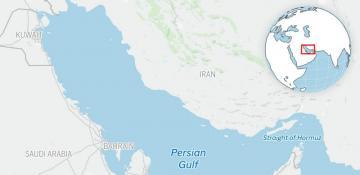
Nigar Sabirgizi: Mr. President, my next question will be about relations with Iran. I believe that your views on this issue might be interesting to everyone. Recently, in the last few years, Iranian-Azerbaijani relations have been going through ups and downs. Sometimes this country exhibits incomprehensible behavior towards Azerbaijan, which causes certain tensions between the two countries. Just a few days ago, the Foreign Ministry of Azerbaijan expressed its protest to the Iranian side regarding another manifestation of such behavior. I would like to know your assessment of the current Azerbaijani-Iranian relations and what policy you expect from the current Iranian leadership in the future?
President Ilham Aliyev: It is a bit early to talk about this. Because we have not had any serious contacts with the current Iranian leadership yet. There have been certain contacts between members of the government. They were more related to economic and transport issues – the issues that, in principle, are separate from our political agenda. We never mix them.
Again, the deterioration of our relations with the previous government was not our fault. I simply want to recall some points. After the end of the Second Karabakh War, when we secured visual observation of the Lachin road, we began to see that fuel trucks from Iran were regularly making trips to Karabakh from Armenia. I instructed my assistant, and he spoke to the then-Iranian Ambassador to Azerbaijan on the phone and asked him to stop this. We don't want to make this public, so we are asking you to stop. This is not good, we are seeing this, and this is our territory. You are doing illegal things here. Unfortunately, this did not stop after that and only intensified. Then, as a second step, we invited the Iranian Ambassador to the Ministry of Foreign Affairs and gave him a note of protest and made this public.
This was followed by both funny and sad developments. Fake Armenian license plates were pasted on Iranian fuel trucks, as if they were Armenian. But there were also Persian inscriptions on them. This surprised us very much. And we started investigating. We saw that the same license plate was attached to several vehicles, i.e. the number was the same, but the vehicles were different. In other words, this fraud was so sloppy that one is truly lost for words. After that, we stopped a vehicle, the drivers were stopped, and we saw that their travel documents state Stepanakert, Armenia. In other words, this was a clear disrespect for our territorial integrity and sovereignty.
After that, the well-known steps towards intimidation, exercises, statements and threats against us began. We also took commensurate steps. If any training, military training is held on our border, we did the same on this side of the Azerbaijani-Iranian border. In other words, we showed that we are not afraid of anyone and that we are the right side. At the same time, this was accompanied by a campaign of insults in the press. Because this, apparently, is the style of work of some ruling circles. In fact, insults are a symbol of powerlessness. If you cannot achieve something – I mean people who are rude – they resort to insults. The one using insults actually insults himself.
Then came the news of the settlement of the issue by Iran and other reports. Then an act of terror was committed against our embassy, it was an organized terrorist act. There were many factors that gave grounds to say this. First, for about 40 minutes, not a single police car approached the building although this was happening in the center of the capital. The person who committed the terror was declared mentally ill immediately, the next day. However, any medical examination takes several days. This person appeared in the press on the very day he committed the terror and gave interviews. Two years have passed since that incident. To this day, that person has not been made to undergo the sentence handed down in relation to him. All this shows that it was organized. It was a show of weakness, and the Azerbaijani side also took adequate steps. You know that we recalled all our embassy employees, and only when we were officially promised – the late Iranian Foreign Minister, Mr. Abdollahian, who died in a helicopter crash, came here and promised to me that the person would be sentenced to death – did we return the embassy employees. But they deceived us again. Because this death sentence was not executed, the case was sent back to court for investigation. In other words, this was an incomprehensible act at the state level, and we insist on our demands. We know that death sentences in Iran are pronounced for less serious crimes and are immediately executed. But here, two years later, not only has it not been carried out, the case has actually been sent back for further investigation.
So this is one side of the issue. It is difficult to analyze the relations with the new government because I have not personally met with the new President. If and when it happens, then I can talk about it.
As for the provincial mullah's hateful attitude towards us, this is not the first time. That mullah from the city of Ardabil has repeatedly used insulting expressions against Azerbaijan, the Azerbaijani people, including me. The question here is what the attitude of the person who appointed him to that position is. After all, he did not come and sit there on his own. We know very well who appointed him. What is his reaction, does he support this or not, and who will apologize to Azerbaijan? Will they apologize or not?
The regret in the statement of the Iranian Foreign Ministry is not enough. There was an open insult: both the presidents of Türkiye and Azerbaijan, our peoples, and during a live broadcast at an official event. And only regret? This, of course, is unacceptable. Therefore, we believe that the provincial mullah should be punished. At the very least, he should be dismissed from his post and made to apologize to Azerbaijan. This is the point.
Nigar Sabirgizi: Thank you very much.
Guy Shawn: Mr. President, Azerbaijan has increased its gas exports to many countries in Europe - Italy, Greece, Hungary, and Türkiye. Could you tell us about your vision for Azerbaijan in helping to secure energy resources for Europe in the future?
President Ilham Aliyev: Yes, our gas exports are growing, and we are now expanding the geography of gas supplies using different infrastructure projects, the main one being the Southern Gas Corridor, but also extensions. Due to the new interconnectors, which have been inaugurated relatively recently in Europe, our access to different markets is possible.
In 2022, as you know, when the Russian-Ukrainian war led to disruption of Russian gas supplies to Europe, the European Commission turned to Azerbaijan, asking us to help. At that time, the President of the European Commission came to Baku, here exactly we were signing that declaration just outside this room. So we said, “Okay, we are ready to help you and to increase, to double our gas supply to Europe.” At that time, our gas supply to Europe was 7 billion cubic meters.
And we started to work on that. We started to invest and look for opportunities to move our gas through different interconnectors. Since then, the number of countries in Europe that are now recipients of our gas has grown, and now it's equal to 10. So, in total, it's 12 countries, and 10 of them are European, with eight out of the 10 being EU members. So, we expanded the geography, and increased the volume of gas. For many countries, members of the European Union, Azerbaijani gas now makes about half of their domestic consumption. This is really a serious support, which we demonstrate to our partners in Europe. Our future plans are to expand the geography. We are already in negotiations with some other European countries, which are close to those already receiving our gas. I think that is possible in the coming years.
But again, since 2022 until now, it has been a dramatic change. Because at that time, our gas exports were limited to Georgia, Türkiye, Greece, and Italy - that was it. Then, we added Bulgaria, Romania, Serbia, North Macedonia, Slovakia, Croatia, and Hungary. All of this happened in a relatively short period of time. So, we have resources, because our proven resources are growing. Many years ago, they were estimated at the level of 2.6 trillion cubic meters, but now, with new discoveries and more to come, it will be more. This year, we hope to get the first gas from ACG, the so-called “Deep Gas” project, which will be a substantial contribution to overall gas production. We are planning to work with the partners in order to increase gas production from the Absheron field from 1.5 to 5 BCM, understanding that the main supply of gas will still be Shah Deniz, which will remain as it is; and many more promising projects like Karabakh, Babek, Asiman, and others. This will increase our potential.
So now, the main issue is how to get to new destinations. For that, there should be additional investments in Europe in order to expand the existing interconnectors or maybe to build more. Even now, with the coverage of 12 countries by pipeline gas, Azerbaijan, I think, is now one of the leading countries in the world with such a broad geography, and in Europe, also one of the leading countries with respect to geography. Because geography is as important as volume. Because for some countries, even 1 billion cubic meters makes a lot of difference. So, we treat our commitments with a high level of responsibility. Of course, in answering this question, I cannot avoid one issue that must also be addressed. We invest a lot, and we try to help the European Union cope with the shortage of gas. At the same time, we are facing a situation where European banks are no longer financing fossil fuel projects. On one hand, they ask us for additional supply. On the other hand, they deprive us of resources. For instance, the European Investment Bank has completely stopped financing fossil fuel projects. The EBRD, as far as I know, still has a very small share. If this continues, then there will be no means to invest, because in this business, you use your corporate financing for about 30%, but you borrow the rest of the money. So, where are we going to borrow the money from? Or Europeans want to build interconnectors between themselves? So, this is an issue, I think, that should be addressed, and the second, not the second, but another issue is the timetable for supplies. Because with


Similar news