BYD overtakes Tesla in battery storage as flash-charging network takes shape


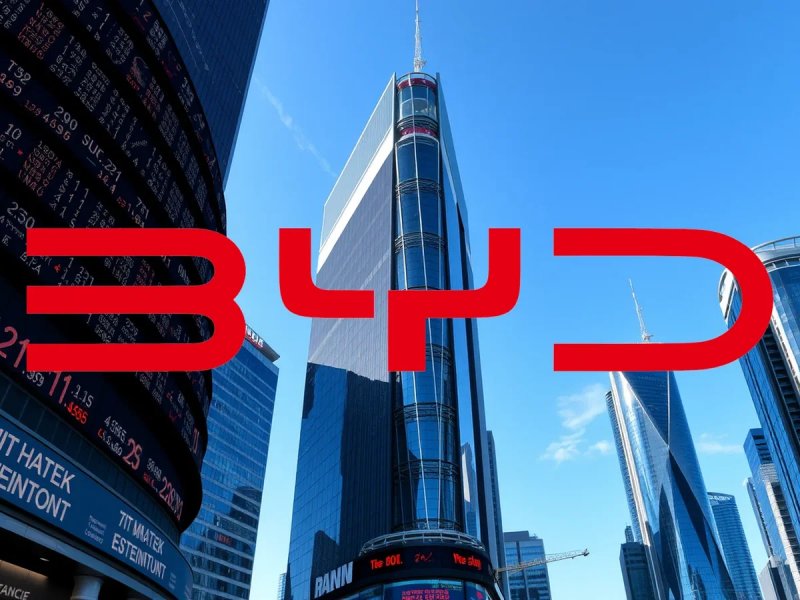
The storyline surrounding BYD has long revolved around electric vehicles, but a quieter revolution in the energy storage business is now demanding attention.
In fiscal 2025, the Shenzhen-based conglomerate captured a 13% global market share for battery energy storage systems, nudging ahead of Tesla’s 10% — a symbolic shift that underscores an increasingly diversified growth profile News.Az reports, citing CNBC.
RECOMMENDED STORIES
The volume numbers are equally telling: BYD deployed more than 60 GWh of storage capacity, versus Tesla’s 46.7 GWh. Its HaoHan system delivers 14.5 MWh per unit, and a 12.5 GWh project is already under development in Saudi Arabia.
That storage push comes as BYD simultaneously accelerates its export drive and rolls out ultrafast charging technology designed to shrink the gap between plugging in and refuelling a petrol car. A new Flash-Charging system, capable of adding 400 kilometres of range in five minutes at a peak power of 1,360 kW, is being integrated into the Fang Cheng Bao Bao 5 and Bao 8 SUVs. The company plans to build 6,000 fast-charging stations outside China, with 3,000 earmarked for Europe. At home the network already spans 5,924 stations across 311 cities, giving BYD a head start in refining the technology at scale.
Exports, too, are at record levels. In April 2026 BYD shipped 135,098 vehicles abroad, surpassing the previous monthly high set in March by roughly 15,000 units. The January-to-April export total reached 456,253 vehicles, a jump of nearly 60% year on year, putting the full-year target of 1.5 million units within striking distance. The geographical spread is notable: in Britain the brand became the best-selling pure-electric marque between January and April, with 12,800 units and a market share of over 7% in the EV segment. Including plug-in hybrids, that figure rose to 26,396 vehicles and a 9.5% share — all achieved without any government purchase subsidies. In Brazil, BYD dethroned Volkswagen in April as the country’s overall bestselling car brand, a first for any Chinese manufacturer, albeit by a razor-thin margin of around 80 vehicles. In Australia the Sealion 7 topped the EV sales charts.
Should investors sell immediately? Or is it worth buying BYD?
Yet the export boom has a jarring counterpoint. In its home market, BYD is mired in an eighth consecutive monthly decline; domestic sales dropped by more than 15% in April. A brutal price war in China, compounded by the phasing out of purchase incentives, is squeezing margins. First-quarter net profit tumbled more than 55% to roughly $600 million. This divergence — surging overseas volumes alongside a softening domestic core — has split the analyst community.
Goldman Sachs views the first quarter as the trough and holds a 134 Hong Kong dollar target, betting on a second-half recovery fuelled by the new Flash-Charging models. Citigroup is more bullish, pegging a target of 142 Hong Kong dollars and expecting second-quarter core profit of up to 11.3 billion renminbi — provided export volumes stay robust and domestic pricing stabilises. BNP Paribas takes the opposite view, reiterating an underperform rating with a price target of 87 Hong Kong dollars.
On the production front, BYD is ramping up its European footprint to mitigate tariff risks and shorten supply chains. The Hungarian plant is already in trial production, and a roughly $1 billion factory in Turkey is scheduled to begin mass production by the end of 2026. Executive Vice President Stella Li told the FT Future of the Car Conference in London that the group is actively scouting a third European site, and has held talks with several manufacturers including Stellantis. BYD prefers full ownership over joint ventures, and is open to acquiring underutilised existing factories. The strategy is clear: transform from a pure importer into a vertically integrated player with local production, a proprietary charging network, and a fast-growing stationary storage business — a combination that distances BYD from both legacy automakers and from Tesla in the energy segment.
By Faig Mahmudov


Similar news