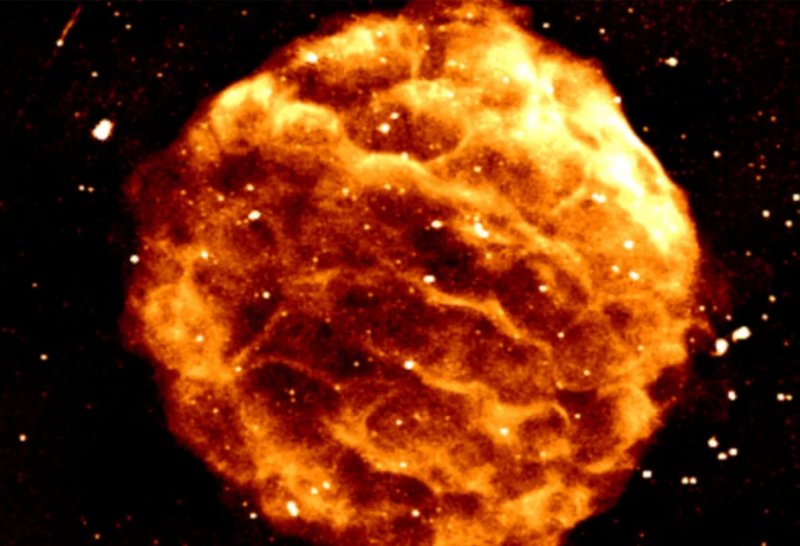
The star, WOH G64, lies inside the Large Magellanic Cloud, about 163,000 light-years from Earth. It is enormous, roughly 1,540 times wider than the Sun and nearly 30 times more massive, News.Az reports, citing foreign media.
For decades, WOH G64 was classified as a red supergiant, a late evolutionary stage of massive stars that typically ends in a supernova explosion. But recent observations suggest the star is no longer acting like a typical red supergiant.
RECOMMENDED STORIES
Since the 1970s, astronomers described WOH G64 as extremely luminous, relatively cool and surrounded by thick dust. Red supergiants are unstable but usually evolve slowly over thousands of years.
Around 2014, however, scientists noticed changes. The star’s light began shifting toward bluer, hotter wavelengths. Its spectrum, the chemical fingerprint of a star, altered significantly. Features associated with cooler red supergiants faded, while signatures of hotter conditions appeared.
Researchers now believe WOH G64 may have transitioned into a yellow hypergiant, a rare and short-lived phase in the life of very massive stars. Yellow hypergiants are hotter and far more unstable, often shedding enormous amounts of material into space.
In cosmic terms, the transformation happened remarkably quickly.
Scientists are exploring two main explanations.
One theory suggests the star expelled large portions of its outer layers in a powerful eruption. If so, hotter inner regions would have become exposed, raising its surface temperature.
Another possibility is that WOH G64 is part of a massive binary system. If a companion star is present, gravitational interaction could be stripping material or disturbing its outer layers, accelerating the transformation.
Both scenarios involve heavy mass loss, a key factor in determining how massive stars ultimately die.
Whether WOH G64 will soon explode as a supernova remains uncertain. Some massive stars can stay unstable for extended periods before collapsing. Others may collapse directly into a black hole without producing a bright explosion.
For now, astronomers continue to monitor the star closely. WOH G64 offers a rare opportunity to witness stellar evolution unfolding almost in real time, a reminder that even well-studied cosmic giants can still surprise scientists.