Saakashvili seeks civilian prisoner status from Ukraine


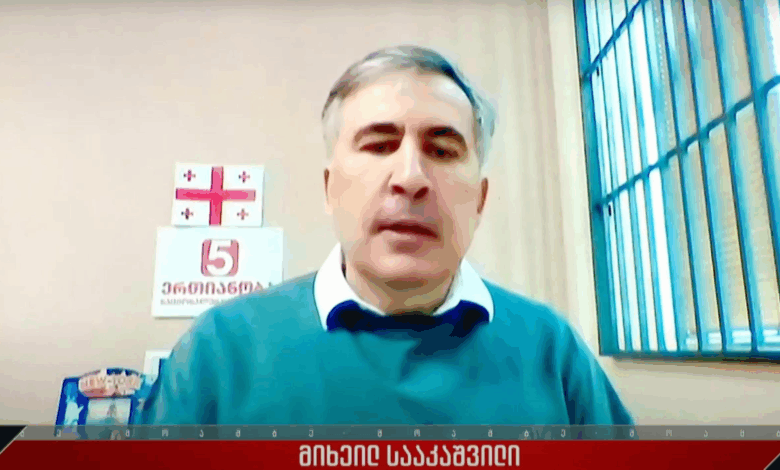
Georgia’s jailed former president, Mikheil Saakashvili, has called on Ukrainian President Volodymyr Zelensky to include him on the list of civilian prisoners for exchange after he was returned to prison from a civilian clinic in Tbilisi, News.Az reports, citing Georgian media.
“I am a citizen of Ukraine and chairman of the Executive Committee of the National Reform Council, where I had the honor of working under your leadership. I want to ask you (…) to include me, as the former head of the Odessa Regional State Administration and as chairman of the Executive Committee of the National Reform Council, illegally held by the pro-Russian regime in Georgia, on the list of civilian prisoners of this war, with the corresponding legal consequences,” Saakashvili wrote on his Facebook page.
The former president links his persecution to the ongoing Russian aggression against Ukraine, stressing that the current Georgian authorities “explicitly declare Ukraine a hostile foreign state.” According to Saakashvili, public statements by Zelensky and his chief of staff, Mykhailo Podolyak, have appeared in the new “sabotage” charges against him and other opposition figures.
Saakashvili claims he was poisoned shortly after the start of the full-scale war in Ukraine and says he has now been returned to the personnel responsible for his poisoning.
Saakashvili had been in Tbilisi’s civilian clinic Vivamed since May 12, 2022, after being transferred there due to serious health problems following a prolonged hunger strike in prison.
On November 12, the Georgian Ministry of Justice announced that the former president had been discharged and returned to prison, noting that his health was satisfactory and that inpatient treatment was no longer required.
Saakashvili, who was sentenced in two separate abuse-of-power cases after returning to Georgia in autumn 2021, has long argued that the charges against him are politically motivated. Under the current sentences, he is to remain behind bars until 2034.
His health and treatment have been the focus of ongoing public and international scrutiny, with opposition groups, NGOs, and several Western officials repeatedly questioning the adequacy of medical care provided in custody.
Despite numerous appeals for his release or transfer abroad for treatment, Georgian authorities maintain that his condition has been under continuous medical supervision and that all decisions regarding his placement are based solely on clinical evaluations.


Similar news