The West is dragging Armenia into a new military conflict - OPINION


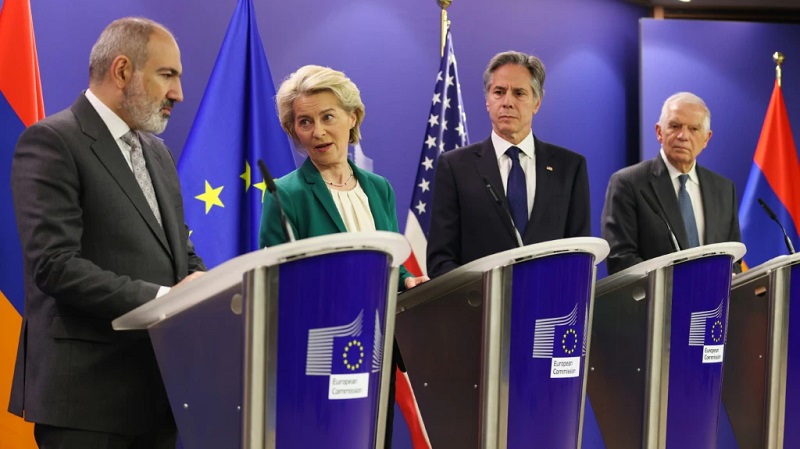
Armenia is drifting away from Russia towards the West, which could trigger a new conflict in the South Caucasus. In Brussels, a meeting took place between the Prime Minister of Armenia, Nikol Pashinyan, the United States Secretary of State, Antony Blinken, and the President of the European Commission, Ursula von der Leyen, unexpectedly joined by the European Union's High Representative for Foreign Affairs and Security Policy, Josep Borrell.
Initially planned as a trilateral meeting, it turned into a forum for discussing key issues, particularly adjustments to the course of discussions, which is especially relevant in the context of previous negotiations between Baku and Yerevan. Attempts by France to steer the dialogue in the right direction were unsuccessful and led to a slowdown in the peace process.
Armenia's expectations from the meeting were high, especially regarding financial support from the West, as highlighted by Armenian media. However, the reality showed the limited nature of the offered assistance: according to Ursula von der Leyen, the European Union will allocate 270 million euros to Armenia over four years, and the United States, as stated by Antony Blinken, will provide 65 million dollars. Such support does not match the scale of economic resilience discussed, especially considering the current state of the Armenian economy.
The discussions at the meeting covered not only economic support but also broader issues like deepening democratic processes in Armenia and ways to enhance regional integration and peace in the South Caucasus. However, Azerbaijan's reaction to these talks, particularly that of President Ilham Aliyev, indicates deep concern about the country's potential isolation and tension in the region, highlighting the complexity of the political mosaic of the South Caucasus.
In light of these discussions, the EU's promises to invest in the Armenian economy, particularly through infrastructure and renewable energy projects, look promising but raise questions about feasibility amidst regional tensions and economic challenges.
This meeting in Brussels underscores the difficulty of balancing hopes for support with the reality of geopolitical and economic constraints faced by Armenia and the entire South Caucasus region. While the West seeks to support a democratic and prosperous future for Armenia, Azerbaijan's reaction reminds us of the ongoing difficulties in achieving sustainable peace and mutual understanding in this part of the world.
The discussion of economic assistance and investments in Armenia undoubtedly held a significant place during the meeting. However, the levels of support announced by the European Union and the United States did not meet the Armenian side's expectations, highlighting the gap between hopes for substantial financing and the actual commitments of the West. This situation raises questions about the potential impact of the allocated funds on improving Armenia's economic resilience and development.
The European Union's ambitions regarding Armenia, especially concerning infrastructure and renewable energy projects, also raise questions about practical implementation in the context of current economic and regional challenges. Plans for energy integration and development, while promising long-term growth prospects, require significant initial investments and strategic planning that exceed the announced financial aid.
Furthermore, it's important to note that security aspects and regional stability were central to the discussions. Azerbaijan's position, expressed by President Ilham Aliyev, reflects deep concern about the potential consequences of the trilateral meeting for regional balance and cooperation in the South Caucasus.
Attention should also be paid to the role of the Russian factor and Armenia's economic ties with Russia, especially in the context of the agricultural sector and energy independence. The potential consequences of Armenia's reorientation towards European markets and strengthening economic ties with the West could lead to changes in the regional economic dynamics and political landscape.
Finally, the visit of the Secretary-General of the Council of Europe to Armenia symbolizes the continuation of dialogue and efforts to strengthen relations between Armenia and European institutions. This indicates a desire for deep and multifaceted cooperation, despite current challenges and disagreements.
The meeting in Brussels could have serious consequences, for which Yerevan may have to pay a price. In the context of these challenges, ensuring long-term stability and prosperity in the region becomes extremely important, especially as Armenia is drawn into a new conflict.
Kerim Sultanov


Similar news