Türkiye revives major freight rail corridor near Syria border
Source: Hurriyet Daily News
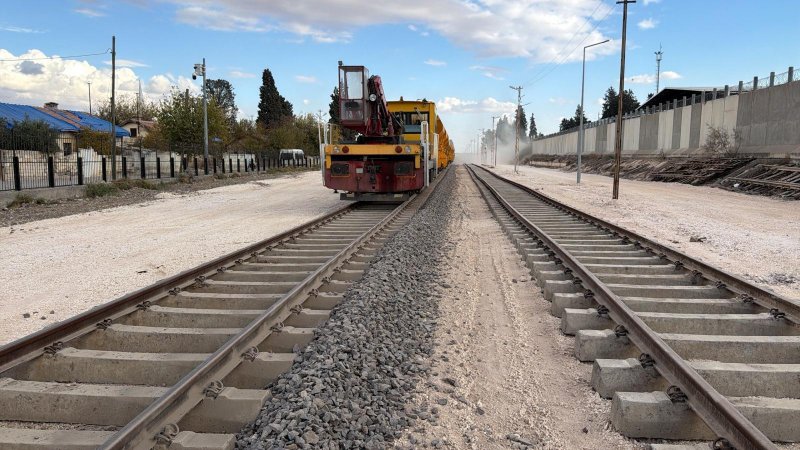
Türkiye has reopened a strategic 350-kilometer (217-mile) railway corridor along the Syrian border for freight traffic after completing an infrastructure overhaul following 13 years of deferred maintenance, with the aim of integrating the country’s southeast into a wider global trade network.
Türkiye’s Transport and Infrastructure Minister Abdulkadir Uraloğlu stated that the restored route consists of two main sections: the 325-kilometer (201.9-mile) Karkamış–Nusaybin line and the 25-kilometer (15.5-mile) Şenyurt–Mardin line, News.Az reports, citing Anadolu Agency.
The reopening marks the return of freight operations along this key border corridor after years of inactivity, following extensive rehabilitation work on the railway infrastructure.
The route resumed train operations on March 31 after its first comprehensive rehabilitation in over a decade. Routine maintenance and repairs along the border route were suspended from 2011 to 2024, so the project turned into a complete reconstruction as it required more than basic upkeep.
Engineers rebuilt track and station foundations, installed new drainage systems to prevent flood damage, and reinforced 750 meters (0.46 miles) of unstable ground.
Uraloglu stated that workers replaced more than 2,500 girders across various bridges and culverts to ensure the route could handle heavy freight, while also implementing critical structural upgrades to the Karkamis Bridge.
The minister said the project is not merely a restoration of the rail corridor but an essential modernization effort to ensure Türkiye’s economic future.
The newly rehabilitated border tracks will serve as a link in the Development Road project.
The restored Karkamis–Nusaybin and Senyurt–Mardin lines are slated to directly support the planned Ovakoy–Nusaybin railway, an upcoming transit corridor connecting the Persian Gulf to European markets via overland routes through Iraq and Türkiye.
News.Az
By Nijat Babayev